
Australian Poetry Slam 2026 brings voices from 60 towns and cities to Sydney, culminating at the Opera House on 25 October in a national final decided by the crowd.
A poem can begin in a quiet room, on a bus ride home or in the middle of a conversation someone cannot stop replaying. On stage, those private beginnings become something shared. A voice rises above the room, the audience leans in, and a few carefully chosen lines can change the atmosphere in an instant.
On Sunday 25 October 2026, that exchange will take place on one of Australia's most recognisable stages when the Australian Poetry Slam 2026 National Final arrives at the Sydney Opera House. After months of heats and regional competitions across the country, the finalists will gather to perform their own work before an audience that has a direct say in the result.
The event's central idea is straightforward: poets run this. There are no critics deciding the winner from a distance. Five judges, selected at random from the audience, determine the outcome of each round. Their decisions will help identify the 2026 Australian Poetry Slambassador, a spoken-word artist who will represent Australia at international festivals during the following year.
The format gives the crowd a responsibility beyond applause. Listeners must respond to the words in front of them, weighing the impact of a performance in the moment. The process is immediate and deliberately democratic, bringing the audience into the structure of the competition rather than leaving it as a passive observer.
The Opera House final is the culmination of a national circuit spanning 65 slams in 60 towns and cities, followed by six State and City Finals. By the time the remaining poets reach Sydney, they will have come through local stages and regional communities where spoken word is made and heard in very different settings.
For the finalists, the Opera House represents a significant destination. For the audience, it offers a chance to encounter contemporary Australian writing not on a page, but in the presence of the person who made it.
From Local Stages To The Sydney Opera House
Australian Poetry Slam is built on the idea that strong writing does not belong exclusively to capital cities, publishing houses or established literary circles. Its national structure begins with local heats, where poets test new work and audiences discover voices from their own communities. The journey then narrows through regional and State and City Finals, eventually bringing the leading performers to Sydney.
That route matters. A national final can appear, from the outside, to be a single evening of competition. In reality, it rests on a network of local organisers, venues, audiences and writers who make spoken word part of their communities. A stage in a regional town may offer a different atmosphere from a city arts venue, but both provide the same essential opportunity: a person stands before others and asks them to listen.
The 2026 circuit includes venues and organisations such as Speakeasy in Dubbo, Spill in Launceston, Mackay Poetry Slam and Enough Said in Wollongong. Word Travels also works alongside groups including Red Dirt Poetry in the Northern Territory, Canberra Slam, Spoken Word SA and Perth Slam. These partnerships help connect local scenes to a broader national programme.
The work is not limited to competition. Word Travels, which presents Australian Poetry Slam, also runs regional tours that combine heats and workshops with story-sharing gatherings involving First Nations and new migrant communities. The approach recognises that spoken word is both an art form and a means of exchange. A performance may be polished and tightly structured, or it may carry the energy of a story still finding its shape. Both can create a meaningful connection between speaker and listener.
The circuit also supports emerging literary communities, including Black Ink, a developing BIPOC literary arts organisation in Brisbane. Such connections broaden the idea of who participates in Australia's literary culture and where those stories are heard.
By the time the National Final begins, the competition will have travelled well beyond the Opera House's harbour-side setting. The poets arriving on stage will carry not only their own experiences, but traces of the communities and audiences that helped bring them there.
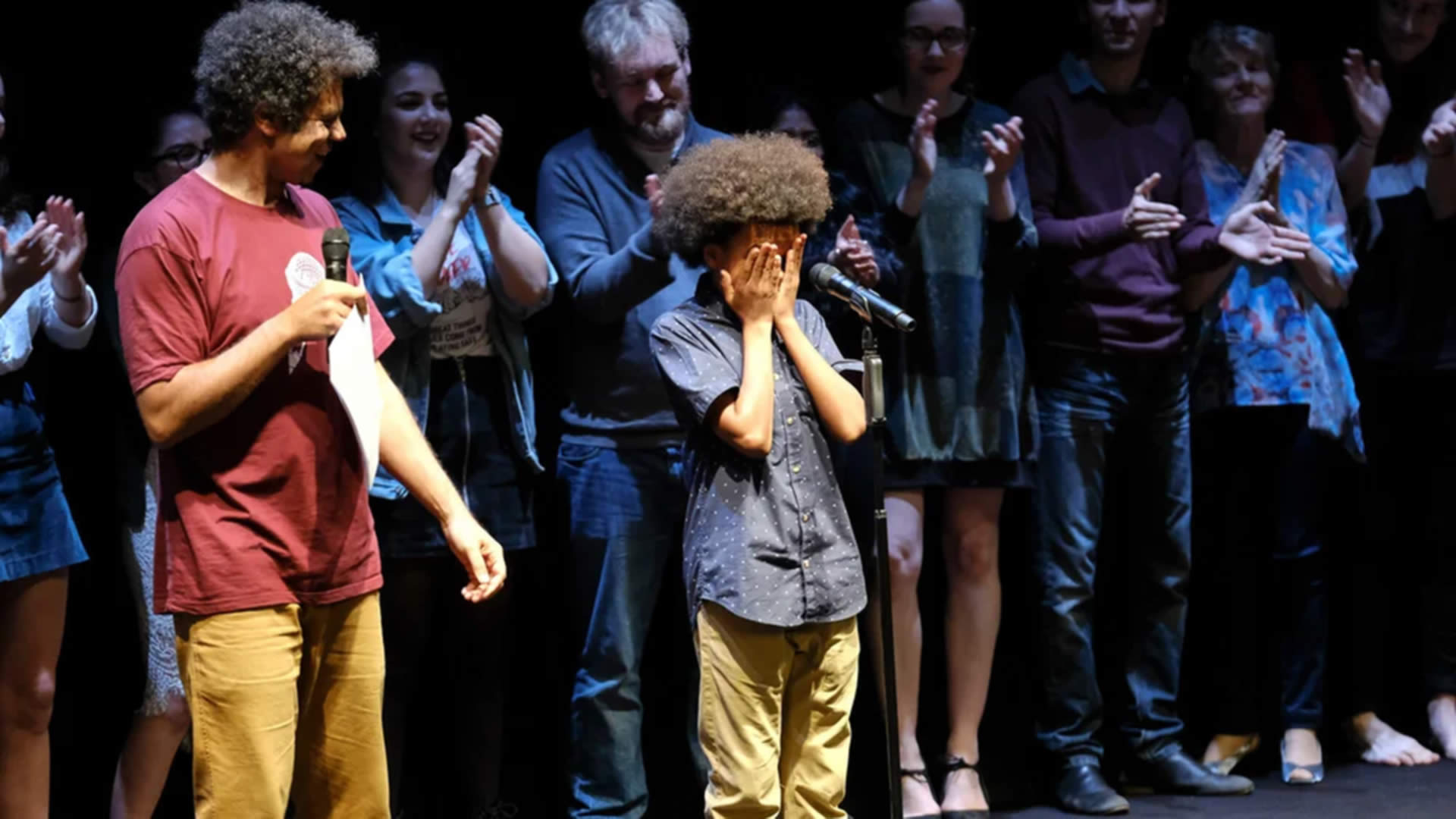
Australian Poetry Slam 2026 And The Power Of A Live Voice
Spoken word occupies a space between writing and performance. The poem exists on the page, but its meaning can change through pace, emphasis, breath and silence. A line delivered quickly may feel like a confession escaping before it can be reconsidered. The same line, spoken slowly, can ask the audience to sit with its implications.
This is part of what distinguishes a slam from a conventional poetry reading. The work is performed within a competitive format, often under a strict time limit, and the audience is asked to respond to the performance as it happens. A poet must consider not only the words themselves, but how those words travel across a room.
At Australian Poetry Slam, the opportunity to perform original work gives writers considerable freedom over subject and form. Personal memory, identity, family, politics, humour and social observation can all find a place in spoken word. Some poems may arrive through narrative, others through repetition, rhythm or a sudden shift in perspective. There is no single voice that defines the form.
The competition's emphasis on audience-selected judges gives this variety particular significance. Five people drawn at random from the room are asked to make decisions that influence the result. They do not stand apart as an established panel of literary authorities. They are listeners whose responses become part of the event's outcome.
That arrangement can make a poetry slam feel unusually immediate. A poet may have spent weeks shaping a piece, but its impact is tested in a few minutes before people encountering it for the first time. The room becomes a place where writing meets reaction, and where the relationship between performer and audience remains visible.
The format also challenges assumptions about poetry as something private or academic. A poem can be literary without being distant, political without becoming a speech, or funny without losing its emotional weight. Spoken word makes the act of listening central, inviting people who may not regularly attend poetry readings to take part.
At the Opera House, that exchange will unfold on a stage more often associated with music, theatre and major cultural performances. The setting gives the words a larger platform, but the fundamental encounter remains the same: a writer, a voice and a room full of people deciding what resonates.
Six Finals On The Road To October
The 2026 finals season opened in Tasmania on Saturday 19 September before travelling through South Australia, Sydney, Victoria, New South Wales and Queensland. Each event brings its own group of finalists closer to the national stage, creating a sequence of performances that reflects the breadth of Australia's spoken-word community.
The South Australia State Final followed on 26 September at Goodwood Theatre and Studios. Sydney's city final took place on 9 October at Word Travels' International Performing Writers Centre at Impact Story Lab in Darlinghurst. The Victoria State Final followed on 10 October at The Performance Space at The Wheeler Centre in Melbourne.
The remaining events lead into the national final. The New South Wales State Final takes place at the State Library of New South Wales on Friday 16 October, followed by the Queensland State Final at the Queensland Multicultural Centre in Kangaroo Point on Saturday 17 October.
Across these competitions, the field narrows until the nation's top 16 spoken-word artists earn their places at the Opera House. The journey gives the national final a sense of accumulated momentum. Each poet arrives with a body of work, but also with the experience of performing under pressure and learning how an audience responds.
The range of venues is part of the story. Libraries, arts centres, theatres and independent performance spaces each create a different relationship between the writer and the listener. Some settings encourage a close, conversational atmosphere; others offer a more formal stage. The poems adapt to these spaces, but the need to make a connection remains constant.
By the time the finalists meet in Sydney, the competition has already brought together different regional scenes and creative approaches. The national stage does not erase those differences. It gives them a shared setting.
The Prize Beyond The Final
The Australian Poetry Slam winner becomes the 2026 Australian Poetry Slambassador, with a $20,000 prize package and a year of international festival appearances through 2027. The role offers more than recognition on the night. It creates a pathway for the winning poet to take their work beyond Australia, building connections with writers, audiences and literary organisations overseas.
The programme includes opportunities associated with events such as the Ubud Writers and Readers Festival in Indonesia and the Singapore Writers Festival. For a spoken-word artist, these appearances can offer new audiences and different contexts in which to perform. A poem shaped by life in an Australian town or city may be heard by listeners with different histories, languages and expectations, revealing both its local specificity and its broader human concerns.
The role is already producing results. The 2025 Australian Poetry Slambassador, Arantza Garcia Ferrand, is on the Ubud programme in 2026 following her national final win with the poem An Ode to Her. Her progression illustrates how a single performance can lead into a longer professional journey, extending a writer's reach beyond the original competition.
The prize also recognises the work required to sustain a practice. Performance opportunities can lead to further invitations, collaborations and publishing connections, while international festivals provide a place to exchange ideas with writers from other traditions. For the winner, the year ahead becomes an opportunity to develop a public voice and represent the range of contemporary Australian spoken word.
Miles Merrill, CEO and Creative Director of Word Travels, describes the competition as an opportunity to hear a country's stories through its poets. His central point is that a short performance can communicate something about Australia that formal public statements may not capture. A poem can bring an audience close to an individual experience, then allow that experience to become part of a wider conversation.
The Slambassador title places that capacity at the centre of the award. The winner is not simply the poet who takes the final round. They become a representative of a national creative community, carrying its different voices and perspectives to stages elsewhere in the world.
Kismet Krystle Joins The National Final
The 2026 National Final also features Kismet Krystle, the Ubud Poetry Slam Champion, as a special guest. Her appearance adds an international dimension to an event already focused on the movement of spoken word between communities.
Poetry slams have developed in different places, shaped by local languages, performance traditions and social concerns. Yet the format offers a point of connection: original writing, a live audience and the possibility of being heard beyond one's immediate community. A guest artist from another slam scene can bring a different rhythm and perspective to the evening, while reinforcing the sense that spoken word belongs to a wider network of performers.
For an audience at the Opera House, the guest performance also broadens the evening beyond the question of who wins. The national final remains a competition, but it is also a gathering around a form of writing that depends on exchange. Each performance offers another way of understanding how language can be used in public, not simply to tell a story but to hold attention, provoke thought or shift a room's mood.
Australian Poetry Slam 2026 At The Opera House
The Sydney Opera House provides a fitting destination for a competition that has travelled across so many different stages. Set on Bennelong Point, beside the harbour and close to Circular Quay, it is both a working performance venue and a familiar part of the city's landscape. Its public spaces connect visitors to the water, the Botanic Garden and the steady movement of the city around them.
On Sunday 25 October, the Opera House becomes the final gathering point for the Australian Poetry Slam season. The National Final runs from 5pm to 8pm, bringing the top 16 spoken-word artists together before an audience that helps determine the winner.
The setting may be grand, but the mechanics of the event remain direct. A poet steps forward, begins to speak and has a limited time to make the words count. There is no distance between the performance and the response. The judges are drawn from the crowd, and the audience's energy becomes part of the atmosphere in the room.
For people who have never attended a slam, the final offers an accessible entry into contemporary poetry. There is no need to know the writers in advance or to arrive with a particular understanding of literary form. The performances are the point of entry. Listeners can respond to a story, a rhythm, a turn of phrase or the moment when a line seems to express something they have struggled to articulate themselves.
For those already familiar with spoken word, the event offers a chance to see how the form continues to develop across Australia. The finalists have come through a broad network of local stages, each with its own audience and creative character. Their meeting in Sydney makes those separate scenes visible within one shared programme.
The Opera House final is therefore both an ending and a beginning. It concludes the 2026 competition, but it also launches the winning poet into a year of international appearances. One voice will leave Sydney with the Slambassador title, while the wider community continues its work in local venues, workshops and performance spaces.
Australian Poetry Slam 2026 Event Details
Event: Australian Poetry Slam 2026 National Final, Poets Run This
Date: Sunday 25 October 2026
Time: 5pm to 8pm
Location: Sydney Opera House, Bennelong Point, Sydney NSW
Featuring: Australia's top 16 spoken-word artists, with special guest Kismet Krystle
Prize: A $20,000 prize package and international festival appearances through 2027 for the 2026 Australian Poetry Slambassador
Tickets and official information: https://www.australianpoetryslam.com/all-events/national-final-aps-2026
Presented by: Word Travels
The national final is the most visible point in a season built on local participation. Its outcome will be decided in the room, by people who have come to listen. When the last poem finishes and the judges deliver their decisions, the result will belong not only to the winning performer but to a national circuit that has carried spoken word across towns, cities and communities.
At the Opera House, the harbour will continue moving beyond the windows and the city will carry on around Bennelong Point. Inside, for a few hours, the focus will rest on the force of a spoken line and the people willing to hear it. That is the simple premise behind Australian Poetry Slam, and the reason the journey from 65 slams to one stage matters.