
Cabramatta Moon Festival fills Western Sydney with food, lanterns, live performances and cultural traditions on Sunday, 20 September 2026.
By late afternoon in Cabramatta, the ordinary rhythm of the town centre begins to change. Traffic gives way to pedestrians, restaurant tables spill towards the street, and the familiar grid of shops and footpaths becomes a stage for something much larger than a single day's entertainment.
On Sunday, 20 September, the Cabramatta Moon Festival takes over the town centre from 11am to 8pm, bringing food stalls, market stalls, cultural performances, children's activities, amusement rides and live entertainment into the streets around John Street, Arthur Street, Park Road, Railway Parade and Dutton Lane.
The festival arrives as Cabramatta is already approaching one of the most atmospheric points of the lunar calendar. The traditional Moon Festival falls on 25 September this year, with the Cabramatta celebration taking place a few days earlier. It is a festival associated with the harvest, the moon and the changing seasons, but in Western Sydney it has also become a particularly local expression of the many Asian cultures that have shaped the suburb.
For visitors, that means the best way to experience the day is not necessarily to arrive with a checklist. Cabramatta rewards wandering. Follow the smell of charcoal. Stop when music catches your attention. Watch a lion dance gather a crowd. Find a shaded spot with something cold to drink. Then keep walking.
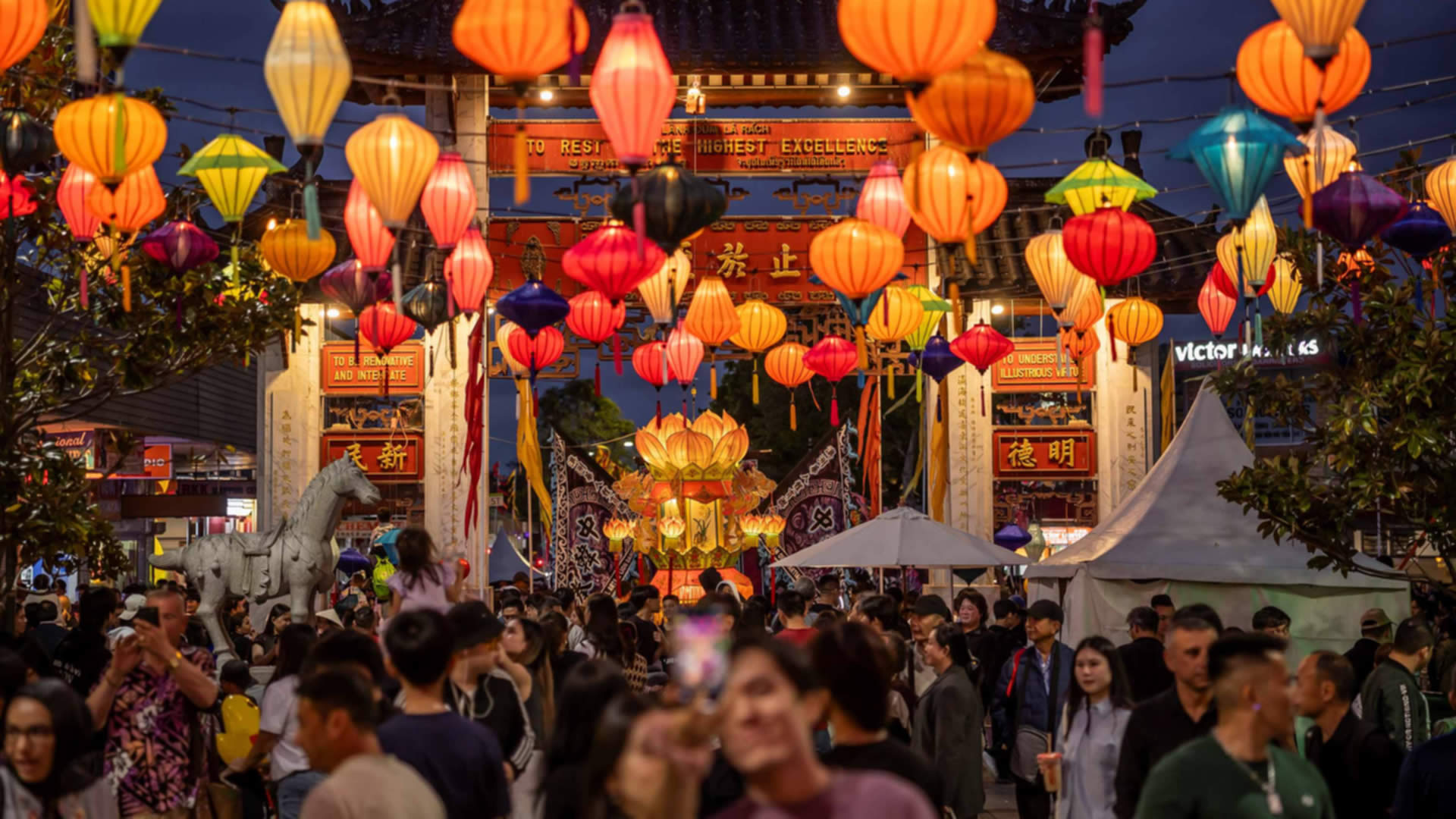
Cabramatta Moon Festival Turns The Town Centre Into A Stage
Cabramatta is one of those Sydney suburbs where the ordinary streets already tell a story.
Vietnamese restaurants sit alongside Chinese, Cambodian, Thai and other Asian businesses. Grocery shops display unfamiliar ingredients beside Australian staples. Bakeries, cafes and restaurants contribute their own aromas to the streetscape. On festival day, that everyday character remains, but the boundaries between dining precinct, public square and performance space become less distinct.
The Cabramatta Moon Festival spreads across the town centre rather than confining itself to a single fenced-off site. The result is a festival that feels connected to the suburb around it.
The official programme begins at 11am, with entertainment and activities continuing throughout the day and into the evening. The main stage on Arthur Street carries cultural performances, music, food competitions and the later festival programme, while activity also moves through John Street and other parts of the precinct.
That movement matters. A festival of this scale is not simply something to watch from one position. It is something to move through.
Food Sits At The Heart Of The Cabramatta Moon Festival
In Cabramatta, food is never merely background scenery, and the Moon Festival understands that.
The streets fill with the smells of grilled meat, herbs, spices, pastry and charcoal cooking. Market stalls add another layer to the town centre, while the area's permanent restaurants provide their own invitation to stop for a meal away from the main festival crowds.
This year's programme introduces a new Charcoal Food Precinct, drawing on the atmosphere and cooking traditions of Southeast Asian street food. It gives the festival a new focus for one of the most familiar rituals of a Sydney festival day: gathering around food, eating something hot from a grill and lingering while the crowd moves around you.
There is also a distinctly Cabramatta take on culinary competition.
The new Battle of the Broths puts two Vietnamese favourites, phở and bún bò huế, head-to-head in a live cooking segment led by home cook Duncan Lu. Visitors can sample the two broths and vote for their preferred bowl. The programme also brings back the phở and mooncake eating competitions, turning food into both spectacle and shared participation.
It is an appropriate way to experience the suburb. Cabramatta's food culture is not something added to the festival for decoration. It is one of the reasons the festival makes sense here in the first place.
A Festival Built Around The Moon
The Moon Festival has ancient associations with harvest, family and the changing seasons, with different Asian cultures carrying their own traditions and stories around the occasion.
Cabramatta's version reflects that diversity rather than attempting to reduce the celebration to a single tradition. Cultural associations appear through dance, music, food, lanterns and community groups, creating a festival that feels less like a reproduction of one historical celebration and more like a contemporary Western Sydney interpretation of the season.
That distinction is important.
The festival is not taking place somewhere removed from everyday life. It takes place in a suburb where these cultures are already part of the landscape, language, food and community. For many people attending, the Moon Festival is therefore both a public celebration and a familiar part of the local calendar.
For others, it offers an accessible way to encounter a part of Sydney that can sometimes feel overlooked by visitors who remain closer to the harbour and inner city.
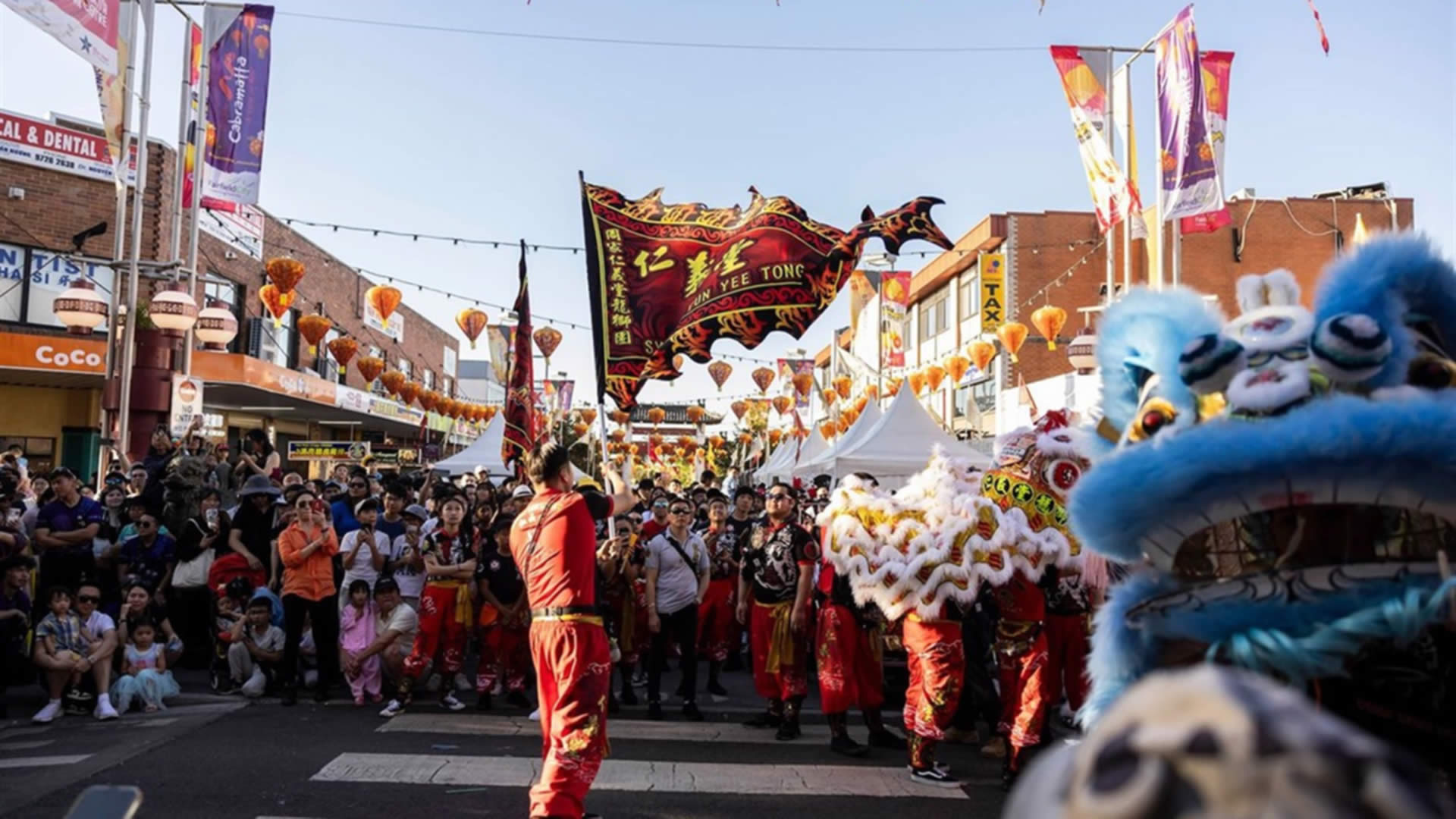
From Lion Dances To The Lantern Parade
As the afternoon progresses, the festival shifts gradually towards spectacle.
Lion dancing is woven through the programme, bringing sudden bursts of movement and sound to the streets. Traditional and contemporary performances share the programme with martial arts, dance groups and live music, reflecting the broad cultural reach of the event.
The lantern parade is one of the day's natural turning points.
Led by the Moon Goddess and Archer, it brings the symbolism of the festival into the streets themselves. By this stage, the character of the day has changed. Families who arrived in the late morning are still moving through the precinct, but more people are beginning to gather for the evening programme.
The lanterns are particularly well suited to Cabramatta. Against shopfronts, overhead signs and the familiar architecture of the town centre, they provide a softer, more traditional visual language. The effect is not that the suburb disappears, but that it is briefly seen differently.
The programme places the lantern parade at around 5.20pm, followed by evening performances.
Cabramatta Moon Festival Is A Family Day Out
For families, much of the appeal lies in the fact that there is no single way to spend the day.
Free children's activities run alongside amusement rides, market stalls, live performances and roaming entertainment. Children can move between watching performances, trying something from a food stall and taking part in activities, while adults have plenty of reasons to linger.
The scale of the event also allows different generations to experience it differently.
Older visitors might be drawn towards traditional performances or food, teenagers may gravitate towards the music and street atmosphere, while younger children tend to find their own entertainment among the rides and family activities.
That mixture is part of what makes a community festival feel genuine. It does not demand that everyone share the same experience. It simply gives people enough reasons to be in the same place.
Getting To The Cabramatta Moon Festival
The practical detail is worth considering before leaving home.
With much of the Cabramatta town centre closed to vehicles, public transport is the simplest option. Cabramatta Station is served by several train routes, and additional planning is recommended because road closures and vehicle exclusion zones operate around the event.
Fairfield City Council is also running free shuttle buses on Sunday from 9am to 9pm. Visitors who prefer to drive can consider parking in nearby Canley Vale or Canley Heights and using the shuttle into Cabramatta. Council also recommends Warwick Farm Commuter Car Park as another option, with Cabramatta just a short train ride away.
The main event runs from 11am to 8pm and entry is free.
It is worth arriving earlier rather than treating the festival as an evening event. The quieter hours offer more time to explore the food and market stalls before the streets become increasingly busy later in the day.
The Evening Belongs To The Lanterns And Fireworks
There is a particular rhythm to festivals that begin in daylight and finish after dark.
The early hours belong to food, shopping, families and exploration. The afternoon brings performances and increasingly busy streets. Then, as the sun lowers, the lights become more visible and the crowd starts to orient itself towards the evening programme.
At the Cabramatta Moon Festival, the lantern parade provides that transition.
The final part of the evening builds towards the lion dance and firecracker finale, followed by the fireworks at 8pm.
Fireworks are familiar territory for Sydney festivals, but here they arrive after a full day of cultural activity rather than standing alone as the main attraction. By the time they begin, the festival has already moved through food, music, dance, family activities and the streets of Cabramatta.
The fireworks are therefore less a beginning than a punctuation mark.
Experiencing Cabramatta At Its Most Social
The Cabramatta Moon Festival works because it does not ask Cabramatta to become something else.
For one Sunday, the town centre becomes a huge shared public space, but the ingredients are already here. The restaurants, grocers, bakeries, community organisations and families that give the suburb its character remain at the centre of the experience.
That is perhaps the most interesting thing about attending.
Sydney has no shortage of large cultural festivals, but some feel as though they could be transported from one location to another without changing much. Cabramatta's Moon Festival is different. Its setting is inseparable from its identity.
The food makes sense here. The languages heard in the crowd make sense here. The cultural performances sit naturally alongside the businesses and streets. Even the act of wandering from one part of the festival to another becomes a way of seeing the suburb itself.
For visitors coming from elsewhere in Sydney, it is worth allowing time before or after the main programme to explore beyond the festival footprint. Cabramatta's character does not switch off when the stage does.
Event Details
Cabramatta Moon Festival takes place on Sunday, 20 September 2026, from 11am to 8pm throughout Cabramatta Town Centre, including John Street, Arthur Street, Park Road, Railway Parade, Dutton Lane and Cabramatta Road West. Entry is free.
The festival is accessible by train, bus and car, although public transport is strongly recommended because of extensive road closures. Free shuttle buses operate from 9am to 9pm on the day.
For the latest programme and visitor information, see the official Cabramatta Moon Festival website.
By the time the fireworks fade above Cabramatta, the streets will have carried the sounds and smells of a long day back into the night. Lanterns will disappear, stalls will begin to pack away and the town centre will slowly return to its usual rhythm.
But for a few hours, the suburb has offered something that Sydney does particularly well when its communities are given room to celebrate: a public place where food, family, culture and everyday life can exist together without needing to be separated.
The moon may be the reason for the festival. Cabramatta is what gives it its character.