
Christmas Carol Goes Wrong brings festive chaos to the Sydney Opera House this December, turning Dickens’ familiar Christmas tale into an evening of theatrical mishaps.
The approach to the Sydney Opera House has its own familiar December atmosphere. Around Bennelong Point, the harbour catches the summer light, ferries cross the water and visitors move between the foreshore and the city’s theatres. Christmas arrives in Sydney without snow or the deep winter hush of a traditional northern hemisphere setting. Instead, it comes with warm evenings, busy public spaces and a calendar increasingly shaped by performances and celebrations.
Inside the Concert Hall this festive season, however, the weather is not the only thing that promises to be unpredictable. Christmas Carol Goes Wrong brings the Cornley Amateur Drama Society to Sydney for a seasonal production in which almost nothing goes according to plan.
The company has chosen a particularly familiar target: Charles Dickens’ A Christmas Carol, the story of Ebenezer Scrooge and his unexpected encounters with the ghosts of Christmas Past, Present and Yet to Come. It is a tale audiences know well, with its themes of generosity, regret and the possibility of change. But the Cornley players have their own interpretation of the material, and their attempt to deliver a respectable festive performance quickly becomes a struggle against backstage confusion, unreliable scenery and a cast whose disagreements threaten to overtake the story.
From 17 to 29 December 2026, Christmas Carol Goes Wrong brings this theatrical disorder to one of Sydney’s most recognisable cultural landmarks. It offers a different kind of Christmas outing: one built around the pleasures of live performance, comic timing and the small disasters that can turn an ordinary evening into a memorable one.
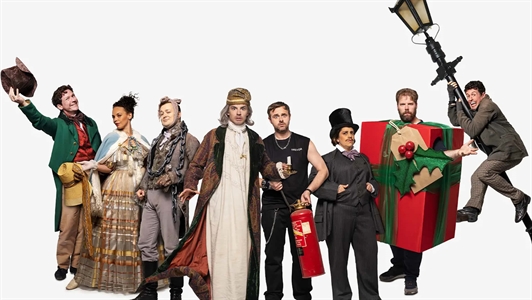
Christmas Carol Goes Wrong Meets a Familiar Christmas Story
The enduring appeal of Dickens’ A Christmas Carol lies partly in its simplicity. Scrooge begins as a man defined by his miserliness, dismissive of Christmas and indifferent to the people around him. Over the course of one extraordinary night, he is confronted with memories, present-day consequences and the possibility of a future he would rather avoid.
The story has travelled far beyond the pages of its original novella. It has been adapted for theatre, film, television and countless seasonal productions. Its characters and imagery are now part of the wider Christmas tradition, making it a natural choice for a theatrical company interested in turning expectations upside down.
Christmas Carol Goes Wrong takes that familiarity and places it in the hands of the Cornley Amateur Drama Society. The fictional company returns with the best of intentions, determined to stage a faithful version of the Dickens classic. The difficulty is that the performers and the production itself are not especially well equipped to manage the task.
The central premise is simple but fertile ground for comedy. A production already under pressure becomes increasingly unstable as miscommunication, delayed scenery, missing actors and backstage tensions begin to interfere with the performance. A growing dispute over who should play Scrooge adds another complication.
The result is a play within a play. Audiences are not simply watching a version of A Christmas Carol; they are watching a company attempt to perform it while the machinery of theatre seems determined to work against them.
The Art of a Production Going Wrong
There is a particular pleasure in watching a carefully constructed stage production appear to lose control. A misplaced entrance, an awkward pause or a prop that refuses to behave can create a moment of uncertainty for both performers and audience. In a conventional drama, such disruptions are usually hidden or corrected as quickly as possible. In a theatrical farce, they become the point.
That is the territory explored by Mischief, the comedy company behind The Play That Goes Wrong and other productions built around the deliberate collapse of theatrical order. Its work draws on the traditions of physical comedy and farce, where timing, movement and escalating complications are central to the storytelling.
Christmas Carol Goes Wrong applies that approach to the festive season. The audience knows the broad shape of Dickens’ story, but the Cornley company’s attempts to follow it introduce a second, increasingly chaotic narrative. Each setback creates the possibility of another, and the performers must continue as though the evening remains under control.
The comedy depends on the contrast between intention and outcome. The actors want to deliver a polished Christmas production. Their circumstances suggest otherwise. A scene that should carry solemnity can become a test of composure; a dramatic entrance can turn into a logistical problem; and a moment designed to advance the story can instead expose the fragile organisation behind it.
This kind of comedy also asks a great deal of its performers. Physical sequences need precision, even when they are designed to look accidental. Entrances, exits, props and set movements must be coordinated so that the apparent disorder remains legible to the audience. The more chaotic the stage appears, the more carefully the production must be managed behind the scenes.
A Different Kind of Christmas Theatre
Seasonal theatre often draws on familiar ingredients: music, nostalgia, family stories and the reassuring return of well-known characters. Christmas Carol Goes Wrong takes a less conventional route. It uses the familiarity of a traditional Christmas story as the foundation for a comedy about the difficulty of putting on a show.
That distinction gives the production a broad point of entry. People who know Dickens’ original will recognise the characters and the moral framework, while those less familiar with the novella can follow the basic premise of a theatrical company struggling to keep its performance intact.
The show is recommended for audiences aged 10 and over. Its humour includes slapstick, mild innuendo and comic physical action, so it is worth considering the age guidance when planning a family visit. Children aged 15 and under must be accompanied at all times at the Sydney Opera House.
The performance runs for approximately 120 minutes, including a 20-minute interval. As with any live production, the duration is a guide and may be subject to change.
For Sydney audiences, the timing also places the show neatly within the busiest part of the Christmas calendar. The season begins on 17 December and continues through the days leading up to Christmas, then resumes after Christmas Day until 29 December. It provides an opportunity to step away from shopping, preparations and the usual December commitments for an evening in the theatre.
The Sydney Opera House as a Festive Setting
The Sydney Opera House is a fitting location for a production that plays with the conventions of theatre. Its position at the edge of the harbour makes a visit feel like more than a straightforward trip to a performance. The approach across Circular Quay, the changing views of the water and the distinctive architecture of the building all contribute to the occasion.
In December, the precinct takes on the particular rhythm of the summer holiday period. Visitors gather along the waterfront, restaurants and bars fill, and the harbour becomes a natural meeting point for people spending time in the city. The Opera House sits within this activity while retaining its role as one of Australia's principal performing arts venues.
Christmas Carol Goes Wrong takes place in the Concert Hall. The venue is best known for its musical performances, but its programme also accommodates theatrical events and large-scale productions. For this show, it provides a setting in which the contrast between the grandeur of the building and the Cornley players’ mounting difficulties can add another layer to the evening.
Arriving early allows time to enjoy the surrounding precinct without rushing directly from the street to the auditorium. The Opera House advises that foyers for Concert Hall performances generally open 90 minutes before the performance, while theatre doors open 30 minutes beforehand. Visitors collecting tickets from the Box Office are encouraged to allow additional time.
The location is also well connected to public transport. Circular Quay is within walking distance, with train, light rail and ferry services providing access from different parts of Sydney. Those travelling by car should allow for city traffic and parking arrangements, particularly during the December holiday period.
A Cast of Characters and Carefully Timed Chaos
The Cornley Amateur Drama Society is central to the appeal of Christmas Carol Goes Wrong. Its members are not simply characters in a story about Scrooge; they are performers trying to maintain the appearance of a functioning theatre company while personal disagreements and practical problems threaten to derail the evening.
The production brings together a local cast of Australian and New Zealand performers, including Melanie Bird, Jack Buchanan, Tim Carroll, Manon Gunderson-Briggs, Douglas Hansell, Michael Howlett, Joe Kosky, Brodie Masini, Anthony Craig, Jess Rogers, Marlena Thomson and Zak Vasiliou.
The creative team includes writers Henry Lewis, Jonathan Sayer and Henry Shields, whose work has helped establish Mischief's distinctive approach to stage comedy. Matt DiCarlo directs the production.
The writing builds on the company's established interest in the mechanics of performance: the assumptions audiences bring into a theatre, the conventions that make a stage production work and the humour that emerges when those conventions are disrupted. In Christmas Carol Goes Wrong, the familiar structure of a Christmas story provides a framework for a different kind of theatrical problem-solving.
The cast must balance the fictional performers’ attempts to stay in character with the physical demands of the comedy. It is a form of theatre that relies on the audience understanding both levels at once: the story the Cornley players are trying to tell and the increasingly desperate effort to keep telling it.
Planning a December Visit
The Sydney season runs from Thursday 17 December to Tuesday 29 December 2026, with a range of afternoon and evening performances. There is no performance listed for Christmas Day, 25 December.
The published schedule is:
- Thursday 17 December: 1.30pm and 7pm
- Friday 18 December: 7pm
- Saturday 19 December: 1.30pm and 7pm
- Sunday 20 December: 1.30pm and 7pm
- Tuesday 22 December: 1.30pm and 7pm
- Wednesday 23 December: 7pm
- Thursday 24 December: 1.30pm and 7pm
- Saturday 26 December: 1.30pm and 7pm
- Sunday 27 December: 1.30pm and 7pm
- Monday 28 December: 6pm
- Tuesday 29 December: 1.30pm
The Wednesday 23 December, 7pm performance includes Auslan interpretation and audio description. A tactile tour is scheduled for 6pm for patrons attending the audio-described performance.
The published age recommendation is 10+. The show includes slapstick comedy, mild innuendo and comic physical action. Children aged 15 and under must be accompanied by an adult.
Ticket prices vary according to seating category and performance date. The Opera House lists pre-Christmas prices for performances from 17 to 24 December, and a separate price scale for performances from 26 to 29 December. A booking fee applies, and final prices are confirmed during seat selection.
For current ticket availability, accessibility information and any schedule updates, consult the official event page before travelling.
Event Details
Event: Christmas Carol Goes Wrong
Dates: 17–29 December 2026
Venue: Concert Hall, Sydney Opera House
Address: Bennelong Point, Sydney NSW 2000
Performance times: Afternoon and evening sessions, with times varying by date
Duration: Approximately 120 minutes, including a 20-minute interval
Age recommendation: 10+
Official information and tickets: https://www.sydneyoperahouse.com/theatre/christmas-carol-goes-wrong
When the Christmas Story Loses Its Script
There is something appropriate about bringing a comedy of theatrical mishaps to the stage in the weeks before Christmas. December is a month of carefully arranged plans, crowded calendars and expectations that everything will come together at the right moment. Family gatherings, travel, presents and festive meals all depend on a degree of organisation. Often, of course, they do not quite work out as intended.
Christmas Carol Goes Wrong finds its comedy in that gap between the plan and the reality. It takes a story associated with reflection and redemption, then asks what happens when the people responsible for telling it cannot keep their own production on course.
For visitors, the experience begins well before the lights go down. There is the walk around the harbour, the familiar outline of the Opera House against the evening sky and the sense of a city moving into its summer holiday season. Then comes the shift into the theatre, where the Cornley company attempts to make sense of its festive ambitions.
Dickens’ story may be about discovering the value of generosity and human connection, but the Cornley players have rather more immediate concerns. Their scenery must behave, their cast must cooperate and their performance must somehow reach its conclusion.
Whether the evening follows the expected path is another matter. At the Sydney Opera House this December, the Christmas spirit arrives with a generous measure of theatrical uncertainty.