
DanceRites 2026 brings First Nations dance, song and cultural storytelling to the Sydney Opera House Forecourt on 24 and 25 October, in a free weekend celebration.
The harbour is rarely still for long. Ferries cross the water below Bennelong Point, the sails of the Sydney Opera House catch the shifting light, and visitors move between the waterfront and the broad steps of one of Australia's best-known landmarks. Yet the significance of this place reaches much further back than the modern city that surrounds it.
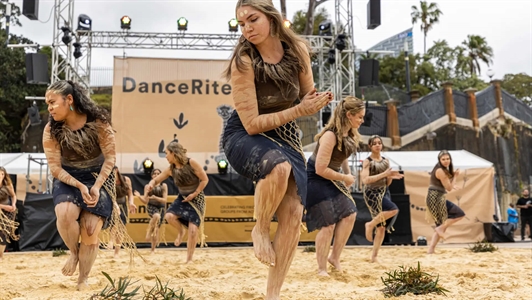
On Saturday 24 and Sunday 25 October 2026, the Opera House Forecourt will become a gathering place for DanceRites, a national celebration of Aboriginal and Torres Strait Islander dance, song and culture. Performers representing diverse First Nations communities from across Australia will come together for two days of cultural performance and friendly competition, with the harbour providing a striking backdrop to the sand circle stage. Entry is free, and no registration is required.
DanceRites arrives at a time when public spaces are increasingly recognised as places not only for entertainment, but also for listening, learning and understanding the stories that shape a community. Here, dance is not simply a performance to watch. It can carry language, history, identity and connections to Country, expressed through movement and song that belong to particular communities.
The event's location is central to that experience. The Opera House stands on Tubowgule, a place of gathering, ceremony and celebration for Aboriginal people long before the building became a symbol of modern Australia. DanceRites continues that tradition by bringing First Nations performers and audiences together on a site whose cultural significance predates its familiar architectural form.
Across the weekend, visitors will encounter different dance traditions, local stories and languages, each shaped by the communities presenting them. The programme will also include special guest performances, an audience workshop and a tribute to the late Rhoda Roberts AO, whose leadership helped establish DanceRites as a major First Nations cultural event.
For those arriving without prior knowledge of the participating groups, the weekend offers an opportunity to encounter the diversity of First Nations cultures through performance. For the communities taking part, it is a chance to represent their traditions, share knowledge and bring cultural expression into a prominent public setting.
DanceRites 2026 And The Meaning Of Cultural Dance
Dance can communicate what ordinary speech cannot easily contain. A gesture, a rhythm or a sequence of movements may hold meaning that is inseparable from the language, Country and cultural knowledge of the people performing it.
At DanceRites, this relationship between movement and meaning is fundamental. The competition's Cultural Dance and Song Cycle category invites groups to represent their communities through local storytelling, language and dance. Performances are assessed by a panel of First Nations dance experts, with attention given to how groups engage with and express their culture.
This is not a single style of dance presented under one national label. Aboriginal and Torres Strait Islander peoples encompass many distinct Nations, Clans, language groups and cultural traditions. Their performances reflect that diversity, offering different relationships between movement, song, place and community.
For an audience, the experience calls for a particular kind of attention. Some elements may be immediately visible in the rhythm of the dancers or the formation of a group. Other meanings may be understood most fully by those who carry the relevant cultural knowledge. The value of the event lies partly in recognising both realities: the invitation to witness, and the importance of respecting the knowledge that belongs to the communities themselves.
The competitive structure adds another dimension. Groups present their work before a panel, but the event also creates a shared space in which cultural expression is recognised publicly. The competition gives performers a framework, while the wider gathering places emphasis on exchange, continuity and pride.
DanceRites also includes a Wild Card category, allowing groups to showcase their individual styles and techniques beyond the principal Cultural Dance and Song Cycle. This part of the programme opens a different creative space, demonstrating how dance traditions can be expressed through varied approaches while remaining connected to the performers' identities and communities.
The distinction between categories helps make the weekend more than a sequence of performances. It allows visitors to see different facets of the participating groups, from cultural storytelling grounded in local tradition to the freedom of a more open-ended dance presentation.
The Stories Carried By Song And Movement
The cultural significance of DanceRites becomes clearer when considered through the relationship between language and place. Across First Nations Australia, language carries more than words. It can express relationships with Country, family, ancestors and cultural responsibilities, connecting people to knowledge that has been maintained and passed on through generations.
In this context, song and dance are not decorative additions to a story. They are ways of expressing and sustaining cultural knowledge, with meanings shaped by the communities that hold them. DanceRites gives those expressions a public setting while allowing participating groups to present their own traditions on their own terms.
The event also provides a meeting point for people whose communities may be separated by vast distances. Groups travelling from northern Australia, the east coast, Victoria and Western Australia bring different histories and cultural practices to the same stage. Their presence at the Opera House makes the diversity of First Nations Australia visible without suggesting that all communities share a single cultural identity.
The programme features groups including Brolga Dance Academy, the Dunghutti Figtree Dancers, Lagaw Titui, the Tingkabee Arrernte Dancers, Sand and Sea Dance Troupe and Walla Mulana. Each represents particular community connections and cultural backgrounds, contributing a distinct perspective to the weekend.
For visitors, learning a little about the groups before arriving can add context to the performances. The Sydney Opera House's official A Guide to DanceRites provides background on First Nations dance and song, including the relationship between cultural expression, language and Country. It is a useful companion for those who want to approach the event with curiosity and care.
There is no need, however, to arrive with specialist knowledge. The programme itself offers an introduction through performance, and the atmosphere of a live gathering provides its own form of understanding. Watching the movement of a group, hearing the rhythms of song and observing how performers share the stage can reveal the care and collective effort involved in bringing cultural work before an audience.
The important distinction is between appreciation and assumption. Not every meaning will be immediately apparent to every visitor, and not every story is intended to be explained in full. DanceRites creates an opportunity to listen and observe, while recognising that cultural knowledge remains grounded in the communities from which it comes.
Honouring Rhoda Roberts AO
DanceRites also carries the legacy of Rhoda Roberts AO, the influential First Nations arts leader whose vision helped establish the event.
Roberts was a significant figure in Australian arts and broadcasting, known for her work supporting Indigenous performance, storytelling and cultural visibility. Her leadership helped shape DanceRites from its early beginnings into a dedicated national gathering for First Nations dance and culture.
The festival began in 2015 as part of the Sydney Opera House's Homeground festival, before becoming a standalone event in 2018. Its development reflects a sustained effort to create a prominent space for First Nations communities to present their cultural practices, connect with one another and share their work with wider audiences.
This year's programme includes a tribute to Roberts, performed by Jannawi Dance Clan. The tribute sits within the opening afternoon, alongside the Smoking Ceremony, Welcome to Country and Calling to Country.
These moments establish a context for the competition that follows. They acknowledge the significance of place and the people whose cultural connections to it long predate the modern city. They also recognise the individuals whose work has helped create opportunities for cultural expression to be seen and heard.
A tribute within a live festival carries a different quality from a formal retrospective. It takes place among performers and audiences who are gathered for the continuing practice of dance and storytelling. In that sense, the acknowledgement of Roberts forms part of the event's living history, connecting the work that established DanceRites with the communities that continue to shape it.
The weekend's guest performances extend this sense of continuity, bringing different cultural experiences into conversation without reducing them to a single narrative.
A Weekend Of DanceRites At Bennelong Point
The setting adds a distinctive physical dimension to the event. The Forecourt lies between the Opera House and the Royal Botanic Garden, with the Monumental Steps rising behind the audience and Sydney Harbour opening out beyond the surrounding buildings.
Unlike a theatre performance, DanceRites takes place outdoors, in a space where weather, light and the movement of the crowd become part of the experience. Visitors may arrive while the afternoon is still bright, then remain as the sky darkens and the Opera House takes on its familiar evening illumination.
The sand circle stage creates a clear focal point for the performances, while the surrounding public areas allow visitors to experience the event at their own pace. Some may stay for the full programme; others may arrive for particular groups or the Sunday finals. Both approaches are accommodated by the free, open-access format.
The Sydney Opera House encourages visitors to check the weather before attending. There is no shade in the public viewing area on the Forecourt, and performances proceed in wet weather unless conditions are considered unsafe. A hat, sunscreen, protective clothing and a refillable water bottle are sensible additions to the day. Free water stations are available onsite, although glass bottles are not permitted.
The location is also well connected to the rest of the city. Circular Quay is around a seven to ten-minute walk away, with trains, ferries, light rail and buses providing options for reaching the precinct. Given the expected audience, arriving early offers time to find a viewing position and settle in before the programme begins.
For those who need accessibility support, the Opera House provides a wheelchair viewing area beside the sand circle and reserved viewing space for Auslan users. A dedicated calm space is also available under the Monumental Steps for visitors who need a quieter environment. These facilities do not require advance registration, though visitors with specific access questions can contact the venue directly.
DanceRites is suitable for all ages. Children aged 15 and under must be accompanied by an adult throughout the event.
DanceRites 2026: Dates, Times And Visitor Information
DanceRites takes place at the Sydney Opera House Forecourt on Saturday 24 and Sunday 25 October 2026. The festival is free, and visitors do not need to register or book tickets in advance.
Event Details
Event: DanceRites 2026
Dates: Saturday 24 and Sunday 25 October 2026
Location: Sydney Opera House Forecourt, Bennelong Point, Sydney NSW 2000
Entry: Free
Site Opens: 1.30pm both days
Saturday Programme: Welcome and opening ceremony at 2pm, competition heats from 2.30pm, guest performances from 5pm, with an international guest performance scheduled for 7pm.
Sunday Programme: Acknowledgement of Country at 2pm, Wild Card performance at 2.05pm, finals from 5.30pm, guest performances and winners ceremony from 7.10pm.
Accessibility: Auslan interpretation, accessible viewing and a dedicated calm space are available.
Official Information: Sydney Opera House DanceRites
Detailed Schedule: DanceRites 2026 Schedule
Performance times may change, so check the official schedule before travelling. Visitors can also watch both days free online through the Sydney Opera House YouTube channel and NITV's Facebook channel, with Auslan interpretation and closed captions.
An Invitation To Witness And Understand
Sydney is a city shaped by movement. People cross its harbour every day, arriving from different places and carrying their own histories, languages and ways of understanding the world. At DanceRites, movement takes on another significance. It becomes a means of expressing identity, maintaining cultural knowledge and bringing communities together in a shared public space.
The weekend offers something more enduring than a programme of performances. It invites audiences to recognise the diversity of Aboriginal and Torres Strait Islander cultures, while understanding that each dance belongs to a particular cultural context. The experience is not about treating these traditions as relics of the past, but witnessing living cultures expressed by the people who carry them forward.
As the afternoon light shifts across Bennelong Point, the sound of song and the rhythm of dancers will sit alongside the familiar movements of the harbour. Visitors will arrive, gather around the sand circle and watch groups take their place before the audience.
When the final performances conclude on Sunday evening, the Forecourt will gradually return to its usual rhythm. The ferry lights will continue across the water, and the city will move on around the Opera House. What remains from DanceRites, however, extends beyond the weekend itself: the cultural knowledge shared, the communities brought together and the opportunity for audiences to listen with greater attention.
In a place long associated with gathering and ceremony, the festival offers a reminder that culture is not simply something preserved in archives or displayed behind glass. It is practised, carried and renewed by people. At DanceRites, that continuity takes shape through song, movement and the simple act of coming together.