
Dangerous When Wet brings the true story of Fanny Durack and Mina Wylie to Randwick Town Hall in a new Australian musical comedy this October.
On a warm Sydney afternoon, it is easy to forget how deeply swimming belongs to the city.
The ocean is never far away. Beaches stretch along the coastline, pools sit between suburbs and parks, and the rhythm of summer is often measured in laps, tides and the sound of water against the edge of a pool.
More than a century ago, however, Australian women who wanted to compete in swimming faced a very different set of boundaries.
In 1912, Sydney swimmers Fanny Durack and Mina Wylie travelled to Stockholm to compete at the Olympic Games. Durack won gold in the 100-metre freestyle and Wylie took silver, establishing a remarkable place for Australian women in Olympic history.
Their story now returns to Sydney in a very different form.
Dangerous When Wet, a new all-Australian, all-woman vaudeville-style musical comedy, will take over Randwick Town Hall from 8 to 18 October 2026. Created around the friendship, rivalry and determination of Durack and Wylie, the production looks back to an era when simply reaching the starting line could require a fight of its own.
The result is intended to be funny, musical and irreverent, but beneath the comedy is a story about ambition, friendship and the changing place of women in Australian sport.

Dangerous When Wet Looks Back To 1912
The Olympic Games of 1912 were held in Stockholm, a long way from the swimming pools and beaches of Sydney.
For Fanny Durack and Mina Wylie, the journey represented more than an opportunity to compete internationally.
Women's swimming was still relatively new to the Olympic program, and the idea of women travelling overseas to compete in serious sporting contests was controversial in ways that can now be difficult to imagine.
Durack was already an accomplished swimmer, while Wylie was both her friend and a formidable competitor.
Their relationship provides the dramatic centre of Dangerous When Wet.
The two women were not simply rivals separated by a stopwatch. They trained together, competed against one another and shared the ambition of representing Australia on an international stage.
Their eventual Olympic results gave each a place in history.
Durack won the gold medal.
Wylie finished second and took silver.
The medals tell only the simplest version of the story.
What happened before they entered the water is where the musical finds its theatrical material.
Sydney’s Swimming Story
The production has particular resonance in Sydney because the story belongs to the city's sporting history.
Sydney's relationship with swimming has always extended beyond competition. The harbour, ocean pools and beaches have provided places for recreation, exercise and community, while swimming clubs have formed an important part of suburban life.
At the beginning of the twentieth century, though, the culture surrounding women's swimming was changing.
Public attitudes were shifting, but slowly.
Durack and Wylie emerged from that transition.
Their achievements helped demonstrate that Australian women could compete internationally at the highest level, at a time when female athletes were still negotiating expectations about behaviour, clothing and public visibility.
The setting of Dangerous When Wet in Randwick adds another layer.
Randwick is close to some of Sydney's most familiar coastal landmarks, including Coogee Beach and the ocean pools that remain part of the area's everyday landscape.
The musical therefore returns this story to a part of Sydney where swimming is not an abstract historical subject.
It is part of the local environment.
From Swimming History To Vaudeville
Dangerous When Wet does not approach its subject as a conventional historical drama.
Instead, the production draws on vaudeville, using comedy, music, theatricality and deliberately heightened characterisation to tell the story.
That approach allows the historical material to breathe.
The performers can move between humour and more serious moments, creating a world that acknowledges the absurdities surrounding the swimmers' struggle without diminishing what they achieved.
The cast is entirely female, while the production also plays with the conventions of traditional vaudeville.
Jacinta Gregory, known for drag-king performance, plays journalist Cecil Healy. The role reflects the production's willingness to treat gender and theatrical convention with a light touch.
Other historical figures appear alongside Durack and Wylie, expanding the story beyond the two swimmers themselves.
The result is a stage populated by athletes, journalists, entrepreneurs and campaigners, each contributing to the social world surrounding Australian swimming in the years before the Stockholm Games.
Dangerous When Wet And The Women Around The Swimmers
The production's cast brings together performers from different areas of Sydney's theatre and performance communities.
Megan Walshe plays the narrator Annette Kellerman, the Australian swimmer and performer who became internationally known for her aquatic performances and influence on women's swimming and swimwear.
Cypriana Singh plays Fanny Durack, while Grace Trainor takes the role of Mina Wylie.
Addy Roberts plays British swimming champion Jennie Fletcher, another important figure in the international swimming world of the period.
Jacinta Gregory takes on Cecil Healy, while Annerose de Jong plays sports entrepreneur Mrs Mack.
Opera performer Eliane Morel appears as Rose Scott, a figure whose presence adds another dimension to the historical tensions surrounding women, sport and public life.
Rather than presenting history as a collection of isolated names, the musical uses these characters to build a social landscape.
The swimmers did not achieve their Olympic success in isolation.
They were part of a broader network of people who trained, reported, organised, supported, criticised and encouraged women entering public sporting life.
The Women Behind Dangerous When Wet
Dangerous When Wet has been developed over several years by creators Eliane Morel, Merran Hughes, Joanna Weinberg and Daryl Wallis.
The production's creative history includes a development period at Randwick Town Hall, where the project evolved through workshops and creative experimentation.
That connection between the venue and the development of the show is significant.
By the time audiences arrive in October, the musical will already have a relationship with the building in which it is being performed.
Randwick Town Hall is not a conventional large-scale theatre. Its civic character gives the production an environment closer to the intimate traditions of vaudeville than to the anonymity of a major auditorium.
That setting should suit a work built around direct communication between performers and audience.
The performers can inhabit the historical characters without requiring an elaborate recreation of Stockholm or early twentieth-century Sydney.
Instead, the imagination does much of the work.
A song can become a training session.
A joke can expose an old social attitude.
A change in character can shift the audience from the sporting world to the wider society around it.
A Story About Competition
At the heart of Dangerous When Wet is the relationship between two women who wanted the same thing.
That makes their friendship particularly interesting.
Competition can complicate even the closest friendships. A stopwatch can turn a training partner into a rival, while a medal can create a permanent distinction between first and second place.
Yet Durack and Wylie continued to share the journey.
Their Olympic results are now fixed in history, but their relationship remains more complicated than the medal table suggests.
The musical gives that complexity room to become theatrical.
There is rivalry, but also mutual recognition.
There is ambition, but also affection.
And there is the shared understanding that getting to Stockholm was itself an achievement.
The 1912 Games did not simply provide the climax of their sporting careers.
They marked a moment when Australian women were beginning to appear on an international sporting stage in a more visible way.
Dangerous When Wet Brings History Into The Present
Looking back at sporting history can sometimes make the past appear tidier than it really was.
The winners are recorded. The medals are catalogued. Photographs survive.
The arguments and uncertainties are harder to preserve.
Dangerous When Wet takes a different route.
Comedy makes it possible to look directly at some of the attitudes that surrounded women in sport without turning the evening into a lecture.
Vaudeville also offers a useful historical connection.
The form was built around variety, personality and direct audience engagement. It could accommodate songs, comedy, character performance and spectacle within the same evening.
For a story involving early twentieth-century swimmers, it provides a natural theatrical language.
The production can celebrate the period while also questioning some of its assumptions.
That balance is important.
The women at the centre of the story were extraordinary athletes, but they were also products of their time. Their achievements become more meaningful when viewed against the expectations they had to negotiate.
A Sydney Premiere In Randwick
The world premiere will take place at Randwick Town Hall, placing the production close to the coastline and communities that continue to define Sydney's swimming culture.
The season runs from Thursday 8 October to Sunday 18 October 2026.
The first performances on 8 October will be previews at 2pm and 7pm, followed by opening night on Friday 9 October.
Performances continue through the following week, giving Sydney audiences several opportunities to encounter the story.
Tickets range from $25 to $100.
The broad ticket range reflects the production's intention to make the story accessible rather than positioning it solely as a conventional theatre event.
For visitors unfamiliar with Durack and Wylie's story, the performance offers an introduction to an important part of Australian sporting history.
For Sydney audiences, there is another pleasure in seeing a local story returned to its geographical setting.
The beaches, pools and harbour that form part of Sydney's modern identity were already shaping the lives of swimmers more than a century ago.
From The Pool To The Stage
There is a quiet irony in bringing a story about swimming into a theatre.
The original competitors depended on physical movement, water and speed.
On stage, none of those things can be reproduced literally.
Instead, the performers have to create them through rhythm, gesture, voice and music.
That transformation is part of the appeal of theatre.
A sporting contest becomes a story.
A stopwatch becomes suspense.
A medal becomes a symbol of a relationship and a changing society.
The production's vaudeville approach adds another layer, allowing the performers to move quickly between different registers.
One moment can be comic, the next unexpectedly tender.
The songs can carry historical information without feeling like a lesson.
And the exaggerated theatricality can remind audiences that history itself is often stranger than fiction.
The story of two Sydney swimmers travelling to Stockholm in 1912 to compete at an Olympic Games already has the shape of drama.
The stage simply gives it another language.
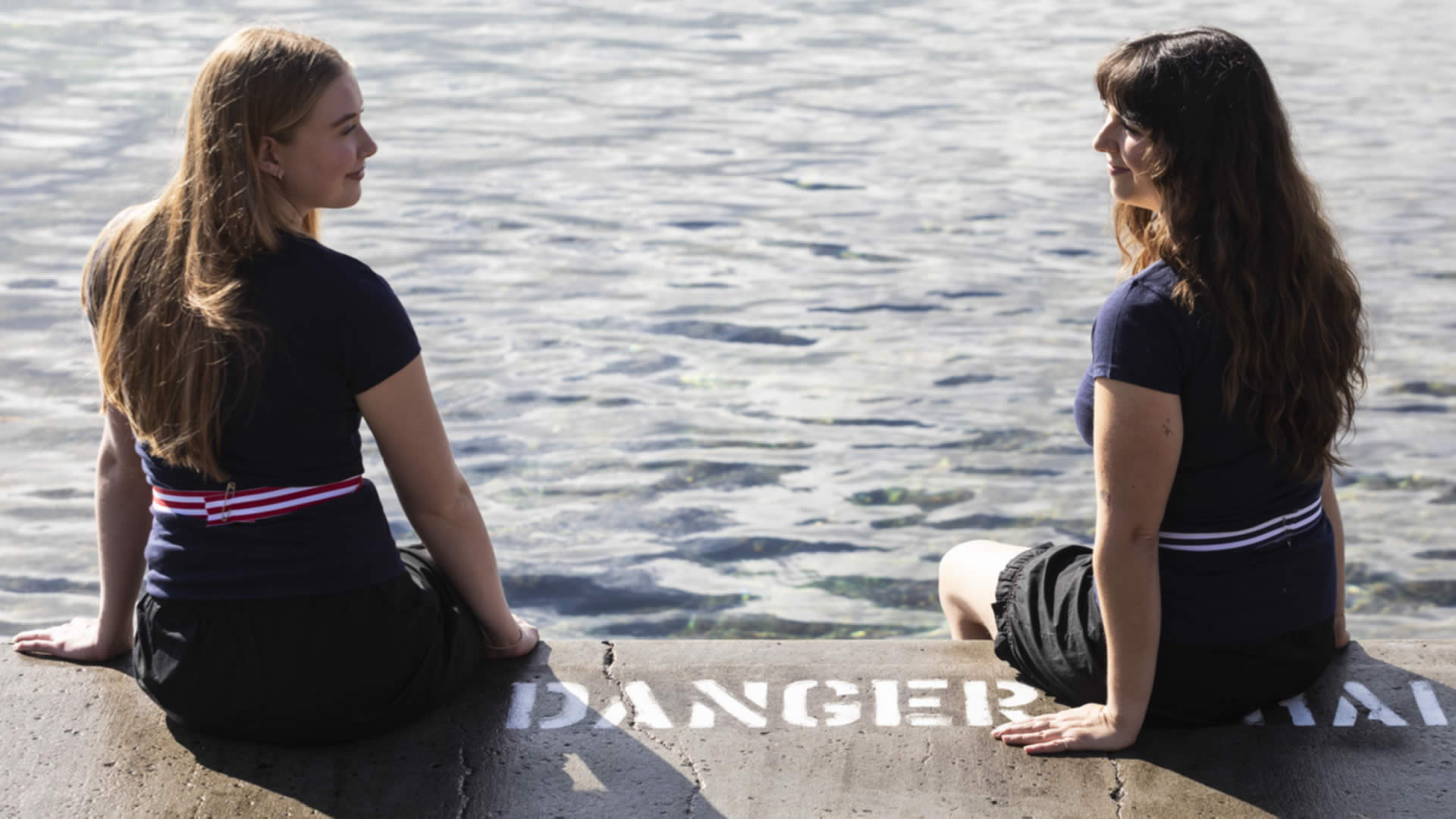
Why Their Story Still Matters
More than a century after Stockholm, Australian women compete across every major sporting arena.
Swimming has become one of the country's strongest Olympic traditions.
The names of Australian swimmers are familiar to generations of spectators, and the country's relationship with the pool remains deeply embedded in national culture.
That makes the story of Durack and Wylie worth revisiting.
Their success arrived at a time when the possibilities available to women were narrower.
They were not simply early Olympic medallists.
They were part of a gradual expansion of what Australian women could do publicly, professionally and competitively.
Dangerous When Wet places that history inside a musical comedy, where the distance between past and present can be explored through laughter as well as reflection.
The approach avoids treating the women as museum pieces.
Instead, it brings them back into a world of ambition, rivalry, friendship and uncertainty.
Those things remain recognisable.
When Dangerous When Wet Reaches The Water’s Edge
There is something fitting about a Sydney story ending up in a theatre in Randwick.
Beyond the town hall, the city continues towards the coast.
The beaches remain. The ocean pools remain. Swimmers still enter the water in the early morning, sometimes alone, sometimes alongside friends and competitors.
The circumstances have changed dramatically since 1912.
But the basic impulse has not.
Someone dives in.
Someone watches the clock.
Someone wants to go faster.
Dangerous When Wet returns to the moment when two Sydney women carried that impulse onto an international stage and helped change the story of Australian swimming.
Their gold and silver medals are the part history remembers most easily.
The more interesting story lies around them: the friendship, the obstacles, the arguments and the determination that made those medals possible.
In October, that story will be told not beside a swimming pool, but under stage lights at Randwick Town Hall.
For an evening, Sydney's swimming history will leave the water and take its place on the stage.
Event Details
Event: Dangerous When Wet – The Musical
Dates: 8 to 18 October 2026
Previews: Thursday 8 October at 2pm and 7pm
Opening Night: Friday 9 October 2026
Venue: Randwick Town Hall
Tickets: $25 to $100
Official Website: https://www.dangerouswhenwet.com.au
Facebook: https://www.facebook.com/DangerousWhen
Instagram: https://www.instagram.com/DangerousWhenWetMusical