
Faulty Towers The Dining Experience returns to Sydney in February 2027, bringing three decades of theatrical mischief to the Opera House through an immersive dinner inspired by the much-loved British sitcom.
There is something reassuring about the ritual of going out for dinner. A table is set, glasses catch the light, menus are considered, and conversation gradually fills the room. At the beginning of Faulty Towers The Dining Experience, the expectation is much the same. Guests arrive ready for a meal, perhaps anticipating an entertaining evening, without necessarily knowing how thoroughly the ordinary conventions of dining are about to unravel.
The premise draws on the world of Fawlty Towers, the British television comedy created by John Cleese and Connie Booth. Its fictional hotel is a place where good intentions rarely survive contact with reality, where misunderstandings gather momentum and where the proprietor, Basil Fawlty, seems perpetually on the verge of losing control. Alongside him are Sybil, his formidable wife, and Manuel, the well-meaning waiter whose efforts to please frequently make matters worse.
In Faulty Towers The Dining Experience, these familiar characters move beyond the television screen and into the dining room. The audience is no longer simply watching the action from a distance. The performance unfolds around the tables, through the service, and in the spaces between courses, with guests becoming part of the hotel's increasingly chaotic daily business.
The production returns to Australia in February 2027 for a special tour marking its 30th anniversary, with Sydney Opera House scheduled to host the experience from 22 to 27 February. The setting provides a distinctive backdrop for a show that has spent decades bringing its distinctly British comic sensibility to audiences around the world.
Rather than placing a conventional play on a stage and asking diners to observe quietly, the experience brings theatre into the social space of a meal. The result rests on a simple but enduring idea: dinner can be more than an occasion to eat. It can become the setting for a story that develops around the people sharing the room.
From Brisbane to the World
The story of Faulty Towers The Dining Experience began in Brisbane in 1997. What started as a theatrical interpretation of a much-loved television comedy has since developed into an international production, touring 43 countries and welcoming millions of guests.
Its longevity is notable in a cultural landscape where live entertainment continually competes for attention. Television comedy provides a familiar starting point, but familiarity alone cannot sustain a theatrical experience for three decades. The production's format offers another attraction: every performance takes place in a room occupied by real people, whose reactions, conversations and willingness to participate help shape the atmosphere.
The anniversary tour also offers an opportunity to consider the unusual journey of a show that has travelled so far from its original Australian beginnings. Although its characters and comic conventions are unmistakably British, the production has developed an international audience through a format that translates readily across borders. The frustrations of a badly managed hotel, the discomfort of social embarrassment and the unpredictability of human behaviour require little explanation.
The show's reported achievements place it among Australia's notable theatrical exports. It is recognised as the longest-running immersive production in the West End, the longest-running production based on Fawlty Towers worldwide, and the longest-running theatrical production based on a television series currently playing in the West End.
These milestones speak to a particular kind of theatrical endurance. Unlike a familiar script performed in a conventional auditorium, an immersive dinner depends on the relationship between performers and audience. The room is not simply a backdrop. It is where the action happens, and where a carefully constructed scene must coexist with the practical business of serving a meal.
Thirty years after its beginnings in Brisbane, that combination of performance and hospitality remains at the centre of the production's appeal.
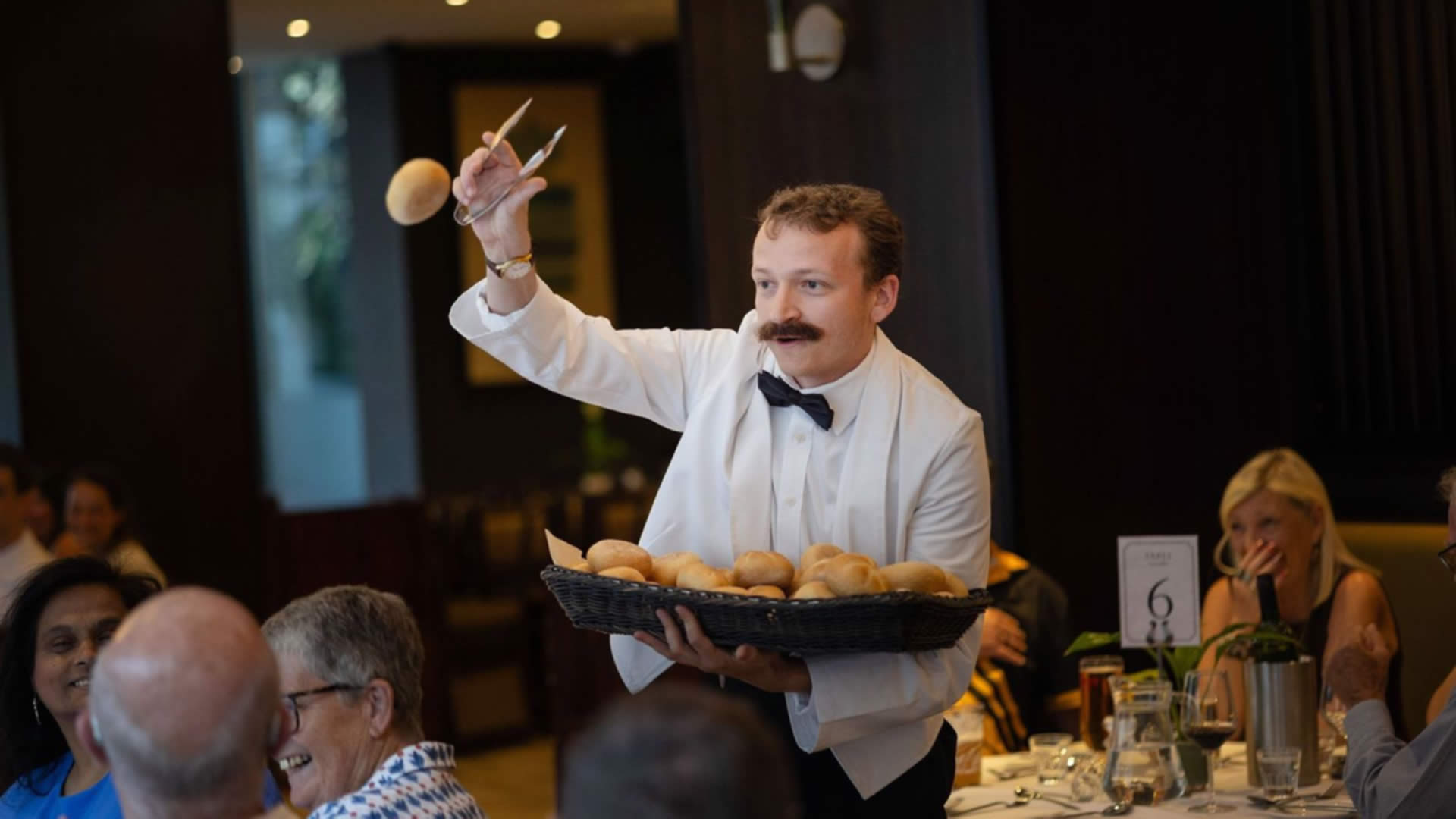
What Makes Faulty Towers The Dining Experience Different?
At first glance, a restaurant and a theatre have different purposes. One provides food and a place to gather; the other creates a fictional world for an audience to enter. Faulty Towers The Dining Experience occupies the space between them, using the familiar structure of a meal to establish the conditions for comedy.
Guests arrive, take their seats and settle into the room. The characters then begin to move through the dining space, bringing the hotel's fictional troubles into the evening. Conversations with staff, the arrival of courses and the interactions between tables become part of the theatrical setting.
The humour draws on the contrast between what should happen during a well-organised dinner and what actually unfolds. A request that would ordinarily be dealt with quietly can become a source of confusion. A simple exchange may develop into an elaborate misunderstanding. The more insistently the characters attempt to maintain order, the more elusive it becomes.
This format also changes the audience's relationship with the performers. In conventional theatre, the boundary between stage and seating is generally clear. Here, that boundary is deliberately less certain. The actors work within the room, responding to the atmosphere while maintaining the framework of the production.
For some guests, the appeal lies in seeing recognisable characters brought to life at close quarters. For others, it is the prospect of being caught up in the action, even briefly, that distinguishes the evening from a standard night at the theatre.
The experience nevertheless remains a performance rather than an unscripted gathering. Its comedy depends on timing, characterisation and the gradual accumulation of mishaps. The dining room supplies the setting, while the performers provide the structure that allows the chaos to develop.
The Enduring Appeal of Fawlty Towers
The original Fawlty Towers occupies a distinctive place in British television comedy. Despite its relatively small number of episodes, the series has remained widely recognised for its tightly constructed farce, sharp dialogue and memorable characters.
Much of its humour comes from the distance between appearance and reality. Basil Fawlty wants to be regarded as a capable hotelier, yet his temper and vanity repeatedly undermine him. Sybil often appears to have a clearer understanding of the situation, even as she becomes entangled in its complications. Manuel approaches his work with enthusiasm, but language barriers and misunderstandings make his attempts to help unpredictable.
These relationships provide a durable framework for physical comedy and escalating confusion. A small mistake rarely remains small for long. The effort to conceal one problem creates another, until the original situation has become almost impossible to manage.
The dining experience takes those dynamics out of the television frame and places them among people who are eating, talking and sharing a table. This shift matters because the original comedy is rooted in social discomfort. A hotel is a place where guests expect to be looked after, where manners and professional responsibilities should keep everything running smoothly. When that promise collapses, the embarrassment is immediate.
In a live dining room, the contrast becomes tangible. The audience can see the characters at close range, hear exchanges unfold around them and experience the collective response of the room. Laughter becomes part of the atmosphere rather than a soundtrack added after the event.
The production's anniversary therefore celebrates more than the continued recognition of a television title. It reflects the adaptability of a comic world that can be reinterpreted through live performance while retaining the basic tensions that made it memorable.
Sydney Opera House as the Setting
Sydney Opera House is a fitting destination for the production's return. Its position on the harbour has made it one of the city's defining cultural landmarks, but its significance extends beyond the familiar exterior. It is a working performing arts centre, with spaces that accommodate productions ranging from large-scale performance to more intimate encounters.
The building sits at the edge of Circular Quay, where ferries cross the water and the movement of the city meets the open harbour. Around it, visitors pass between transport terminals, waterfront paths, restaurants and cultural venues. The area is particularly suited to an evening built around an occasion rather than a quick trip to a performance.
For audiences attending Faulty Towers The Dining Experience, the location provides a recognisable Sydney setting for a production with an international history. The harbour, the architecture and the surrounding streets establish a sense of place before the fictional hotel takes over the room.
February is late summer in Sydney. The days are generally warm, and the waterfront remains active into the evening, making it possible to build a visit around the performance. Guests might arrive early enough to walk beside the harbour, watch the ferries pass or pause near the Opera House forecourt before taking their seats.
The contrast between the venue's architectural formality and the show's comic disorder is also an appealing one. The Opera House is associated with performance, precision and the city's cultural identity. The fictional hotel, by comparison, is governed by confusion and a persistent inability to keep things under control.
That contrast is central to the evening's premise. A distinguished cultural venue becomes the setting for a comedy about hospitality gone wrong, allowing the familiar rituals of a night out to become part of the joke.
A Meal That Becomes Part of the Story
Food gives the production its structure. In a conventional theatrical performance, a pause between scenes is usually a practical interval. Here, the arrival of each course is part of the evening's rhythm, creating opportunities for the characters to interact with the room and for new complications to emerge.
The dining table becomes a shared point of attention. Guests are simultaneously there to eat and to follow the unfolding performance, with the ordinary expectations of restaurant service becoming part of the dramatic arrangement.
This is one of the more interesting aspects of immersive entertainment. Rather than asking an audience to suspend its surroundings and concentrate on a distant stage, the production uses those surroundings as material. Plates, tables, conversations and the movement of staff all belong to the world of the performance.
The format also draws on the social nature of dining. People rarely experience a meal in complete isolation. They notice the conversations around them, respond to the mood of the room and share reactions with the people at their table. In an immersive production, these small exchanges help create a collective atmosphere.
For visitors, it is worth approaching the event with an understanding that the meal and the performance are connected. The experience is designed around the combination, rather than treating dinner as a separate activity that happens to take place before a show.
The precise running order, menu arrangements and service details can vary by engagement, so guests should consult the official event information when planning their visit. What remains central to the concept is the collision between the familiar pace of dining and the increasingly unpredictable behaviour of the hotel's staff.
Why the Format Continues to Travel
The international reach of Faulty Towers The Dining Experience suggests that its central idea has a broader appeal than nostalgia alone. While audiences may arrive with an affection for the original series, the live format offers something that television cannot reproduce in quite the same way: the possibility of sharing the same space as the characters.
Immersive performance has become an established part of contemporary theatre, inviting audiences to encounter stories through movement, proximity and participation. Yet the dining room is a particularly effective environment for this approach because it already carries its own social rules.
Guests know how a meal is supposed to proceed. Food should arrive in a reasonable order, requests should be understood, and the people responsible for service should make the experience comfortable. Comedy emerges when those expectations are steadily disrupted.
The setting also removes some of the distance that can exist between performers and spectators. The action is close enough to become part of the evening's conversation, and the room's shared response can give each performance a slightly different atmosphere.
That does not mean every guest must participate actively. The experience is built around the presence of an audience, but people will approach it in different ways. Some may enjoy the possibility of an exchange with the characters, while others may prefer to watch the proceedings unfold around the table.
The format's flexibility helps explain how a production born in Brisbane can find audiences across a wide range of countries and venues. Its references are specific, but its underlying comic situations are familiar: the overconfident manager, the employee trying to help, the customer who expects competence and the small misunderstanding that becomes a much larger problem.
Planning a Visit in February 2027
The Sydney engagement runs from 22 to 27 February 2027 at Sydney Opera House. With performances scheduled across six dates, the anniversary visit offers an opportunity to experience a production that has spent three decades turning the conventions of dining into live comedy.
Visitors should check the official listing for the confirmed performance schedule, start times, ticket arrangements and any age or dining requirements before making plans. Because the event combines a meal with a theatrical performance, it is sensible to allow enough time for the full experience rather than arranging another activity immediately afterwards.
The Opera House's location near Circular Quay makes public transport a practical option. Trains, buses and ferries serve the surrounding area, while walking routes connect the precinct with the Royal Botanic Garden, the Rocks and other parts of the harbour foreshore. Anyone travelling by car should check parking options and allow extra time during busy periods.
For visitors from outside Sydney, the engagement can form part of a broader cultural stay. The city's harbour setting, galleries, restaurants and coastal walks provide plenty to explore before or after the performance. Those already familiar with the Opera House may find the show offers a different way to spend an evening in a venue more often associated with formal concerts, opera and theatre.
The key is to treat the booking as an evening in its own right. The performance unfolds alongside dinner, and its timing is shaped by that shared experience. Checking the details in advance helps ensure that the practical arrangements do not compete with the occasion.
Thirty Years of Comic Chaos
The return of Faulty Towers The Dining Experience to Australia marks a significant point in the life of a production that began in Brisbane and grew into an international touring success. Its 30th anniversary provides a reason to revisit a familiar comic world, but the show's enduring identity rests on more than the recognition of its characters.
At its heart is a simple transformation. A room set aside for dinner becomes a stage, a meal becomes part of a narrative, and the usual expectations of hospitality provide the conditions for disorder. The audience remains close to the action, surrounded by the sounds and movements of a working dining space, rather than observing from the other side of a conventional proscenium.
At Sydney Opera House, the experience arrives in a city that understands the relationship between place, food and performance. The harbour provides the setting, the venue supplies its cultural weight, and the fictional hotel brings its own particular brand of confusion into the room.
By the end of the evening, the familiar idea of a quiet dinner may seem a little less predictable. That is the enduring premise of Faulty Towers The Dining Experience: a reminder that some of the most memorable occasions begin with an ordinary expectation, then take an unexpected turn.
Event Details
Event: Faulty Towers The Dining Experience
Occasion: 30th anniversary Australian tour
Dates: 22 to 27 February 2027
Location: Sydney Opera House, Sydney, New South Wales
Times: Check the official event listing for session times.
Official Website: https://www.faultytowersdining.com/
Venue Website: https://www.sydneyoperahouse.com/