
Sydney’s Floating Christmas Tree returns to Cockle Bay from 20 November to 26 December 2026, bringing a festive glow to the heart of Darling Harbour.
There is a particular quality to Darling Harbour as the afternoon begins to fade. The light softens across the water, the city’s buildings take on the colours of early evening and the movement along the promenade gradually changes. Office workers head towards the restaurants, families pause beside the railings and visitors find a place to watch the boats move through Cockle Bay.
At this time of year, another landmark takes its place on the water. Rising more than 10 metres above the surface, the Floating Christmas Tree becomes one of the harbour’s most distinctive seasonal sights. It does not stand in a square or occupy the centre of a busy shopping precinct. Instead, it sits on the water, framed by the buildings, walkways and reflections that make this part of Sydney feel different after dark.
The Floating Christmas Tree returns to Cockle Bay from 20 November to 26 December 2026. Free to view, it offers a simple reason to spend time beside the water during the weeks leading up to Christmas. Its scale makes an impression from a distance, but its setting is just as important. The harbour gives the installation room to breathe, while the changing light gives it a different character throughout the day.
For Sydney, where Christmas often arrives alongside warmer evenings and longer days, the scene feels particularly at home.
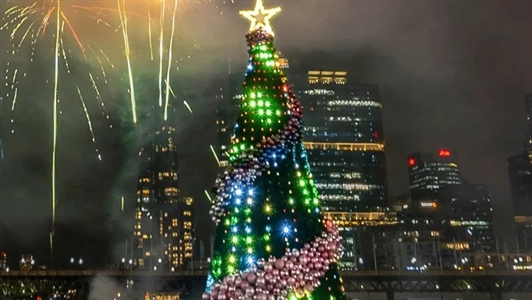
A Christmas Tree On The Water
The Floating Christmas Tree is unusual not simply because of its size, but because of where it stands. More than 10 metres tall, it rises from Cockle Bay rather than from solid ground. The surrounding water becomes part of the display, catching the colours of its decorations and the glow of its lights as evening settles over Darling Harbour.
During daylight, the tree has a different presence. Its baubles catch the sun, while the structure stands out against the movement of the bay. From the promenade, visitors can take in the full shape of the installation, with the surrounding architecture providing a distinctly urban backdrop.
As the day draws to a close, the scene changes. The lights become more noticeable against the darkening sky, and reflections begin to appear on the water. The harbour's surface is rarely still. Passing boats, small movements in the breeze and the shifting colours of the city all contribute to the view.
It is a seasonal display, but one that belongs to its location. The Floating Christmas Tree does not attempt to recreate a traditional Christmas setting. Its appeal comes from the contrast between a familiar symbol and the open, contemporary landscape of Darling Harbour.
That contrast is part of what makes it memorable. Christmas arrives in Sydney without snow-covered streets or winter evenings. Here, the festive season unfolds beside the water, with warm air, outdoor dining and the sound of the city continuing around it.
The Harbour Becomes Part Of The Display
Cockle Bay provides a natural setting for an installation of this kind. The enclosed stretch of water is surrounded by restaurants, public spaces and pedestrian walkways, creating several different ways to view the tree.
From the waterfront promenade, the installation can be seen across the bay. The wider perspective allows its height and position on the water to become clear, while the surrounding buildings give a sense of scale. Closer to the edge, the reflections and details of the decorations become more prominent.
The view also changes according to the time of day. In the afternoon, the tree sits within the ordinary movement of the harbour. People cross the bridges, stop for lunch or meet friends before heading elsewhere. There is no need to make a special occasion of the visit. It can be part of a walk through the city or a pause between other plans.
After sunset, the atmosphere becomes more distinctly festive. The lights stand out across the water, and the bay takes on the appearance of an outdoor stage. Yet the scene remains open and accessible. There are no walls or entrance gates separating visitors from the display. The harbour itself provides the setting.
This is one of Darling Harbour's strengths as a public space. It brings together dining, entertainment, recreation and everyday city life in a relatively compact area. During the Christmas period, the Floating Christmas Tree adds another point of interest without changing the character of the place entirely.
A Familiar Sydney Christmas Tradition
Sydney has no shortage of Christmas decorations during December. Streets, shopping centres, public buildings and neighbourhoods all take on their own seasonal character. Some displays are designed to be passed on the way to somewhere else, while others encourage people to stop and spend time in a particular place.
The Floating Christmas Tree occupies a position somewhere between the two. It is a recognisable Christmas symbol, but its location gives it a distinctly Sydney identity. The water, the surrounding cityscape and the open-air setting make it different from the trees found in traditional town squares or indoor public spaces.
Its return also gives the city a seasonal landmark that can be enjoyed over several weeks. Rather than being limited to a single lighting ceremony or one evening of entertainment, the installation remains at Cockle Bay throughout the period from 20 November to 26 December.
That longer display allows people to visit when it suits them. Families can include it in an afternoon outing, visitors can make a stop during a wider exploration of the city, and locals can return on a quieter evening to see how the harbour looks under a different sky.
For those who live in Sydney, there is something familiar about returning to the same waterfront as the year draws towards its end. The decorations change, the crowds become more noticeable and the city begins to move at a different pace. The Floating Christmas Tree becomes one of the markers of that transition.
Finding A Place Along Cockle Bay
One of the pleasures of seeing the tree is that there is no single viewpoint. Cockle Bay has a number of pedestrian areas from which the installation can be appreciated, and a short walk around the waterfront offers different perspectives.
The promenade is an obvious place to begin. From here, visitors can look across the water towards the tree and take in the broader setting. The surrounding restaurants and public spaces make it easy to combine a visit with a meal or a relaxed evening out.
The bridges and connecting walkways also offer changing angles across the bay. Moving through the area rather than staying in one spot reveals how the tree sits within the harbour. At some points it appears close to the surrounding buildings; from others, the water creates a wider separation between the installation and the city.
There is no need to rush. The display is part of a public waterfront, and the experience is as much about being beside the harbour as it is about seeing the tree itself. A few minutes spent watching the water can be as rewarding as taking a photograph.
Those visiting with children may find the scale and position of the tree particularly engaging. It is visible from a distance, easy to incorporate into a walk and free to enjoy. For visitors who are less familiar with Sydney, it also provides a chance to experience Darling Harbour at one of the city's liveliest times of year.
As with any busy public space during December, evenings and weekends can attract more people. Arriving earlier in the day offers a quieter view, while a visit after sunset reveals the full effect of the lighting.
More To See Around Darling Harbour
The Floating Christmas Tree is part of a broader Christmas season at Darling Harbour. The waterfront becomes a gathering place for a range of seasonal activities, with entertainment, family events and fireworks adding to the atmosphere over the weeks before Christmas.
The surrounding area offers plenty to explore before or after a visit to Cockle Bay. Tumbalong Park provides open green space close to the water, while Darling Quarter has places to eat and pedestrian areas that connect the precinct. The Australian National Maritime Museum is also nearby, offering a different perspective on Sydney's relationship with the harbour.
For those who prefer to make an evening of it, the restaurants around Cockle Bay provide an opportunity to settle in for dinner before taking a walk beside the water. Others may simply stop for a coffee or a casual meal and continue exploring.
The wider Christmas programme includes selected fireworks displays and other festive events. These take place on particular dates and are separate from the Floating Christmas Tree, which remains on display throughout its scheduled period. Visitors planning around a specific performance or fireworks evening should check the individual event details before travelling.
There is also a practical advantage to visiting Darling Harbour by public transport. The precinct is within walking distance of Town Hall and the city centre, with light rail, bus and ferry services providing connections from other parts of Sydney. The nearest transport option will depend on where the visit begins, but the area is well connected for those who would rather leave the car at home.
The Best Time To Visit
The Floating Christmas Tree can be viewed throughout the day, but the experience changes as the light fades. Daytime visits reveal the scale of the structure and the colour of its decorations. The bay is generally brighter, the surrounding buildings are more visible and the tree becomes part of the broader waterfront scene.
For the full effect of the lighting, an evening visit is the natural choice. As the sky darkens, the illuminated tree becomes a focal point across Cockle Bay. Its reflection adds another dimension, particularly when the water is relatively calm.
The period around sunset can be a good time to arrive. Visitors can see the installation in daylight before watching the lights become more prominent. It also provides an opportunity to explore the waterfront before the evening crowds gather.
There is no admission charge, and no fixed viewing session is required. The display is an outdoor installation, so conditions on the day can influence the experience. A little flexibility is useful, particularly during unsettled weather or on busy December evenings.
Photography is an obvious part of the appeal, but the best view is not necessarily the one captured on a phone. From the edge of the bay, the tree can be seen as part of a larger scene: the water in the foreground, the city rising behind it and the movement of people along the promenade.
It is worth taking a moment to look beyond the decorations.
A Different Kind Of Festive Evening
Christmas in Sydney is often experienced outdoors. The warmer weather encourages people to meet in parks, walk along the waterfront and spend more time in public spaces after work. Darling Harbour reflects that seasonal rhythm particularly well.
The Floating Christmas Tree gives the precinct a clear festive centre, but it does not demand that visitors follow a particular programme. People can arrive for a few minutes or stay for an entire evening. They can make it the main reason for a visit or discover it while walking through the area.
That informality is part of its appeal. There is no need for a grand occasion to enjoy the sight of a Christmas tree rising above the water. Its presence changes the familiar harbour, adding a little colour and light to a place that is already part of everyday Sydney life.
As December progresses, Cockle Bay becomes busier and the festive atmosphere spreads through the surrounding streets and public spaces. The tree remains in place as a steady point of reference amid the seasonal activity.
For a city that celebrates Christmas beneath a summer sky, it is an appropriately open-air tradition. The decorations shimmer in the afternoon sun, the lights take over after dark and the harbour provides a setting that is unmistakably local.
By the time the display finishes on 26 December, the city is already beginning to turn towards the quieter days between Christmas and the new year. Until then, the Floating Christmas Tree offers a reason to return to the water's edge, slow down for a while and see Darling Harbour in a different light.
Event Details
Event: Floating Christmas Tree
Dates: Friday 20 November to Saturday 26 December 2026
Location: Cockle Bay, Darling Harbour, Sydney NSW
Viewing times: All day, with the illuminated display best viewed after dark
Entry: Free
Official information: https://whatson.cityofsydney.nsw.gov.au/events/floating-christmas-tree
Visitors should check the official event page for any updates before setting out.