
Heilung returns to Sydney Opera House on 1 and 2 March 2027, bringing ancient-inspired music, hypnotic percussion and theatrical rituals to Sydney.
There are few places in Sydney where the contrast between ancient ideas and modern architecture feels quite as striking as the Sydney Opera House. Its white sails rise above Bennelong Point, overlooking a harbour that has carried stories, traditions and cultural exchanges for thousands of years.
In March 2027, that setting will welcome a performance that draws its inspiration from a very different part of human history.
European experimental music collective Heilung will return to Australia and New Zealand for a seven-date tour, including two performances at the Sydney Opera House on Monday 1 March and Tuesday 2 March 2027.
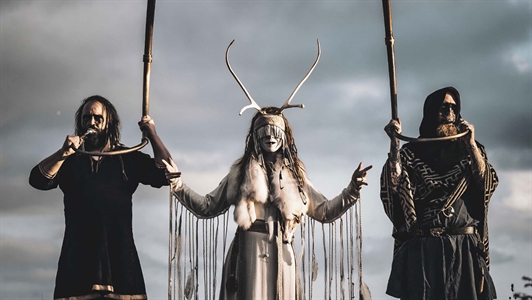
Known for describing their work as "amplified history", the group creates performances that combine music, theatre and ceremonial imagery. Ancient-inspired instruments, deep percussion, layered voices and elaborate costumes form a distinctive stage language that reaches beyond the conventions of a traditional concert.
The result is an exploration of sound, movement and the human fascination with the past.
For Sydney audiences, the two performances offer an opportunity to encounter a collective whose work occupies an unusual space between contemporary music and historical imagination.
Against the backdrop of one of Australia's most recognisable cultural landmarks, the experience will bring together two very different expressions of human creativity.
Heilung Brings Amplified History to Sydney
Heilung emerged in 2015, developing an approach to music that draws upon the sounds, languages and spiritual traditions of early European civilisations.
Rather than attempting to recreate a particular historical period with strict documentary accuracy, the collective uses surviving cultural fragments as the foundation for contemporary artistic interpretation.
Ancient texts, archaeological discoveries, traditional instruments and historical imagery provide material for compositions that feel both unfamiliar and strangely recognisable.
The group's description of its music as amplified history captures this relationship between research and imagination.
Percussion forms a central part of the sound. Deep, repeated rhythms establish a physical presence, while voices move between chanting, singing, spoken passages and throat singing.
The music often develops gradually, allowing individual sounds to gather into larger arrangements.
There is a deliberate emphasis on repetition, creating an atmosphere in which the listener becomes increasingly aware of rhythm and texture.
For audiences accustomed to conventional song structures, the experience offers a different way of engaging with live music.
Melody remains important, but so do silence, movement and the interaction between performers.
At the Sydney Opera House, these elements will unfold within a venue more commonly associated with opera, orchestral music, theatre and contemporary performance.
The contrast between Heilung's ancient-inspired imagery and the building's modern design provides an intriguing setting for the group's return.
The Sound of a Distant Past
Human beings have used rhythm, voice and movement to communicate long before the development of modern musical notation.
Across cultures, percussion has accompanied ceremonies, storytelling, communal gatherings and expressions of spiritual belief.
Heilung draws upon this broad relationship between sound and human experience.
The collective's compositions incorporate instruments and techniques inspired by early traditions, creating layered arrangements that move between quiet vocal passages and powerful rhythmic sequences.
Throat singing introduces an earthy, resonant quality, while chanting gives the music a communal character.
The effect is not simply historical.
These sounds are arranged through contemporary production and performance techniques, making the music a modern interpretation rather than a literal reconstruction of the past.
That distinction is important to understanding the group's work.
Heilung does not offer audiences a precise account of how ancient ceremonies sounded. Instead, it explores how fragments of historical knowledge can inspire new artistic expression.
The performances invite listeners to consider the enduring human relationship with rhythm, ritual and collective experience.
For some, the attraction lies in the unusual instrumentation. Others are drawn to the theatrical presentation or the sense of immersion created by the music.
Together, these elements form an artistic language that resists easy classification.
Heilung and the Art of Live Ritual
Heilung refers to its live performances as rituals, a description that reflects the careful integration of music, costume, movement and ceremonial structure.
Each performance begins with an ancient prayer led by founding member Kai Uwe Faust.
The opening establishes a deliberate separation from the ordinary atmosphere of a concert, inviting the audience to enter the artistic world created on stage.
Faust performs alongside vocalist Maria Franz and producer Christopher Juul, whose combined work forms the foundation of the collective.
An ensemble of performers adds further dimensions through movement, percussion and visual presentation.
Costumes draw upon historical and natural imagery, while incense and atmospheric lighting contribute to the sensory environment.
The stage becomes a place where individual performers operate as part of a larger composition.
Movement is closely connected to sound. Rhythmic gestures accompany percussion, while vocal passages develop within carefully arranged theatrical scenes.
Although the imagery suggests distant historical periods, the performance remains a contemporary artistic creation.
Its purpose is less about transporting an audience to one specific time than exploring the ideas and emotions associated with humanity's cultural beginnings.
This approach gives the music a distinctive theatrical quality.
The audience witnesses a performance in which sound and visual storytelling are inseparable.
A Philosophy of Cultural Connection
Beneath Heilung's elaborate stage presentation lies an interest in the ways cultures influence one another across time and geography.
The collective draws inspiration from historical traditions while acknowledging the broader human exchanges that shape cultural development.
Kai Uwe Faust has described this philosophy as an attempt to reconnect with the beginnings of human expression.
"With singing these primordial songs we want to give tribute to these cultures, reconnect to the beginnings and remember that we all, from East to West, from past to present, are connected through the exchange of ideas and inspiring each other."
The statement offers a useful perspective on the group's work.
Although Heilung's visual language is strongly associated with ancient northern Europe, its underlying themes concern experiences that extend beyond any single region.
Rhythm, storytelling, ceremony and communal gathering appear in different forms throughout human history.
The collective uses these shared characteristics as a starting point for artistic exploration.
At the same time, the music raises interesting questions about how contemporary audiences encounter the distant past.
Historical knowledge is often incomplete. Surviving objects, inscriptions and written accounts reveal fragments of earlier lives, but many details remain uncertain.
Art provides one way of responding to those gaps.
Rather than presenting definitive answers, Heilung creates an imaginative space in which historical influences can be reconsidered through sound and performance.
Heilung at Sydney Opera House: A Meeting of Different Worlds
The Sydney Opera House provides a particularly interesting setting for Heilung's two March performances.
Completed in 1973, the building represents one of the defining achievements of twentieth-century architecture.
Its sculptural roof forms have become inseparable from Sydney's identity, while its performance spaces host artistic traditions from across Australia and the world.
For Heilung, the venue offers a meeting point between contemporary cultural infrastructure and artistic ideas inspired by early human societies.
The contrast is striking.
Inside a building shaped by modern engineering and architectural experimentation, audiences will encounter music that draws upon ancient texts, ceremonial rhythms and historical imagery.
Yet the two worlds are not entirely separate.
Both the building and the performance reflect the human desire to create shared spaces for artistic expression.
The Opera House has long provided a setting for works that challenge expectations about music, theatre and performance.
Heilung's approach fits within that broader tradition of experimentation.
The March concerts also provide an opportunity for Sydney audiences to experience the collective in a setting closely associated with cultural significance rather than the conventional touring circuit.
For visitors, the surrounding harbour adds another dimension.
Arriving at Bennelong Point as evening approaches, with ferries crossing the water and the city skyline beginning to illuminate, creates a memorable transition into the performance.
From Ancient Soundscapes to Modern Storytelling
Heilung's creative work extends beyond live performance and studio recordings.
The collective has collaborated with video game developer Ninja Theory on Senua's Saga: Hellblade II, contributing music to a fictional world shaped by Norse-inspired mythology and psychological storytelling.
The collaboration demonstrates how the group's distinctive sound can operate within another artistic medium.
Video games increasingly use music as an essential part of their storytelling, creating emotional and atmospheric environments that respond to the experiences of players.
Heilung's layered percussion, vocal textures and ceremonial qualities are particularly suited to this form of immersive sound design.
The collaboration has also led to Sagas, a collection of recordings created for and inspired by the game.
The release includes previously unheard material and provides another perspective on the collective's musical approach.
While live performances depend on the interaction between performers and audiences, music created for a game becomes part of a wider narrative environment.
Both forms share an interest in atmosphere and emotional response.
The connection illustrates how historical inspiration can move between contemporary artistic disciplines, from recorded music and theatre to interactive storytelling.
A New Chapter for Heilung
The Australian and New Zealand tour arrives during an important period in Heilung's creative development.
Following a hiatus, the collective is scheduled to return to the studio in late 2026 to begin work on its fourth studio album.
The forthcoming recording represents another stage in a musical journey that has developed considerably since the group's emergence in 2015.
Across its releases, Heilung has continued to refine its combination of historical inspiration, experimental sound and theatrical presentation.
The group's audience has also expanded internationally, bringing its unusual approach to venues and festivals across different countries.
The March 2027 tour reflects that growing reach.
Alongside the two Sydney performances, the collective will visit Melbourne, Brisbane, Adelaide, Perth and Auckland.
German-American singer-songwriter Lilith Max will join the tour for performances outside Sydney, bringing her own interest in folklore, mythology and fantasy.
She is not scheduled to appear at either Sydney Opera House performance.
For Sydney audiences, the focus will remain on Heilung's distinctive live presentation and the continuing evolution of its musical world.
Experiencing the Harbour Before the Performance
For those attending the Sydney concerts, the location offers opportunities to make the evening part of a broader visit to the city.
The Sydney Opera House sits at Bennelong Point, within walking distance of Circular Quay.
Trains, ferries and light rail provide connections to the precinct, making public transport a practical option for visitors travelling from across metropolitan Sydney.
The surrounding area includes restaurants, cafes and waterfront walkways, with views towards the Harbour Bridge and the northern shoreline.
An early arrival allows time to explore the harbour before entering the venue.
The changing light across Circular Quay provides a quieter counterpoint to the intensity of the performance to come.
As the sun lowers, the harbour's colours shift and the movement of ferries continues against the city skyline.
These familiar Sydney scenes form part of the experience of attending an event at the Opera House.
They also create a contrast with the ancient-inspired artistic world waiting inside.
Where the Past Meets the Present
When the final sounds fade, the audience will return to a very different environment from the one created on stage.
Outside, Sydney Harbour continues its familiar evening rhythm.
Ferries move across the water, city lights reflect beneath the Harbour Bridge, and the Opera House stands against the night sky.
The contrast between these surroundings and Heilung's ceremonial performance may be one of the evening's most lasting impressions.
The collective's music invites audiences to consider forms of human expression that existed long before modern cities, recording technology or contemporary performance venues.
Yet its work is unmistakably part of the present, shaped by modern artistic choices and the continuing exchange of cultural ideas.
That relationship between past and present gives Heilung its particular character.
The performances do not attempt to recover a lost world exactly as it was.
Instead, they explore what fragments of history can mean to people living now.
For two nights in March 2027, the Sydney Opera House will become the setting for that exploration, bringing ancient-inspired rhythms and contemporary theatrical imagination together beside one of the world's most recognisable harbours.
Heilung Sydney 2027: Event Details
Event: Heilung Australia and New Zealand Tour 2027
Artist: Heilung
Sydney Dates:
- Monday 1 March 2027
- Tuesday 2 March 2027
Venue: Sydney Opera House
Location: Bennelong Point, Sydney NSW 2000
Performance Times: To be confirmed through the official event and ticketing information.
Sydney Presale: Wednesday 21 October 2026, 12pm AEDT
General Tickets On Sale: Friday 23 October 2026, 9am AEDT
Ticket Prices: Check the official ticketing website for current prices and seating categories.
Special Guest: Lilith Max will not appear at the Sydney performances.
Getting There: Circular Quay train, ferry and light rail connections, followed by a short walk to the Sydney Opera House.
Official Tour Website: Heilung Australia and New Zealand Tour 2027 – Destroy All Lines