
Mozart's Requiem fills Sydney Town Hall with candlelight on 8 November 2026, honouring Australia's military nurses through music and remembrance.
Sydney Town Hall has witnessed generations of public gatherings, civic ceremonies and musical performances. Its grand interiors have long provided a setting for occasions that bring the city together, but on Sunday, 8 November 2026, the historic building takes on a particularly reflective role. As candlelight illuminates the hall and the first notes of Mozart's final composition begin to rise, the evening turns towards remembrance.
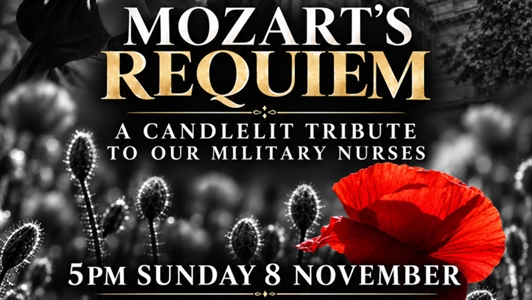
Mozart's Requiem: A Candlelit Tribute to Military Nurses brings an 80-strong choir and orchestra together with distinguished soloists for a commemorative concert marking Remembrance Sunday. The performance honours Australia's fallen, returned and serving military nurses, including the 110 nurses who lost their lives while serving the nation.
There is something fitting about bringing this music into the heart of Sydney. Outside, George Street continues its familiar Sunday rhythm, with light rail moving through the city and people making their way between shops, restaurants and railway stations. Inside, the atmosphere shifts towards stillness, inviting an audience to consider lives shaped by service, sacrifice and care.
The concert falls three days before Remembrance Day, giving Sydney audiences an opportunity to reflect on a part of Australia's military history that has not always received the same public attention as those who served on the battlefield.
Mozart's Requiem and the Weight of Remembrance
Few works in the classical repertoire carry the emotional complexity of Mozart's Requiem. Written during the final months of Wolfgang Amadeus Mozart's life in 1791, the composition has become closely associated with mourning, mortality and the search for peace.
Mozart died before completing the work, leaving behind a musical legacy that others would help bring to its finished form. His pupil Franz Xaver Süssmayr played a significant role in completing the version most commonly performed today.
That unfinished history lends the composition a particular poignancy. The Requiem moves between moments of overwhelming intensity and passages of extraordinary tenderness, giving musical expression to emotions that can be difficult to articulate.
Its opening unfolds with a sombre gravity. The choir enters against the orchestra's measured accompaniment, establishing an atmosphere that feels both intimate and monumental. Later movements introduce urgency, sorrow and consolation, carrying listeners through a sequence of changing emotional landscapes.
The familiar Lacrimosa, with its rising choral phrases and sense of grief, remains among the most recognisable passages in sacred classical music.
In the setting of Sydney Town Hall, these musical contrasts take on an additional significance. The work becomes more than a reflection on death. It offers a space in which remembrance can be shared, allowing individual histories to form part of a collective experience.
For an audience gathered to honour military nurses, that sense of shared memory sits at the centre of the evening.
The Nurses Behind Australia's Military History
Australia's military nursing history reaches back through generations of conflict, humanitarian service and medical innovation. From the South African War to the First and Second World Wars, and through later deployments overseas, Australian nurses have worked in circumstances that demanded considerable physical endurance and emotional resilience.
Their responsibilities extended far beyond the familiar image of a nurse tending a wounded soldier beside a hospital bed.
Military nurses worked in field hospitals, casualty clearing stations, hospital ships and medical facilities close to active conflict. They cared for patients suffering from severe injuries, infectious diseases, exhaustion and psychological trauma, often with limited resources and under extraordinary pressure.
During the First World War, members of the Australian Army Nursing Service served in places including Egypt, France, Belgium and Greece. Their experiences exposed them to the enormous human consequences of industrial warfare.
In the Second World War, Australian nurses again found themselves working across distant and dangerous locations, including the Middle East, Southeast Asia and the Pacific.
Some became prisoners of war. Others died during attacks, while travelling aboard hospital ships or while carrying out their duties in hostile environments.
The 1942 sinking of the SS Vyner Brooke and the subsequent massacre of Australian nurses on Bangka Island remain among the most devastating episodes in Australia's wartime nursing history.
Yet the broader story is also one of survival, professional dedication and the relationships formed between nurses and those they cared for.
The concert acknowledges that history while extending its tribute to returned and currently serving military nurses, whose contributions continue through modern defence and medical operations.
A Candlelit Evening Inside Sydney Town Hall
Completed in stages during the nineteenth century, Sydney Town Hall remains one of the city's most recognisable civic landmarks. Its sandstone exterior, elaborate architectural detailing and central location give it a distinctive presence along George Street.
Inside, the building reveals another side of its character.
Centennial Hall, the Town Hall's principal ceremonial and concert space, is known for its high ceilings, decorative finishes and monumental Grand Organ. The hall has hosted orchestral concerts, civic receptions, public meetings and major cultural occasions for more than a century.
The building's scale gives performances a sense of occasion without removing the audience from the human experience of the music.
For Mozart's Requiem, the planned candlelit presentation introduces a quieter visual language. Against the hall's historic surroundings, the warm glow of candlelight offers a contrast to the movement and brightness of the surrounding city.
Rather than relying on elaborate staging, the evening draws its atmosphere from the relationship between architecture, light and sound.
The setting also carries its own history of public remembrance. Sydney Town Hall has long been a gathering place for the city's shared milestones, making it an appropriate location for a concert that connects personal loss with national memory.
As the audience settles into the hall for the 5pm performance, the familiar sounds of central Sydney give way to the anticipation of live music.
The Human Voice at the Centre of Mozart's Requiem
At the heart of the November concert is the combined sound of an 80-strong choir and orchestra, joined by soloists.
Mozart's writing gives each of these musical forces an essential role.
The orchestra establishes the work's shifting emotional character, moving from restrained accompaniment to passages of considerable dramatic power. The choir gives voice to the Requiem's Latin text, while the soloists introduce moments of individual expression within the larger composition.
This balance between collective and individual voices feels particularly appropriate for a commemorative occasion.
Military remembrance often considers service through the scale of national history, recording campaigns, casualties, deployments and dates. Yet behind those accounts are individual lives, each with its own relationships, responsibilities and experiences.
The Requiem's musical structure allows both perspectives to coexist.
Its larger choral passages suggest the weight of shared grief, while quieter moments invite a more personal response. The music does not prescribe a single emotion, leaving room for sorrow, gratitude, reflection and hope.
Listeners do not need extensive knowledge of classical music to follow that progression. Much of the composition's impact comes from the natural expression of the human voice, supported by the changing colours of the orchestra.
For those attending with a personal connection to military service or nursing, the performance may carry particular meaning. For others, it offers an opportunity to encounter a history that is often remembered through official ceremonies rather than artistic expression.
Remembrance Sunday and a Tradition of Reflection
Remembrance Sunday has its origins in the commemorative traditions that followed the First World War. Observed on the second Sunday in November in countries including Britain, it provides an occasion to remember those affected by military conflict.
In Australia, Remembrance Day on 11 November remains the principal national observance, marking the armistice that ended fighting on the Western Front in 1918.
The Sydney concert takes place on Sunday, 8 November 2026, positioning it within this wider period of remembrance.
The timing encourages a different form of participation from the traditional minute's silence, wreath-laying ceremony or formal service.
Music allows remembrance to unfold over time.
Rather than asking an audience to focus on a single symbolic moment, a concert creates space for reflection to develop gradually. A passage of music may bring one memory to mind, while another invites consideration of experiences beyond one's own.
The tribute to military nurses also broadens the familiar narratives surrounding wartime service.
Nursing required courage of a different but equally significant kind, involving the responsibility of preserving life in circumstances defined by injury, uncertainty and loss.
Recognising that work is an important part of understanding Australia's military past.
The evening's emphasis on nurses who died in service acknowledges the ultimate consequences of that commitment, while its recognition of returned and serving nurses connects historical remembrance with the present.
The Stories That Remain Beyond the Battlefield
One of the challenges of remembering military nursing is that much of its work occurred away from public view.
Nurses were often present during the most vulnerable moments of a patient's experience, providing medical treatment, reassurance and companionship when familiar surroundings had disappeared.
Their stories survive through letters, diaries, photographs, service records and the memories of families.
These records reveal the ordinary details that existed alongside extraordinary circumstances: long shifts, makeshift wards, unfamiliar climates, homesickness and the friendships that developed between colleagues.
They also show how nursing service could continue to shape lives long after a conflict ended.
Returned nurses brought their experience into civilian hospitals, communities and families, sometimes carrying memories that were difficult to communicate to those who had not witnessed war.
The legacy of military nursing therefore extends beyond the battlefield or the hospital ward. It forms part of Australia's broader medical, social and cultural history.
A commemorative concert cannot tell every individual story, nor does it attempt to replace the historical record.
What it can offer is a setting in which those experiences are acknowledged without reducing them to statistics.
Through music, the audience is invited to consider the people behind the uniform, the work they performed and the lives touched by their care.
Planning an Evening in Central Sydney
Sydney Town Hall's position in the CBD makes the concert accessible from across metropolitan Sydney.
Town Hall Station sits immediately nearby, connecting the area with Sydney's suburban rail network. Light rail services along George Street also provide convenient access, while surrounding streets offer numerous options for a meal or coffee before the performance.
For visitors travelling into the city, the surrounding neighbourhood offers a familiar combination of historic architecture and contemporary Sydney life.
The Queen Victoria Building stands just across George Street, while Hyde Park, Pitt Street Mall and the city's southern entertainment precincts are within walking distance.
Arriving a little early allows time to appreciate the Town Hall's exterior and the surrounding streets before entering the venue.
As the performance begins at 5pm, the concert also fits naturally into a Sunday afternoon visit to the city.
The duration, ticketing arrangements and any specific entry requirements should be confirmed through the official event information before attending.
Event Details: Mozart's Requiem in Sydney
Date: Sunday, 8 November 2026
Time: 5:00pm AEDT
Venue: Sydney Town Hall, 483 George Street, Sydney NSW 2000
Event: Mozart's Requiem: A Candlelit Tribute to Military Nurses
Official Link: Not supplied in the event information. Confirm booking details with the organiser or Sydney Town Hall.
When the Music Gives Way to Silence
There is a particular quality to the silence that follows a substantial piece of music. It is not quite the same as the quiet before a performance begins. Something has been shared, even among people who arrived as strangers.
For Sydney's Remembrance Sunday concert, that silence may carry as much significance as the music itself.
Mozart's Requiem provides the musical framework, but the evening's deeper purpose lies in remembering the Australian military nurses whose work was often performed in difficult circumstances, far from home and without expectation of recognition.
Beyond the Town Hall doors, the city continues its ordinary Sunday evening. Trams pass along George Street, restaurant lights come on and people make their way home.
Inside, the final notes leave room for something less easily expressed: an acknowledgement of service, of lives lost and of the enduring importance of those who cared for others when care was needed most.