
Nepali Culture Connection: Dashain brings Nepalese food, music, storytelling and traditions to Hurstville Library in a free community celebration.
On a spring morning in Hurstville, the scent of freshly brewed chai and the sound of conversation offer an invitation to discover Nepal through its traditions. At a library, a place more often associated with quiet reading and study, stories, music, craft and food create a different kind of meeting ground.
The free Nepali Culture Connection: Dashain event took place at Hurstville Library on Saturday 17 October 2026, bringing the traditions of Nepal's most significant cultural festival into the heart of Sydney's south. Across the day, visitors encountered hands-on craft activities, storytelling, live performances, a digital exhibition and tastings of Nepali food and chai. The programme welcomed people of all ages, whether they were part of the local Nepali community or simply curious about a culture they wanted to understand better.
The timing gave the gathering particular meaning. Dashain is a major annual festival in Nepal, a period associated with family reunions, blessings, shared meals and the renewal of relationships. For Nepali Australians, it can also be a way to maintain connections with family, faith and home while building a life elsewhere.
At Hurstville Library, these traditions became accessible through everyday experiences: listening to a story, watching a dance, learning about a festival or tasting a cup of chai. Rather than presenting culture as something distant or fixed, Nepali Culture Connection: Dashain created space for it to be shared, discussed and experienced in a local setting.
Nepali Culture Connection: Dashain And The Meaning Of The Festival
Dashain unfolds over several days, with customs and observances varying between families, regions and communities. It is widely associated with the triumph of good over evil and with the worship of the goddess Durga. Yet its significance reaches beyond religious observance. For many people, Dashain is also a time to travel home, reconnect with relatives, honour elders and spend time with the people who matter most.
Family gatherings are central to the festival. Blessings, gifts and shared food help mark the occasion, while the exchange of tika and jamara carries particular significance in many households. Tika, commonly a mixture of coloured substances applied to the forehead, is given as a blessing. Jamara, young shoots grown from barley or other grains, is also used in traditional observances. Customs differ, and not every Nepali family celebrates in the same way.
The festival's rhythms can be especially meaningful for people living far from their place of birth. Work, school and the distance between countries can make family traditions harder to maintain. Community celebrations offer another way to participate, creating opportunities for younger generations to learn about customs and for neighbours to understand what the season means to their friends and colleagues.
The Hurstville event took place during Dashain and included a storytelling session about the festival led by spiritual leader Acharya Rajan Sharma, also known as Bhimsen Sapkota. Tika was available later in the morning, offering visitors a chance to encounter a tradition through direct participation rather than description alone.
For those unfamiliar with Dashain, these experiences provided an entry point into a festival whose meaning is built through family life, faith, memory and community. For those who already knew it well, the event offered a shared space in which familiar customs could be celebrated in Sydney.
A Taste Of Nepal In Sydney's South
Food often carries cultural memory in a particularly immediate way. A recipe can preserve the habits of a household, recall a grandparent's kitchen or bring people together across generations. At a community event, tasting something unfamiliar can become the beginning of a conversation.
At Nepali Culture Connection: Dashain, food tastings and chai demonstrations ran from 11am to 2pm. Visitors could sample Nepali dishes and learn about the preparation of traditional chai, a drink whose warmth and aroma are familiar across much of South Asia but whose ingredients and methods vary from household to household.
Nepali food reflects the country's varied geography and cultural influences. Everyday meals may include rice, lentils, vegetables, pickles and seasonal ingredients, with regional traditions shaping flavours and preparation. Momos, the dumplings widely associated with Nepal, are familiar to many Australians, but they represent only a small part of a much broader food culture.
Dashain itself is often marked by substantial family meals. Relatives gather around the table, dishes are prepared in quantities that allow for sharing, and cooking becomes part of the work of welcoming people home. The food is not separate from the festival's social life. It is one of the ways that care and belonging are expressed.
A tasting at a library cannot reproduce the intimacy of a family kitchen, nor does it need to. Its value lies in creating an opening: a flavour prompts a question, a demonstration reveals a technique, and a brief exchange makes a tradition feel less remote. Such moments allow cultural understanding to develop through the senses as well as through words.
Chai offers a similar point of connection. Served across different regions and communities in many forms, it is often associated with hospitality and conversation. Sharing a cup encourages people to pause, sit together and talk. In a busy public programme, that simple act can be as important as the formal performances.
Music, Dance And The Stories Passed Between Generations
Live performance brings another dimension to cultural celebration. Music and dance communicate through rhythm, gesture and shared attention, offering ways to encounter traditions even when language is unfamiliar.
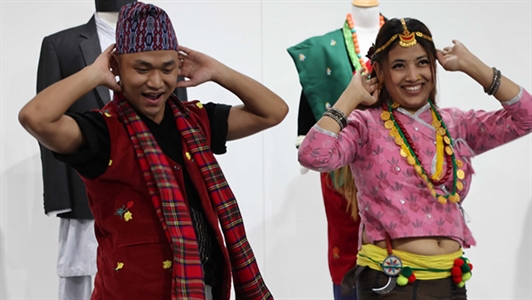
The Hurstville programme included a performance by Laligurans Dance Group in the morning, a bansuri performance by musician Sabin Ghising, and later appearances by students from Shabdamala Nepalese Language School and the folk-song performers of Nepalese Grandparents Australia. Their scheduled performances connected different generations and forms of cultural expression across the day.
The bansuri, a bamboo flute used in South Asian musical traditions, has a sound that can feel both clear and meditative. In a community programme, instrumental music gives an audience time to listen closely, noticing phrasing, breath and the way a melody develops. Dance offers a different kind of storytelling, using movement, costume and rhythm to carry meaning.
The presence of language-school students and older community performers was also significant. Cultural traditions are rarely passed down through a single formal lesson. They are sustained through repetition and participation: children hearing songs at home, learning the language, watching adults prepare for festivals and gradually becoming performers and organisers themselves.
For younger Australians of Nepali heritage, opportunities to take part in public cultural events can help connect identity with lived experience. Heritage is not simply something inherited from the past. It changes as people move between languages, countries and generations, and as families decide which customs to preserve and how to adapt them.
For older participants, sharing a song or story can be an act of continuity. It makes knowledge visible to people who might otherwise encounter it only through family conversations or online media. The event's programme brought these different roles into the same public space, allowing culture to be experienced as something actively practised.
A Library Becomes A Meeting Place
Libraries have long offered more than shelves of books. They provide accessible places to learn, gather and take part in community life, often without the cost or formality associated with larger cultural venues.
Hurstville Library's setting suited an event designed to encourage discovery. Situated at the corner of Queens Road and Dora Street, it is part of a busy urban centre where people arrive for many different reasons. On a cultural programme day, the library becomes a meeting place for residents, families, children and visitors who might not otherwise find themselves in the same room.
The activities were designed to offer several ways to participate. Kite-making and card-making crafts ran throughout the day, alongside a digital display of Woven From A Hundred Flowers, a Nepali exhibition from Hurstville Museum and Gallery. The exhibition provided another route into the stories and creative heritage of Nepal, complementing the practical workshops and live programme.
Craft activities can make cultural learning tangible. A visitor who makes a card or works on a kite leaves with something created by hand, along with a memory of the activity. For children, that process can make an unfamiliar cultural subject easier to approach. For adults, it offers an opportunity to learn alongside younger family members rather than simply observing from the sidelines.
The digital exhibition, meanwhile, provided a way to explore cultural material at an individual pace. Visitors could move between the exhibition and the live programme, deciding whether to listen, watch, ask questions or take part in a workshop. The range of formats acknowledged that people learn differently and that a community celebration works best when it leaves room for curiosity.
The event was supported in part by funding from the Australian Library and Information Association's Libraries as Social Cohesion Hubs initiative. That support reflects a wider understanding of libraries as places where people can encounter one another's experiences and build connections through shared activities.
Nepali Culture Connection: Dashain And A Changing Community
Sydney's cultural identity is shaped by migration, with communities maintaining connections to places of origin while contributing to the life of their adopted home. The Nepali community is part of this changing story, bringing languages, food, religious traditions, music and family customs into neighbourhoods across the city.
For people who have migrated to Australia, a festival such as Dashain can hold several meanings at once. It may be a religious observance, a family reunion, a reminder of childhood or a way to introduce Australian-born children to the traditions of their parents and grandparents. Those meanings can shift from one household to another, but the desire to maintain a sense of connection often remains.
Public events create room for these personal experiences to become part of a wider community conversation. Someone who celebrates Dashain each year can share what the festival means to them, while a first-time visitor can ask questions and learn without needing prior knowledge. The exchange works in both directions: a community shares its traditions, and the broader public gains a more textured understanding of the people who live nearby.
Georges River Council Mayor Elise Borg described the event as an opportunity to recognise the area's cultural diversity and the traditions that help make the community welcoming. The council's announcement emphasised that Nepali Culture Connection was open both to members of the Nepali community and to anyone interested in learning about Nepal.
The importance of such gatherings is often found in small interactions rather than grand gestures. A child learns the meaning of a festival from a story. A visitor hears a folk song for the first time. Someone tastes a dish and asks how it is prepared. These moments do not erase cultural differences, but they can make those differences easier to approach with interest and respect.
The event also demonstrates how local cultural programmes can connect institutions that serve different purposes. Libraries, museums, community groups, language schools and performers each contribute something distinct. Together, they create opportunities for cultural knowledge to move beyond the home and into public life.
Exploring Nepali Culture Connection: Dashain In Hurstville
Although the 2026 event has now passed, its programme offers a useful picture of how cultural celebrations can be shared in a local setting. The day brought together storytelling, craft, music, exhibition material and food, with a schedule that allowed visitors to move between activities rather than follow a single performance from beginning to end.
For families, the combination of hands-on activities and live events offered different ways to spend time together. For people seeking a deeper understanding of Dashain, the storytelling session and opportunity to receive tika provided cultural context. The performances introduced musical and dance traditions, while the food and chai demonstrations offered a more sensory point of entry.
The event was free and open to all ages. Bookings were encouraged but not required, although registration helped secure a place. Georges River Libraries also advised that parents or guardians of children aged 12 and under needed to remain in the library throughout the programme.
For future cultural events at Hurstville Library, the Georges River Council What’s On page remains the best place to check schedules, access information and registration details. Programmes and times may vary from one event to another, so visitors should confirm details before attending.
Event Details
Event: Nepali Culture Connection: Dashain
Date: Saturday 17 October 2026
Time: 10am to 4pm
Location: Hurstville Library, corner of Queens Road and Dora Street, Hurstville, NSW
Cost: Free
Ages: All ages
Bookings: Encouraged, but not required for the 2026 event
Official information: Georges River Council – Nepali Culture Connection: Dashain
The Traditions That Travel With Us
A cultural celebration does not need to recreate a distant homeland to make its traditions meaningful. In Hurstville, Nepali Culture Connection: Dashain brought elements of a major festival into a familiar public space, where stories could be heard, music shared and food tasted by people from different backgrounds.
The event's value lay in this act of sharing. Dashain may be celebrated most intimately among family and friends, but its themes of connection, blessing and renewal can be understood more widely. Through the simple invitation to listen, make something, watch a performance or share chai, a private tradition becomes an opportunity for public understanding.
As Sydney continues to grow and change, these local gatherings help make cultural diversity more than a description of the city's population. They allow people to encounter the living practices behind it, shaped by memory and faith but also by the realities of contemporary Australian life.
At the end of a day like this, what stays with a visitor may be a melody, a new flavour, a handmade card or a conversation that began with a question. Such details are modest, but they are often how familiarity begins. A library becomes a meeting place, a festival becomes a story shared, and the traditions people carry with them find room to take root in another home.