
Powerhouse Parramatta opens on 7 November 2026 with 23 days of exhibitions, music, food and culture, bringing a new creative landmark to Western Sydney.
The Parramatta River moves quietly through a city that rarely stands still. Along its banks, apartment towers rise above older streets, commuters cross between offices and cafes, and the sound of construction has become part of the everyday rhythm of Western Sydney's changing centre. On Saturday, 7 November 2026, a new chapter begins as Powerhouse Parramatta opens its doors to the public.
The opening marks a significant moment for a city whose cultural identity has long extended beyond the traditional boundaries of Sydney's CBD. Set beside the river on Dharug Country, the new museum brings together science, design, technology, art and community stories within a building designed to become part of Parramatta's everyday life.
Its arrival is accompanied by a 23-day Opening Festival, running from 7 to 29 November 2026. Across three weeks and four weekends, the program presents 179 events, including exhibitions, performances, workshops, conversations, film screenings and food experiences.
There is a sense of scale to the occasion, but the more interesting story lies in what it means for the surrounding city. Parramatta has always been a meeting place, shaped by its waterways, First Nations heritage, migration and generations of working life. The new museum enters that landscape not simply as another attraction, but as a place where those histories meet contemporary ideas.
Powerhouse Parramatta Opens a New Chapter
For decades, major cultural institutions in Sydney have largely been associated with the harbour and the inner city. The opening of Powerhouse Parramatta represents a deliberate shift in that geography.
The museum is Western Sydney's first state cultural institution of its kind, forming part of a wider investment in the region's cultural infrastructure. The $915 million project includes the new museum, collection storage facilities at Castle Hill and work to preserve and digitise significant collection objects.
Designed by Franco-Japanese architecture practice Moreau Kusunoki in collaboration with Australian firm Genton, the building makes a distinctive addition to the Parramatta skyline. Its exposed structural framework and generous interior spaces reflect an approach to museum architecture that emphasises flexibility, openness and large-scale public gathering.
The location is equally important.
Positioned close to the Parramatta River, the museum occupies a site connected to the longer history of Burramattagal and Dharug people. The surrounding waterways remain central to understanding the region's identity, well before the establishment of colonial Parramatta and its later development into a major commercial centre.
The new institution opens within this layered setting, bringing contemporary cultural activity into conversation with the landscape around it.
For local residents, its presence also changes the possibilities of an ordinary weekend. A major exhibition, public discussion or evening performance no longer necessarily requires a journey into central Sydney.
A Museum Shaped by the City Around It
Parramatta is often described through the language of growth, but its character is better understood at street level.
Around Church Street, restaurants reflect the city's diverse communities. Small businesses sit alongside major commercial developments, while historic buildings remain visible between newer towers. The railway station carries a steady movement of people arriving from suburbs across Western Sydney.
The river provides a quieter counterpoint.
Walking beside the water reveals another rhythm, one shaped by changing light, passing cyclists and the movement of people between the city centre and its surrounding neighbourhoods.
The museum's opening adds a new destination to this familiar landscape.
Its program has been developed in collaboration with Western Sydney communities, reflecting the region's cultural diversity and its connections to international ideas. That relationship matters in a city where creativity has long existed through local music, food, design, performance and community organisations.
Rather than presenting Western Sydney as a place waiting for cultural development, the opening acknowledges the creative life already established here.
The festival brings that work into a larger public setting, placing local voices alongside international artists, designers and thinkers.
Five Exhibitions at the Heart of Powerhouse Parramatta
The museum opens with five major exhibitions, drawing on more than 3,000 objects, including over 1,600 from the Powerhouse Collection.
Together, they explore subjects ranging from humanity's relationship with space to the design of everyday environments.
Task Eternal examines aviation, space exploration and the human ambition to move beyond Earth. Its subject connects technological achievement with the more personal questions surrounding exploration, uncertainty and the limits of human experience.
The Mall turns towards a familiar part of contemporary life. Developed with architectural practice OMA, the exhibition considers the history and cultural significance of shopping centres, exploring how these spaces influence the way people gather, move and interact.
It is a particularly relevant subject for Western Sydney, where shopping centres have often functioned as social meeting places as well as commercial environments.
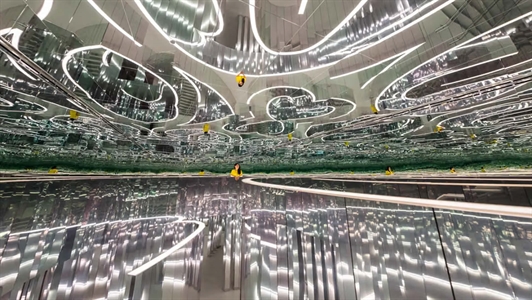
The remaining opening exhibitions, Overflow, The Dark and Es Devlin: The Turning, extend the museum's exploration of contemporary art, design and ideas.
The range of subjects suggests an institution interested in the connections between different disciplines rather than treating science, technology and culture as separate worlds.
Visitors may arrive with an interest in engineering and find themselves considering architecture, or enter through contemporary art and encounter questions about human behaviour.
That freedom to move between subjects forms part of the museum's wider purpose.
Twenty-Three Days of Culture and Conversation
The Opening Festival gives the new building an immediate public life.
From 7 to 29 November, its spaces host a changing program of talks, music, workshops, screenings, performances and food events. Around 65 per cent of the announced program is free, while exhibition entry is free for visitors under 16.
The opening weekend on 7 and 8 November introduces audiences to the museum through conversations about its architecture, exhibitions and broader cultural ambitions.
A discussion titled Making Powerhouse Parramatta brings together people involved in designing and constructing the building. Other talks examine the future of museums, the role of shopping centres in contemporary cities and the possibilities of space exploration.
The festival also extends beyond traditional museum subjects.
Food demonstrations and conversations bring culinary knowledge into the program, including appearances by Maggie Beer, Stephanie Alexander, Aunty Beryl Van-Oploo and Sharon Winsor.
Music and performance provide another layer, with events ranging from local and international contemporary sounds to cultural performances and community celebrations.
Later in November, the program includes discussions about artificial intelligence, design and storytelling, alongside film screenings and workshops for younger audiences.
The variety allows visitors to experience the museum in different ways. Some may spend an afternoon exploring exhibitions, while others arrive for an evening performance or a conversation about an unfamiliar subject.
The Place of Food in Western Sydney's Cultural Life
Food has long been one of the most immediate ways to understand Parramatta.
Across the surrounding streets, the city's restaurants and cafes reflect communities with connections to South Asia, the Middle East, East Asia and many other parts of the world.
Meals are part of the city's social fabric, whether shared around a family table, collected during a working lunch or enjoyed during a long weekend gathering.
The Opening Festival recognises this connection by including food within its cultural program.
Conversations with cooks, producers and culinary figures explore the relationships between ingredients, memory, migration and identity. Demonstrations introduce techniques and traditions, while communal dining events bring people together through shared meals.
These experiences sit naturally alongside exhibitions about design and technology.
Cooking involves inherited knowledge, practical innovation and the movement of ideas between generations. It is both an everyday activity and a form of cultural expression.
For visitors travelling to Parramatta during the festival, the surrounding dining precinct offers an opportunity to continue that exploration beyond the museum.
Architecture Designed for Changing Ideas
The physical scale of the new building reflects an ambition to accommodate forms of exhibition and performance that are difficult to present in conventional museum spaces.
Its design includes expansive galleries and areas intended for public gathering, education and cultural activity.
The exposed structural framework gives the exterior a recognisable identity, while the interior allows for changing exhibitions and installations.
That flexibility is significant for an institution whose collection spans applied arts, scientific instruments, industrial design, transport, fashion and technological innovation.
A museum concerned with the future needs room to respond to ideas that have not yet emerged.
The building's relationship with its riverside setting also creates opportunities for visitors to experience the museum as part of the city rather than as an isolated destination.
During the Opening Festival, extended evening hours from Thursday to Sunday allow the building to remain active after the working day ends.
As daylight fades over the river, the museum will become part of Parramatta's evening landscape, adding another reason for people to remain in the city centre after dark.
Powerhouse Parramatta and the Next Generation
One of the opening program's important themes is the relationship between cultural institutions and younger audiences.
Workshops, family activities and educational events introduce children and teenagers to creative processes through direct participation.
Rather than approaching science or design solely through finished objects, these experiences encourage visitors to consider how ideas develop through experimentation, observation and problem-solving.
For families across Western Sydney, the museum creates another place where learning can take place outside the classroom.
Its proximity to public transport and the surrounding city centre also makes it accessible for school excursions and family visits.
The opening festival includes activities aimed at different age groups, from creative workshops to conversations about emerging technologies.
These experiences may become some of the institution's most enduring contributions.
A young visitor encountering an unfamiliar object, testing a design idea or listening to an artist describe their work may leave with a different understanding of what is possible.
The significance of that encounter is difficult to measure, but it remains central to the purpose of a public museum.
A New Gathering Place on the Parramatta River
The museum's opening also raises a broader question about how Sydney understands its cultural geography.
Western Sydney is home to a substantial and diverse population, with creative communities whose work has influenced the city's music, food, literature, performance and visual culture.
Yet access to major cultural infrastructure has not always reflected that contribution.
The new museum changes part of that equation by placing a major state institution within Parramatta's city centre.
Its success over time will depend not only on exhibitions or visitor numbers, but on the relationships it develops with surrounding communities.
The opening festival provides an early indication of that approach, bringing together established international figures, local practitioners, students, families and people encountering the museum for the first time.
The result is an opportunity to consider culture as something shared and continually changing.
Planning Your Visit to Powerhouse Parramatta
The museum is located at 34 Phillip Street, close to the Parramatta River and within walking distance of Parramatta's commercial and dining precincts.
Visitors travelling by public transport can use Parramatta Station and continue on foot through the city centre. Local bus and light rail connections also serve the surrounding area.
The Opening Festival runs for 23 days, beginning on Saturday, 7 November and concluding on Sunday, 29 November 2026.
During the festival, the museum opens from 10am to 5pm Monday to Wednesday, with extended opening until 9pm Thursday to Sunday. Individual events have their own scheduled times, and some require advance booking.
For the opening weekend, visitors need to reserve an arrival time for free entry to the museum and four of its exhibitions. Task Eternal is separately ticketed for adults, with free admission for children aged 16 and under.
Checking the official program before travelling is recommended, particularly for talks, workshops and evening performances.
Powerhouse Parramatta Opening Festival Event Details
Event: Powerhouse Parramatta Opening Festival 2026
Dates: Saturday, 7 November to Sunday, 29 November 2026
Location: Powerhouse Parramatta, 34 Phillip Street (1 Danyamada Place), Parramatta NSW 2150
Opening Festival Museum Hours:
- Monday to Wednesday: 10am to 5pm
- Thursday to Sunday: Extended opening until 9pm
- Individual event times vary
Admission: Many festival events are free. Selected exhibitions, performances and workshops require tickets or bookings.
Official Website: Powerhouse Parramatta
Full Festival Program: View Events and Bookings
A Different Cultural Future for Western Sydney
By the end of November, the Opening Festival will have brought thousands of people through the museum's doors, introducing a new building to the everyday life of Parramatta.
The larger story, however, will continue long after the final scheduled performance.
Museums become meaningful through repeated encounters. A family returns for another exhibition. A student discovers a new interest. A local resident begins to think of the building as somewhere to spend an afternoon rather than somewhere reserved for special occasions.
Powerhouse Parramatta enters a city already rich with stories, shaped by Country, community, migration and change.
As evening settles over the river and the lights of the surrounding streets begin to appear, the museum will stand among the familiar landmarks of a growing city.
Its opening offers more than a new place to visit. It creates another setting in which Western Sydney can gather, reflect on its past and imagine what comes next.