
Sculpture by the Sea Bondi marks 30 years with 100 artworks on the coastal walk from Bondi to Tamarama, running until 2 November 2026.
The ocean rarely holds still for long. Along the cliffs between Bondi and Tamarama, waves fold into the rocks, seabirds ride the wind and the sandstone changes colour with the passing clouds. For a few weeks each spring, another presence enters this familiar landscape: sculptures that invite walkers to pause, look again and consider the coastline from a different perspective.
Sculpture by the Sea, Bondi is underway for its 30th anniversary, transforming the two-kilometre coastal walk into an open-air exhibition of 100 artworks. Free to visit, the event brings together artists from Australia and overseas, placing their work among headlands, grassy reserves, ocean views and the steady movement of people along one of Sydney’s best-known walking routes. The exhibition runs from 16 October to Monday 2 November 2026.
There is no single way to experience Sculpture by the Sea. Some visitors arrive with a particular artist in mind, while others come for a walk and discover the exhibition along the way. Children stop at the works that capture their imagination; photographers wait for a change in the light; regular coastal walkers find that a familiar turn in the path now holds something unexpected.
The setting is integral to the experience. Unlike a conventional gallery, the exhibition has no controlled lighting, quiet rooms or fixed viewing distance. The sky becomes part of the composition, the sea supplies a moving backdrop, and the wind can alter the way a work feels from one moment to the next. Here, sculpture shares the landscape rather than standing apart from it.
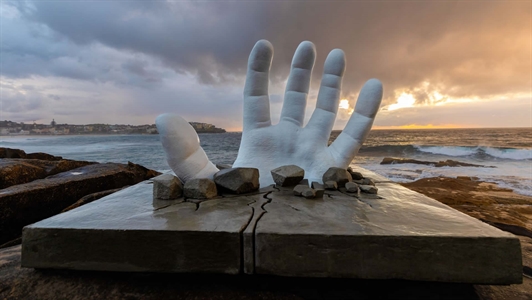
Sculpture By The Sea Bondi Celebrates Thirty Years
The 2026 exhibition marks three decades since Sculpture by the Sea began in 1997. What started as a modest, one-day event has grown into a major fixture on Sydney’s cultural calendar, drawing hundreds of thousands of visitors to the coast each spring.
The essential idea remains straightforward: bring sculpture out of the gallery and place it in a setting where people encounter it as part of an ordinary day outdoors. The result is an exhibition that does not ask visitors to leave the landscape behind in order to look at art. Instead, the art gives them reasons to notice the landscape more closely.
This year's 100 works represent artists from 14 countries, including Australia, Japan, India, China, New Zealand, Slovakia and South Africa. Thirty artists are exhibiting at Sculpture by the Sea, Bondi for the first time, bringing new approaches and materials to a route that many Sydneysiders know well. Organisers expect around 450,000 visitors over the 18-day exhibition.
The anniversary also offers a chance to consider how public art changes a place. The Bondi to Tamarama walk is already a destination in its own right, shaped by the rhythm of exercise, swimming, conversation and the daily pull of the ocean. During the exhibition, people move through it with a slightly different purpose. They slow down, gather around particular works and look across the water from angles they might otherwise pass without a second glance.
That shared experience is part of the exhibition's character. Visitors do not need specialist knowledge to take part, and no two people are likely to respond to every work in the same way. A sculpture that seems playful to one person may feel unsettling or contemplative to another. The conversation between the work and its audience is left open.
Harrie Fasher Wins The Aqualand Sculpture Award
One of the defining moments of the 2026 exhibition arrives with the announcement of the Aqualand Sculpture Award. The $70,000 prize goes to Harrie Fasher, an artist from Portland in regional New South Wales, for Unveiling the Edges of the Sky, a large-scale sculpture made from steel and bronze. The work stands six metres tall and stretches five metres long, bringing a commanding human presence to the coastal setting.
Fasher's sculpture draws on both figurative and abstract forms. Its scale encourages visitors to consider it from a distance before moving closer to its materials and details. Steel and bronze carry their own visual weight, connecting the work to ideas of strength, endurance and transformation. Set outdoors, the sculpture also changes in appearance as the light moves across its surfaces and the surrounding sky shifts.
The award marks Fasher's sixth appearance at Sculpture by the Sea, Bondi. She has previously received the major award at Sculpture by the Sea, Cottesloe, making her an established presence within the exhibition's wider history.
In her acceptance remarks, Fasher dedicates the prize to women around the world, including artists and the people whose often unseen work brings an exhibition of this scale to life. She describes the making of the sculpture as a community effort, acknowledging the team, trust and support that sustain her studio practice. Her words bring attention to the work behind the finished object: the planning, collaboration, technical skill and shared labour that allow an ambitious sculpture to take shape.
That labour is particularly visible in an exhibition spread across an exposed coastal path. Large works must be conceived for a specific site, constructed, transported and installed with careful attention to the terrain and the safety of visitors. The final encounter may feel spontaneous, but much of what makes it possible happens well before the public arrives.
Aqualand Group Managing Director Jin Lin describes the exhibition as a connection between art, the natural landscape and the community, arguing that a city's character is shaped not only by its buildings but also by its culture and shared experiences. That idea is especially relevant here, where the setting is not simply a backdrop but an active part of how the works are encountered.
International Artists Meet A Familiar Coastline
The international reach of Sculpture by the Sea is one of the features that distinguishes the Bondi exhibition. The 2026 program brings together artists working across different cultural contexts, generations and approaches to sculpture. Their works share the same stretch of coastline, but they do not necessarily share the same visual language or starting point.
Japanese sculptor Keizo Ushio reaches a notable milestone this year, celebrating his 50th Sculpture by the Sea exhibition across the Bondi, Cottesloe and former Denmark events. His long association with the exhibition reflects the way a public art event can become a continuing conversation between artists and audiences, revisited in different places and across changing stages of a career.
He is joined by Chen Wenling, one of China's most internationally recognised sculptors, while Koichi Ishino marks his 20th Sculpture by the Sea, Bondi exhibition. Archibald Prize winner Tim Storrier AM also returns after receiving the iShares People's Choice Award at last year's Bondi exhibition.
Alongside these established names, the 30 artists making their debut at the Bondi exhibition introduce fresh perspectives to the route. The mixture is important. Familiar artists bring a sense of continuity, while new participants change the character of the exhibition from year to year. Even visitors who have walked the trail many times cannot assume they will see the same things, or respond to them in the same way.
The materials themselves contribute to that variety. Outdoor sculpture may be built from metal, stone, timber, found objects or unexpected combinations of materials. Some works seem to answer the landscape through their shape or surface; others create a deliberate contrast with the open space around them. Certain pieces draw people close, while others make their strongest impression from the path or across a grassy rise.
The ocean complicates every encounter. A sculpture viewed against a bright horizon can look entirely different when clouds gather behind it. Shadows shift, the wind moves through surrounding grasses and the sound of surf competes with conversation. The works remain in place, but their setting is always changing.
For visitors, this makes walking between sculptures as important as arriving at them. The gaps between works are not empty corridors. They are part of the experience, allowing the eye to travel from an artwork to the headland, from the path to the water, and back again.
Love Written Across The Bondi Sky
Among this year's most poignant works is Love by Stephanie Quirk, an artwork created not on the ground but in the sky above Bondi Beach. A skywriter forms the word overhead, turning an expanse usually associated with weather, flight and the changing light into a temporary public canvas.
The work is Sculpture by the Sea's response to the wider world and, in particular, the Bondi massacre of 14 December 2025. Quirk describes Love as a way of bringing an inner, immaterial world into public space, offering a reminder of love as a shared human instinct and a source of belonging.
The skywriting is planned for four occasions during the exhibition. Its first appearance is scheduled for the launch on Friday morning, weather permitting, with further iterations planned for each of the three Saturdays: 24 and 31 October, and 1 November. As with any skywriting, visibility and conditions may affect what visitors are able to see, so it is worth checking the official exhibition updates before making a special trip.
There is something fitting about an artwork that cannot be held in place. The word appears above the beach, visible to people who may be walking the trail, sitting on the sand or looking up from the water's edge. It occupies the same sky for everyone, without requiring visitors to enter a particular space or follow a prescribed route.
Its temporary nature also sets it apart from the more substantial objects along the path. Metal, stone and other materials remain after a visitor moves on, but a word written in the sky gradually disperses. The artwork becomes a shared moment rather than a permanent object, asking people to look up together before the letters fade.
In a landscape as public and well-loved as Bondi, the gesture carries meaning beyond the exhibition itself. It offers a moment of reflection within a busy coastal setting, acknowledging grief while holding open a space for care and connection.
Supporting The Artists Behind The Exhibition
Sculpture by the Sea is not only an exhibition of finished works. It is also a platform for supporting artists, particularly those undertaking ambitious projects that require significant time, resources and technical assistance.
The 2026 program includes $90,000 in Helen Lempriere Scholarships for Anne Neil, James Tapscott and Elyssa Sykes-Smith. The Transfield Australian Invited Artist Program supports Harrie Fasher and James Rogers, while the Clitheroe Foundation Emerging Sculptor Mentor Program backs Nate Don and Joe Liu. David Norton receives the $10,000 Waverley Council Mayor's Award, and David Doyle is the inaugural recipient of the NRMA Insurance Indigenous Artist Program, which provides $20,000 to an Indigenous artist to create and present a new sculpture at Bondi.
These programs sit behind the public experience, but they are an important part of the exhibition's continuing life. A large sculpture may be the work of a single artist, yet its realisation can depend on fabricators, engineers, installers, transport crews, donors and other supporters. Financial assistance can help artists meet those demands and make work that would otherwise be difficult to produce.
Founding CEO and Artistic Director David Handley has credited Sydney's enthusiasm for the exhibition with encouraging artists to take on increasingly ambitious projects, while helping attract the philanthropic and corporate support needed to stage them. The relationship between artists and visitors is therefore more than a final exchange between creator and audience. Public interest helps sustain the conditions that make future work possible.
For the visitor, this support becomes tangible in the diversity of work across the coastal walk. The exhibition offers room for established practitioners to extend their ideas, for emerging artists to reach a broad audience and for international work to be encountered outside the confines of a gallery. It also gives the public a chance to experience contemporary sculpture without the barrier of an admission fee.
Making A Day Of Sculpture By The Sea Bondi
The exhibition is best approached as a walk rather than a venue to be hurried through. The route between Bondi and Tamarama stretches for about two kilometres, and the works reward different distances and different amounts of time. Some visitors complete the trail in a steady stroll; others pause frequently, return to particular sculptures or spend time watching how the coastal light changes around them.
Comfortable walking shoes are useful, as the route follows a coastal path with uneven sections and gradients. The weather can shift quickly, so a hat, sunscreen and a light layer are sensible additions. Weekdays can offer a quieter experience than busy weekends, although the exhibition attracts visitors throughout its run.
Public transport is the more practical choice during the event. Transport for NSW advises visitors to allow extra time, with trains running to Bondi Junction and connecting buses serving the beach. Crowds and limited parking can make driving difficult, particularly on weekends, when special event clearways also operate on nearby roads. Check current transport information before setting out.
The official exhibition website provides current event information and updates: sculpturebythesea.com/bondi.
Sculpture by the Sea, Bondi runs from Friday 16 October to Monday 2 November 2026. The outdoor exhibition is free to the public, with 100 sculptures spread along the Bondi to Tamarama coastal walk. A separate indoor presentation, Sculpture Inside, is also open daily from 10am to 6pm in a marquee at Marks Park, Tamarama, where visitors can see smaller works by participating artists.
Where The Art Meets The Sea
By the time visitors reach the end of the walk, the exhibition has usually become something more than a sequence of objects. It is a way of seeing a familiar stretch of Sydney differently, with each sculpture briefly changing the relationship between the path, the cliffs and the water.
That is the enduring appeal of Sculpture by the Sea. The works are carefully made, transported and installed, yet their meaning remains open to the people who encounter them. One visitor may remember the scale of Fasher's award-winning sculpture; another may carry the image of a word written across the sky. Someone else may remember a small detail in a work glimpsed between gusts of wind, or the view from a headland where the ocean seemed to become part of the artwork.
The exhibition cannot make the coastline stand still, and it does not try to. Instead, it brings art into a landscape already in motion, inviting visitors to linger a little longer and look a little more closely.
As the 30th anniversary edition continues until 2 November, the sculptures remain part of the daily life of the coast: alongside walkers, swimmers, families and the ever-changing sea. Then the works will come down, the path will return to its usual rhythm, and the memory of the exhibition will be carried away by the people who walked it.