
Stewart Copeland brings Police Deranged For Orchestra to the Sydney Opera House on 30 August 2027, reimagining The Police’s songs.
A familiar bass line can change the atmosphere of a room before the first verse begins. The clipped rhythm of a guitar, a sudden drum fill or a melody that has travelled through decades of radio play can return a listener to a particular summer, a long drive or a dance floor remembered in fragments.
For Stewart Copeland, the music of The Police is both a celebrated part of rock history and material that continues to offer new possibilities. The drummer and co-founder of the band has spent much of his career moving between musical worlds, from the urgency of rock to film scores, opera and orchestral composition. In Police Deranged For Orchestra, those strands meet.
The production comes to the Sydney Opera House on Monday 30 August 2027, giving Australian audiences the chance to hear The Police’s catalogue reconsidered through a large orchestral arrangement, a rock trio and a group of singers. The concert forms part of a five-city Australian tour and arrives in a significant year for Copeland and the band: 2027 marks his 75th birthday and the 50th anniversary of The Police.
The idea is not simply to place familiar songs in front of an orchestra. It is to take music built around precision, space and restless rhythm, then explore what happens when those qualities are expanded.
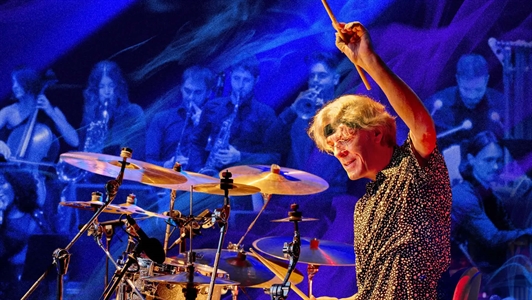
Police Deranged For Orchestra: Familiar Songs, Different Scale
The Police emerged in the late 1970s with a sound that was difficult to place neatly within one category. The band's music drew on punk's economy, reggae's offbeat pulse, new wave's sharp edges and a pop instinct for memorable melodies. The combination was distinctive, but its impact depended on restraint as much as force.
Copeland's drumming was central to that character. His playing rarely settled into a simple supporting role. The rhythms were busy without feeling crowded, with accents and small shifts giving the songs much of their forward movement. Alongside Sting's bass and Andy Summers' guitar, the drums helped create a sound that could feel spacious and tightly wound at the same time.
Police Deranged For Orchestra approaches that catalogue from a different direction. Rather than reproducing the original recordings, Copeland reshapes the arrangements for orchestral forces, retaining the recognisable musical foundations while allowing new textures to emerge.
Songs including Roxanne, Message in a Bottle, Don't Stand So Close to Me, Every Breath You Take and Walking on the Moon are among the material associated with the production. Their melodies are familiar to listeners across generations, but an orchestral setting changes the balance. A line once carried by guitar or bass can be answered by strings or brass; a rhythmic figure can take on a different weight when supported by a much larger ensemble.
The result is a conversation between the original songs and the musical life they have acquired since their release.
Stewart Copeland: From Rock Drummer To Composer
To understand the thinking behind Police Deranged For Orchestra, it helps to look beyond Copeland's years with The Police. His career has never been confined to one instrument or musical form. Since the band's dissolution, he has developed a substantial body of work as a composer, writing for film, television, ballet, opera and orchestral performance.
That background gives the project a different perspective from a conventional anniversary concert. Copeland is not approaching the songs only as a former band member revisiting old material. He is also a composer with decades of experience working with larger musical forces, and the arrangements reflect that broader understanding of sound.
His work for film includes music for Francis Ford Coppola's Rumble Fish and Oliver Stone's Wall Street, among other projects. He has also written for the concert stage and explored theatrical forms, including operas based on stories by Edgar Allan Poe. These experiences have taken him well beyond the compact arrangements that first brought him international recognition.
Yet the rhythmic instincts of a drummer remain central to his work. Copeland's playing is marked by movement, precision and a willingness to make rhythm an expressive force in its own right. Those qualities are particularly relevant when familiar rock songs are expanded for orchestra. The challenge is not simply to make the sound bigger, but to retain the tension and character that made the original compositions distinctive.
The project began as a live orchestral interpretation several years ago and was developed into a studio recording, Police Deranged for Orchestra, released in 2023. The 2027 tour gives the work another life on stage, with Copeland leading a large-scale production through some of the world's best-known performance venues.
What The Orchestra Adds To The Police Catalogue
The Police's music is often remembered for its economy. A small number of instruments created a sound that was lean, immediate and full of detail. The arrangements left space between the parts, allowing a bass line or a drum pattern to carry as much character as the vocal melody.
An orchestra changes that equation. Strings can lengthen a phrase or add a sense of unease; brass can bring a sharp accent into focus; woodwind can introduce colour and movement that were not part of the original recording. The songs become larger, but the most interesting changes may happen in the quieter details.
The Sydney performance features a 28-piece orchestra alongside a rock trio and three singers. Copeland will play drums and guitar, and may also take a role in conducting. The Australian dates bring together local orchestral musicians, with the ensemble changing between cities. Sydney's performance is part of a collaboration that places the project within Australia's own orchestral landscape.
Conductor Sarah-Grace Williams leads the Australian performances. The touring rock band includes Mike Mills, known for his work with Toehider, alongside Jude Perl and Nick Delaney. Three international vocalists complete the line-up, bringing different voices to songs originally shaped around Sting's distinctive delivery.
That vocal dimension is important. The Police's catalogue is closely associated with a particular voice, but the songs themselves have proved adaptable. Their melodies and lyrical themes have travelled well beyond the original recordings, becoming part of a shared popular music vocabulary. New singers can approach them from a different angle, while the orchestral arrangements create room for fresh interpretations.
The concert is therefore less about reproducing the past than examining what remains in the music when its familiar elements are rearranged.
A Significant Year For Stewart Copeland And The Police
The 2027 tour coincides with two milestones. Copeland turns 75, while The Police reaches the 50th anniversary of its formation in 1977. The timing gives the project a retrospective quality, although its musical approach looks forward rather than simply back.
The Police's rise was unusually rapid. The trio built an international following through a succession of sharply defined singles and albums, becoming one of the most recognisable bands of the late 1970s and 1980s. Their music travelled across radio formats and audiences, combining the immediacy of pop with rhythmic ideas drawn from reggae, punk and new wave.
Songs such as Roxanne and Message in a Bottle established the band's early identity. Later releases, including Synchronicity, broadened its reach and produced some of its most enduring recordings. The music remains familiar, but its distinctive arrangements have also made it an inviting catalogue for reinterpretation.
The band's history was not without its tensions, and its original run ended in the mid-1980s. A reunion tour in 2007 and 2008 brought the three musicians together again for a major international series of performances. Copeland's 2027 Australian concerts mark his first live music appearances in the country in almost two decades since that reunion period.
For Australian listeners who remember those years, the return carries a particular sense of occasion. For younger audiences, the production offers a way to encounter the songs outside the recordings that made them famous.
The Sydney Opera House As A Setting
The Sydney Opera House provides a distinctive setting for a performance that brings rock music and orchestral tradition into the same space. Set on Bennelong Point, beside the harbour and within sight of the city, it is one of Australia's most recognised cultural landmarks. Its position gives an evening performance a sense of arrival, whether visitors approach on foot from Circular Quay, by ferry across the harbour or along the waterfront.
The concert takes place in the Opera House Concert Hall, beneath the building's largest roof sail. The venue has a different atmosphere from the open spaces and grand foyers that visitors often associate with the building. It is designed around the experience of listening, with the stage and auditorium bringing performers and audience together in a shared acoustic environment.
For Police Deranged For Orchestra, that setting is particularly apt. The production relies on the contrast between the physical energy of a rock performance and the scale and detail of orchestral music. The Concert Hall offers room for both, allowing the full ensemble to occupy the stage while keeping the focus on the musicians and their interplay.
There is also a broader sense of place. The Opera House sits within a harbour precinct that has long been central to Sydney's public life. Before the performance, visitors can walk around the forecourt, look back towards Circular Quay or pause along the waterfront as ferries move through the harbour. The changing light over the water is part of the experience, especially as an evening begins.
The building stands on the traditional lands of the Gadigal people of the Eora Nation. Its presence is now woven into the city's cultural identity, welcoming audiences to performances from Australia and around the world.
For anyone travelling into the city for the concert, it is worth allowing time to enjoy the precinct rather than arriving at the last moment. The Opera House is around a seven to ten-minute walk from Circular Quay, which is served by trains, ferries, buses and light rail. Its location also makes it easy to combine the performance with dinner or a walk through the nearby harbour foreshore.
A Five-City Australian Tour
Sydney is the second stop on the Australian leg of Police Deranged For Orchestra. The tour opens at the Palais Theatre in Melbourne on Saturday 28 August 2027 before arriving at the Opera House two days later.
From Sydney, the production travels north to Brisbane, where it performs at QPAC on Wednesday 1 September. It then moves to Adelaide for a performance at Her Majesty's Theatre on Friday 3 September, before concluding in Perth at the Regal Theatre on Sunday 5 September.
The tour's orchestral collaborations give each city a local dimension. The production works with Australian ensembles, including the Met Orchestra, Perth Symphony, Adelaide Symphony, Australian Pops Orchestra and Brisbane Symphony. Rather than taking one fixed orchestra from venue to venue, the performances draw on musicians from different parts of the country.
That approach creates a meeting between Copeland's arrangements and the musicians of each city. It also places the project within Australia's established orchestral community, where classical musicians regularly work across contemporary music, film, theatre and other forms.
For Sydney, the performance is a chance to hear a familiar catalogue interpreted through this combination of local orchestral talent and an international touring line-up.
Planning Your Visit
The performance is scheduled for Monday 30 August 2027 at 7.30pm in the Sydney Opera House Concert Hall. The advertised duration is approximately 135 minutes, including an interval, although the venue notes that timings are subject to change.
At the time of publication, the Opera House lists several seating categories, from C Reserve through to Premium, as well as a VIP Collector's Package. The VIP package includes a premium reserved seat, a pre-signed official tour poster and a limited-edition collector tote bag. A booking fee applies per transaction, and prices and availability may change.
The Opera House is the authorised ticket agency for the Sydney performance. Visitors should check the venue's event page for current ticket information, accessibility arrangements and any updates before attending.
The performance is listed as suitable for all ages. Children aged 15 and under must be accompanied by an adult. The venue also advises that the production may include strobe lighting or smoke machines.
Event Details
Event: Stewart Copeland's Police Deranged For Orchestra
Date: Monday 30 August 2027
Time: 7.30pm
Venue: Sydney Opera House, Concert Hall
Address: Bennelong Point, Sydney NSW 2000
Duration: Approximately 135 minutes, including interval
Official event and ticket information: Sydney Opera House
Hearing The Songs Again
There is something revealing about hearing a familiar song in an unfamiliar arrangement. The melody remains, but the details around it begin to shift. A rhythm that once seemed effortless becomes more intricate; a line that sat quietly behind the vocal takes on new prominence. The listener recognises the music, then notices it again.
That is the territory Stewart Copeland explores with Police Deranged For Orchestra. The songs of The Police have been part of the musical landscape for decades, but they are not fixed objects. Their rhythmic foundations and memorable melodies leave room for new interpretations, particularly when the person reshaping them helped create the original sound.
At the Sydney Opera House, that exchange will unfold on a large scale. Copeland's drumming, the voices, the rock trio and the orchestra will bring different musical traditions into one performance, without losing sight of the songs at its centre.
For an audience gathered beneath the Concert Hall's great roof sail, the evening will offer more than a return to familiar hits. It will be an opportunity to hear how music changes when it is revisited by the people who know it most closely, and how a song can remain recognisable while finding another life.