
Storytime Ballet: Cinderella brings young audiences into the world of dance at the Sydney Opera House from 17 December 2026 to 3 January 2027.
A child's first encounter with ballet may begin with a question rather than a curtain rising. Why do dancers stand on their toes? How can a story be told without speaking? And what happens when a pumpkin, a pair of glass slippers and a little imagination lead to a royal ball?
This summer, those questions find their way into the Drama Theatre at the Sydney Opera House, where The Australian Ballet presents Storytime Ballet: Cinderella. Designed for children aged three and older, the production introduces a familiar fairytale through movement, music, narration and theatrical illusion. It runs from 17 December 2026 to 3 January 2027, offering families a chance to share a live performance during the summer school holidays.
The setting lends the occasion a particular character. Outside, Sydney moves into its festive-season rhythm: ferries cross the harbour, visitors gather around Circular Quay, and the Opera House sails catch the changing light. Inside the theatre, the pace slows. The audience settles, the lights dim and a story begins to unfold through the movement of dancers rather than the turning pages of a book.
For adults, Cinderella may be a story known almost by heart. For younger audience members, it can be an introduction to the language of live performance, where music sets a mood, gestures suggest a feeling and a change of light can signal the arrival of something magical. The experience is designed to be welcoming rather than formal, with an engaging narrator guiding children through the story and room for them to respond as it unfolds.
Storytime Ballet: Cinderella occupies a useful space between the familiar ritual of reading a bedtime story and the larger experience of attending a full-length ballet. It offers a first glimpse of classical dance without asking young viewers to sit through a lengthy production. At around 50 minutes, it leaves space for concentration, curiosity and the occasional burst of excitement.
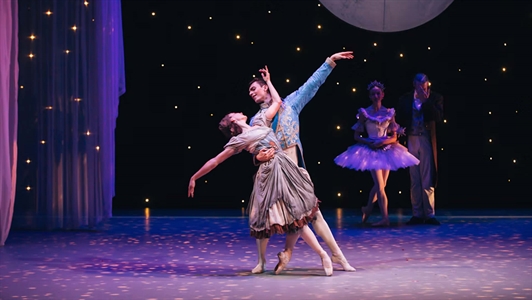
Storytime Ballet: Cinderella And The Magic Of A Familiar Story
The story at the heart of the production is one that has travelled across generations and cultures. Cinderella is mistreated by her stepmother and stepsisters, her daily life shaped by chores and exclusion. With the help of her fairy godmother, she is transformed for a royal ball, where she meets a prince. A glass slipper becomes the clue that eventually changes her circumstances.
Its appeal lies partly in the contrast between the ordinary and the extraordinary. Domestic work gives way to a glittering celebration; a quiet young woman takes centre stage; and a small object becomes the key to a much larger change. These are clear visual ideas, well suited to a medium in which movement, costume and music can carry meaning without extensive dialogue.
For children encountering the story for the first time, the ballet offers more than a sequence of familiar plot points. A dancer's posture can communicate uncertainty or confidence, while a change in tempo can turn a scene from playful to tense. The audience is invited to notice how movement tells a story, even when nobody is speaking.
The Storytime Ballet format makes this process easier to follow. Rather than expecting young viewers to interpret every gesture on their own, a narrator helps connect the action and maintain a sense of narrative direction. Children can follow the broad outline of Cinderella's journey while discovering the particular way ballet expresses it.
That balance between guidance and discovery is important. A young audience does not need to understand every technical element of classical dance to respond to the shape of a story, the energy of a performance or the appearance of a character. Sometimes the first connection is as simple as recognising a familiar moment on stage and seeing it made real.
The production is choreographed and produced by former Australian Ballet Artistic Director David McAllister, whose approach brings the fairytale into a format created specifically for children. The music is Sergei Prokofiev's Cinderella, Op. 87, performed by Orchestra Victoria under conductor Jonathan Lo.
Prokofiev's score gives the story another layer of expression. Music can suggest the pace of a character's thoughts, the tension of a hurried moment or the scale of a celebration. For children, it offers a way into the story that does not depend on understanding words. They can listen, watch and gradually connect the sound of the orchestra with what is happening on stage.
A First Ballet Experience At The Sydney Opera House
A theatre can feel like an unfamiliar place to a young child. There are ushers, rows of seats, dimmed lights and the expectation that a crowd will watch something together. Storytime Ballet: Cinderella recognises that a first visit is as much about discovering the theatre itself as following the performance.
The show runs for around 50 minutes, keeping the experience shorter than a traditional full-length ballet. Dressing up in ballet-inspired clothing is encouraged, and children are welcome to dance in their seats. These small invitations help soften the boundary between stage and audience without taking away the sense of a shared performance.
For a child, that might mean wearing a favourite skirt or imagining a pair of slippers beneath their everyday shoes. Another might be more interested in the dancers' costumes, the movement of the scenery or the moment when a character appears. There is no single way to watch. Some children sit quietly and absorb the action, while others lean forward or whisper questions to the adult beside them.
The narrator offers a thread through the story, helping young viewers understand what they are seeing. It is an approach that respects the way children learn: through a mixture of listening, watching, imitation and surprise. Rather than explaining ballet as a set of rules, the performance allows its language to emerge through the action.
This is also a chance for adults to experience a familiar story differently. Parents and grandparents may remember Cinderella from books, films or earlier stage productions. Watching it with a child can bring attention back to details that familiarity has dulled: the shape of a gesture, the pause before a character enters, or the way a musical phrase changes the mood of a scene.
A first ballet does not need to lead immediately to a lifelong interest in dance. Its value may be simpler. It can give a child a new experience of music and movement, a story to talk about afterwards, or a memory of sitting in a theatre as the lights faded and another world appeared.
Costumes, Sets And The Art Of Illusion
Fairytales depend on transformation, and Cinderella offers several opportunities for theatrical imagination. Everyday life gives way to the world of the ball, a character's appearance changes, and the familiar becomes briefly extraordinary. On stage, these shifts are created through the combined work of dancers, designers, lighting and illusion.
Costume designer Louisa Fitzgerald, set designer Ishan Vivekanantham, lighting designer Jon Buswell and illusion designer Lee Cohen contribute to the production's visual world. The original set and costume design, created in 2023, was developed in collaboration with the Master of Design and Production at the Victorian College of the Arts, University of Melbourne.
For young audiences, such elements can be as absorbing as the choreography. A change in lighting may signal that the story has entered a different place; a costume can make a character instantly recognisable; an illusion can create a moment that seems to defy the ordinary rules of the world.
These effects also offer an early introduction to how theatre works. The magic may appear effortless from the seats, but behind it lies careful coordination between performers and the people who shape the stage environment. Every entrance, shift and visual cue must work with the music and movement to keep the story clear.
There is a particular pleasure in seeing a fairytale made physical. In a book, a palace or a magical transformation exists in the reader's imagination. In the theatre, it takes shape in real time, shared by everyone in the room. The result is temporary, disappearing when the performance ends, but that is part of its appeal.
Families should note that the production uses flashing wands, which may be overwhelming for people affected by flashing lights, migraines, light sensitivity or certain cognitive disabilities. Checking the official event information before booking can help families decide whether the performance is suitable for their child.
A Summer Visit To The Sydney Opera House
The timing of Storytime Ballet: Cinderella makes it a natural fit for a family outing during the summer holidays. The Sydney Opera House sits at Bennelong Point, close to Circular Quay and the harbour foreshore, with ferries, trains and buses connecting the area to suburbs across the city.
The walk towards the building is part of the experience. Visitors pass the busy waterfront, watch boats move across the harbour and approach the distinctive white roof forms that have become one of Sydney's most recognisable landmarks. For children, the outing can begin well before they enter the theatre, with plenty to notice along the way.
The performance takes place in the Drama Theatre at the Sydney Opera House. Families should check their tickets for the exact session and arrive with enough time to find their seats, visit the facilities and settle younger children before the show begins. The Opera House advises that children aged 15 and under must be accompanied at all times.
The Sydney season runs from Thursday 17 December 2026 to Sunday 3 January 2027, with performances at various times, including morning, afternoon and late-afternoon sessions on selected dates. The schedule includes performances at 11am, 2pm and 4pm, although times vary by day. The performance on Tuesday 22 December at 2pm is audio described, while the Sunday 27 December performances at 2pm and 4pm are Auslan interpreted. Families should consult the official schedule for current availability and session details.
Tickets are available through the Sydney Opera House event page and The Australian Ballet. Children aged under two are admitted free when seated on an accompanying adult's lap, according to the event information. Ticket prices vary by session and seating category, so it is worth checking the booking page before making plans.
The Opera House location also makes it easy to build a wider day around the performance. Families might take a ferry before the show, walk along the harbour afterwards or pause for a snack at Circular Quay. With young children, leaving room in the schedule can be as valuable as filling it. A performance, a little time outdoors and an unhurried journey home can make for a more comfortable outing than trying to fit too much into one day.
Helping Children Feel At Home In The Theatre
A little preparation can make a first ballet visit more enjoyable. Talking about the story beforehand gives children a familiar thread to follow, while explaining that the dancers use movement rather than ordinary conversation can help them understand what to expect.
There is no need to turn the occasion into a lesson. A few simple ideas are enough: the dancers tell the story with their bodies, the music helps express the feelings of the characters, and the stage creates the places where the action happens. Children who enjoy dressing up can choose an outfit inspired by the fairytale, while those who prefer their usual clothes can arrive exactly as they are.
It can also help to acknowledge that live performance feels different from watching a screen. The people on stage are present in the room, the music fills the theatre and the story moves forward without a pause button. Some children may be captivated from the first moment; others may need time to become comfortable with the surroundings.
The production's shorter running time helps make the experience manageable, but every child responds differently. Parents can check the venue's practical information in advance, including accessibility arrangements and the show's sensory warning, to decide what will work best for their family.
Afterwards, children might want to talk about a favourite dancer, recreate a movement or ask how a particular stage effect happened. Those conversations are part of the experience, carrying the performance beyond the theatre doors and into the rest of the day.
The Fairytale Beyond The Final Curtain
Cinderella has endured because its story leaves room for wonder. It offers transformation, music, movement and the idea that a life can change in a single evening. Ballet adds another dimension, allowing the story to be felt through rhythm and gesture as much as understood through words.
Storytime Ballet: Cinderella brings that tradition to a younger audience in a format shaped around curiosity and discovery. Its purpose is not simply to introduce children to a famous fairytale, but to offer a first encounter with the possibilities of live dance: the discipline of the performers, the atmosphere of the theatre and the quiet communication between music and movement.
For families visiting the Sydney Opera House this summer, the performance will offer a chance to share that experience in one of the city's most recognisable cultural settings. The harbour outside will continue its daily rhythm, ferries arriving and departing as visitors move across the forecourt. Inside, for about 50 minutes, another world will take shape through dancers, music, costumes and light.
When the curtain falls, the story will return to the imagination of the people who watched it. A child may remember the glass slipper, the ball or a moment when the stage seemed to change by magic. An adult may remember the concentration on a small face, or the way a familiar story felt new when seen through a child's eyes.
That is often how a first encounter with the performing arts begins: not with an expectation of expertise, but with a moment that stays in the mind. For young audiences, Storytime Ballet: Cinderella offers an invitation to step into that world, one movement at a time.
Photos by: Kate Longley