
Sydney Chamber Choir Masterworks brings Britten, MacMillan and Vaughan Williams to Sydney and the Blue Mountains this November, exploring faith, justice and the search for meaning.
There is a particular stillness that settles inside a church before a concert begins. Light falls across the pews, footsteps soften on stone, and the architecture seems to hold its breath. Outside, the city carries on with its familiar pace. Inside, a different kind of attention takes over, one shaped by silence, expectation and the possibility of being moved by sound.
This November, the Sydney Chamber Choir invites audiences into that space with a programme of three substantial works that approach faith from strikingly different directions. Presented under the title Cantos Sagrados, the concert brings together Benjamin Britten's Rejoice in the Lamb, James MacMillan's Cantos Sagrados and Ralph Vaughan Williams' Five Mystical Songs. Together, they explore the relationship between the human and the divine, moving through personal conviction, political injustice, private doubt and collective affirmation.
The programme arrives at the close of the choir's 2026 season, offering a meeting point between centuries of sacred poetry and the distinctive musical languages of three composers. It is a concert concerned with belief, but not belief alone. Its deeper question is where meaning can be found when the world is uncertain, when suffering challenges faith, and when the ordinary experiences of human life become unexpectedly profound.
For Sydney audiences, the two performances also offer an opportunity to encounter this repertoire in very different settings: St Finbar's Church in Glenbrook, among the ridgelines and established neighbourhoods of the Blue Mountains, and St James' Church on King Street, within the historic heart of the city.
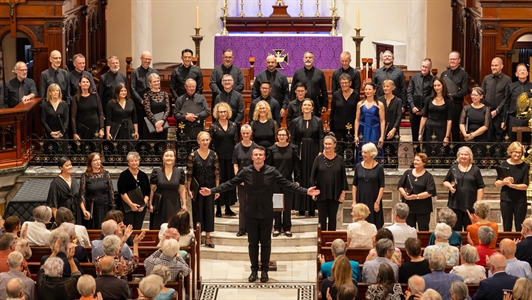
Sydney Chamber Choir Masterworks Across Two Distinct Settings
The locations are part of the experience. Churches are not simply convenient venues for choral music. Their proportions, reverberation and accumulated histories shape how voices are heard, allowing a musical phrase to linger after the singers have moved on.
At St Finbar's in Glenbrook, the concert takes place within a Blue Mountains community where the built environment sits close to bushland and the rhythms of suburban life are tempered by the surrounding landscape. The setting offers a different atmosphere from the city, with the prospect of an afternoon spent listening before returning to the mountain roads and streets beyond the church.
The Sydney performance at St James' on King Street brings the programme into one of the city's enduring historic places of worship. In the central business district, where office buildings, traffic and busy footpaths define much of the daily scene, the church offers a quieter interior. Its setting creates a natural contrast between the movement of contemporary Sydney and the contemplative character of the music.
The two performances share the same repertoire, but the experience of hearing it will be shaped by each building and its acoustic character. Choral music depends on the relationship between individual voices and the space around them. A consonant, a held note or the gradual gathering of several vocal lines can take on an added dimension when sound is allowed to travel and settle.
For the Sydney Chamber Choir, this relationship between music and place is especially fitting for a programme that asks listeners to consider how people make sense of the world around them.
Britten's Rejoice In The Lamb And The Imagination Of Faith
Benjamin Britten's Rejoice in the Lamb, composed in 1943, opens a window onto a religious imagination that is exuberant, eccentric and deeply human. Rather than presenting faith as a tidy sequence of declarations, the work embraces the peculiarities of existence, finding spiritual significance in creatures, objects and seemingly insignificant details.
Its source is the poetry of Christopher Smart, an eighteenth-century English writer whose visionary devotional text, Jubilate Agno, emerged during a period of confinement in an asylum. Smart's writing moves between praise, observation and startling flights of imagination. His celebrated passages concerning his cat Jeoffry sit alongside reflections on animals, nature and the many forms through which creation might express devotion.
Britten responds with music that moves just as freely between contrasting moods. Bright choral passages sit beside more intimate solo writing, while playful rhythms and intricate vocal lines give the work a sense of movement and discovery. There are moments of tenderness, but also an unusual wit, as though the music recognises that wonder does not always arrive in solemn form.
The result is a portrait of faith that leaves room for vulnerability and individuality. Smart's poetry does not depend on conventional composure. It suggests that the search for the sacred can be untidy, intensely personal and alive to the details others might overlook.
That quality gives the work an enduring relevance. Questions about mental distress, social exclusion and the difficulty of understanding another person's inner life remain part of contemporary experience. Without turning the piece into a modern commentary, Britten's setting invites listeners to consider the relationship between imagination and belonging, and the possibility that a marginalised voice may reveal something others have missed.
In the context of the Sydney Chamber Choir masterworks programme, Rejoice in the Lamb establishes an important starting point. Faith appears not as an abstract concept but as something encountered through the fragile, surprising and sometimes unconventional experiences of being human.
James MacMillan's Cantos Sagrados Confronts Injustice
Where Britten finds spiritual possibility in the unexpected, Scottish composer James MacMillan brings sacred music into direct contact with political suffering. His Cantos Sagrados, composed in 1990, gives the programme its title and introduces a more urgent, confrontational perspective on the relationship between faith and the world.
MacMillan combines Latin liturgical texts with contemporary poetry by Ariel Dorfman and Ana María Mendoza, writers whose work speaks to oppression, violence and the human cost of political power in Latin America. The result challenges any easy separation between religious devotion and the realities of public life.
Here, sacred language does not offer an escape from suffering. Instead, it becomes a means of confronting it.
The music moves between contemplative passages and moments of considerable intensity. Rhythmic force, sharply defined vocal writing and contrasting textures create a sense of tension that reflects the moral weight of the texts. Prayer and protest occupy the same musical landscape, making it difficult to consider one without acknowledging the other.
For listeners, the work raises questions that extend well beyond its historical and geographical context. What does faith mean in the presence of injustice? How should religious belief respond when suffering is inflicted in the name of authority or ideology? And what responsibility does music carry when words alone seem insufficient?
MacMillan does not resolve these questions with a neat conclusion. Instead, he places them before the audience with an emotional directness that makes the work particularly compelling within this programme.
Its position alongside Britten and Vaughan Williams is significant. Across the three compositions, faith emerges as a source of imagination and comfort, but also as something tested by human behaviour. In Cantos Sagrados, that test is inseparable from the dignity of people whose lives are shaped by forces beyond their control.
The work's contemporary perspective also broadens the idea of sacred music. Rather than treating the church as a place removed from the world, MacMillan's composition insists that spiritual reflection must remain connected to the lives, struggles and moral choices of people outside its walls.
Vaughan Williams And The Quiet Power Of Devotion
Ralph Vaughan Williams' Five Mystical Songs, composed in 1911, offers a different kind of encounter with faith. Setting poetry by the seventeenth-century English priest and poet George Herbert, the work turns towards the intimate language of personal devotion while retaining the breadth and communal character of choral music.
Herbert's poetry is notable for its clarity, its attention to ordinary experience and its willingness to approach spiritual questions through familiar images. His writing moves between humility and conviction, reflecting on the relationship between the individual and the divine without losing sight of the practical world in which belief must be lived.
Vaughan Williams finds a musical language capable of holding these contrasting qualities together. Expansive melodies, rich harmonies and passages of reflective simplicity create a cycle that unfolds with the character of an inward journey. There is room for uncertainty and restraint, but also for moments when the music opens out into something larger than private contemplation.
The inclusion of Australian baritone David Greco gives the cycle a distinctive point of focus. His role brings Herbert's words into a more individual register, set against the collective presence of the choir. That relationship between solo voice and ensemble is central to the work's character, allowing personal reflection to develop into a broader expression of shared belief.
The concluding movement, Antiphon, is particularly notable for its expansive sense of praise. Its music moves beyond the confines of individual experience towards an inclusive vision of celebration. After the more searching passages that precede it, this final statement offers a sense of release without diminishing the seriousness of the journey.
For contemporary audiences, Herbert's poetry may feel distant in language and theological outlook, yet its underlying concerns remain recognisable. People continue to negotiate the relationship between conviction and doubt, private experience and public identity, and the desire for certainty in a world that rarely provides it.
Vaughan Williams' setting allows those concerns to be heard rather than explained. The emotional force lies in the gradual movement of the music, in the way a phrase gathers weight or a harmony changes the atmosphere of a passage.
Together with Britten and MacMillan, the work completes a programme in which sacred music is neither uniform nor confined to one emotional register. It can be playful, troubled, defiant or serene. Its power lies partly in its ability to make room for these differences.
David Greco, Thomas Wilson And The Art Of Listening
The programme brings together experienced performers whose individual contributions are integral to its shape. Baritone David Greco takes a prominent role in Vaughan Williams' Five Mystical Songs, while St James' master organist Thomas Wilson partners the choir across the programme.
The organ has a particular place in the sound world of sacred music. Its capacity to sustain a tone, establish harmonic foundations and move between delicate support and considerable power makes it a natural partner for the human voice. Yet the relationship depends on balance. The instrument must give the singers room to articulate the words while contributing to the larger musical structure.
In a church, that balance is also affected by the building itself. Notes continue to resonate after they are played, and the decay of sound becomes part of the listening experience. A passage that feels direct in a dry rehearsal room can take on a more spacious quality in a resonant interior.
For a programme moving between Britten's intricate writing, MacMillan's rhythmic intensity and Vaughan Williams' expansive melodies, clarity of text and sensitivity to the acoustic environment are especially important.
Under the direction of conductor and artistic director Sam Allchurch, the Sydney Chamber Choir brings these distinct musical worlds into a shared programme. Allchurch describes the repertoire as a rare opportunity to hear three substantial works together, occupying a space between a single large-scale composition and a collection of shorter pieces.
His framing is useful because the programme is not simply an anthology of sacred music. Each composition changes the perspective established by the one before it. Britten offers an imaginative and deeply personal response to faith, MacMillan confronts the consequences of injustice, and Vaughan Williams returns to the language of devotion with a sense of warmth and affirmation.
The listener is invited to follow those shifts without needing to arrive at a single conclusion. The experience depends as much on attention as interpretation, allowing the words, voices and musical textures to establish their own connections.
Why These Sydney Chamber Choir Masterworks Matter Now
The word masterwork can suggest a fixed place in musical history, a composition preserved because generations have agreed on its importance. Yet these three pieces continue to speak because they address questions that remain unsettled.
Britten's setting asks us to consider the value of unconventional perspectives and the relationship between suffering and imagination. MacMillan places moral responsibility at the centre of sacred expression, refusing to separate spiritual ideals from human consequences. Vaughan Williams gives voice to a more intimate tradition of devotion, finding strength in the movement from individual reflection towards communal praise.
Heard together, they offer a broader picture of belief than any one work could provide.
That breadth is also what makes the programme suitable for listeners approaching choral music for the first time. Familiarity with the composers or their literary sources is not essential. The words provide a framework, but the emotional experience unfolds through the sound itself: the interplay of voices, the contrast between stillness and movement, and the changing relationship between individual expression and collective singing.
For regular concertgoers, the programme offers an opportunity to hear well-established works in a sequence that draws out their differences. For those more interested in architecture, poetry or the history of religious thought, it provides another way into the repertoire.
The two venues give the experience an additional local dimension. One performance takes place in Sydney's historic centre, where the church interior sits within the daily movement of the city. The other brings the music to Glenbrook, where the Blue Mountains provide a different setting for an afternoon of listening.
Neither location needs to be treated as a backdrop. Both are places where music, architecture and community meet, creating conditions for an experience that differs from listening through headphones or speakers at home.
The concert also arrives at a moment when questions of belief and belonging remain part of public conversation. People continue to search for meaning through religion, art, relationships and civic life. Music cannot settle those questions, but it can make space for them to be considered without haste.
Concert Details And How To Attend
Sydney Chamber Choir presents Cantos Sagrados, a programme featuring Britten's Rejoice in the Lamb, MacMillan's Cantos Sagrados and Vaughan Williams' Five Mystical Songs.
Sunday, 8 November 2026, at 3 pm
St Finbar's Church, Glenbrook, New South Wales.
Saturday, 14 November 2026, at 5 pm
St James' Church, King Street, Sydney, New South Wales.
Further information and bookings are available through the official Sydney Chamber Choir website at www.sydneychamberchoir.org.
Audiences should consult the official website for ticket availability and any additional venue or performance information before attending.
An Answer That Remains Open
As the final notes of a choral work fade, there is often a moment when the audience waits before responding. The silence is brief, but it carries something of the music's afterlife, the space in which an idea or feeling continues to settle.
The three works in Cantos Sagrados approach that moment from different directions. Britten finds wonder in an unconventional voice. MacMillan turns sacred language towards the realities of injustice. Vaughan Williams traces the movement from personal devotion to collective affirmation.
None offers a simple answer to the question of where the divine might be found. Instead, the programme suggests that the search itself can take many forms, shaped by joy, grief, resistance and the need to belong.
In the quiet interiors of St Finbar's and St James', these Sydney Chamber Choir masterworks invite audiences to listen across differences of time, place and belief. The result is not a prescription for faith, but an opportunity to sit with its complexities.
When the music ends and the doors open back onto the streets of Sydney or the quieter roads of Glenbrook, the questions remain. Perhaps that is the point. Some experiences are valuable not because they resolve uncertainty, but because they give it a voice.