
The Curious Case of Benjamin Button arrives in Sydney in July 2027, bringing an Olivier Award-winning musical about love, memory and a life lived backwards to the Opera House.
There is something about the harbour in Sydney that makes stories of time and change feel especially fitting. Ferries cross the water on familiar routes, the light shifts across the sandstone and glass, and the Opera House stands at the edge of it all, its sails appearing different with every change in weather. It is a place where the old and the new sit comfortably together, and where stories from elsewhere can acquire a fresh resonance.
In July 2027, the Drama Theatre at the Sydney Opera House will welcome a musical built around one of literature's most unusual lives. The Curious Case of Benjamin Button, adapted for the stage by Jethro Compton and Darren Clark from F. Scott Fitzgerald's short story, will make its Australian premiere in Sydney before continuing on to Melbourne and Brisbane.
At the centre of the story is a man who ages in reverse. Born an old man, Benjamin Button moves through life towards youth while the people around him travel in the opposite direction. It is an arresting premise, but beneath the fantasy lies a familiar human predicament: the difficulty of loving someone when time refuses to follow the course we expect.
The production arrives after a celebrated West End run, where it won three Olivier Awards in 2025, including Best New Musical. Its Australian season will run from 16 July to 29 August 2027, bringing a story about the passage of time to one of the country's most recognisable cultural landmarks.
For Sydney audiences, the appeal lies not simply in the novelty of its central idea, but in the opportunity to encounter a familiar literary work through music, movement and the intimacy of live performance.
The Curious Case Of Benjamin Button And The Shape Of Time
Scott Fitzgerald's original short story, published in 1922, begins with a reversal of the natural order. Benjamin Button enters the world with the appearance of an elderly man, unsettling the expectations of his family and the society around him. As the years pass, his body becomes progressively younger, leaving him increasingly out of step with the people whose lives he shares.
The premise lends itself to comedy, but its deeper implications are more troubling. The milestones that ordinarily give life its shape become difficult to recognise when age and experience move in opposing directions. Childhood, adulthood and old age no longer arrive in their expected sequence. Relationships become complicated by the fact that Benjamin and those he loves cannot experience time in the same way.
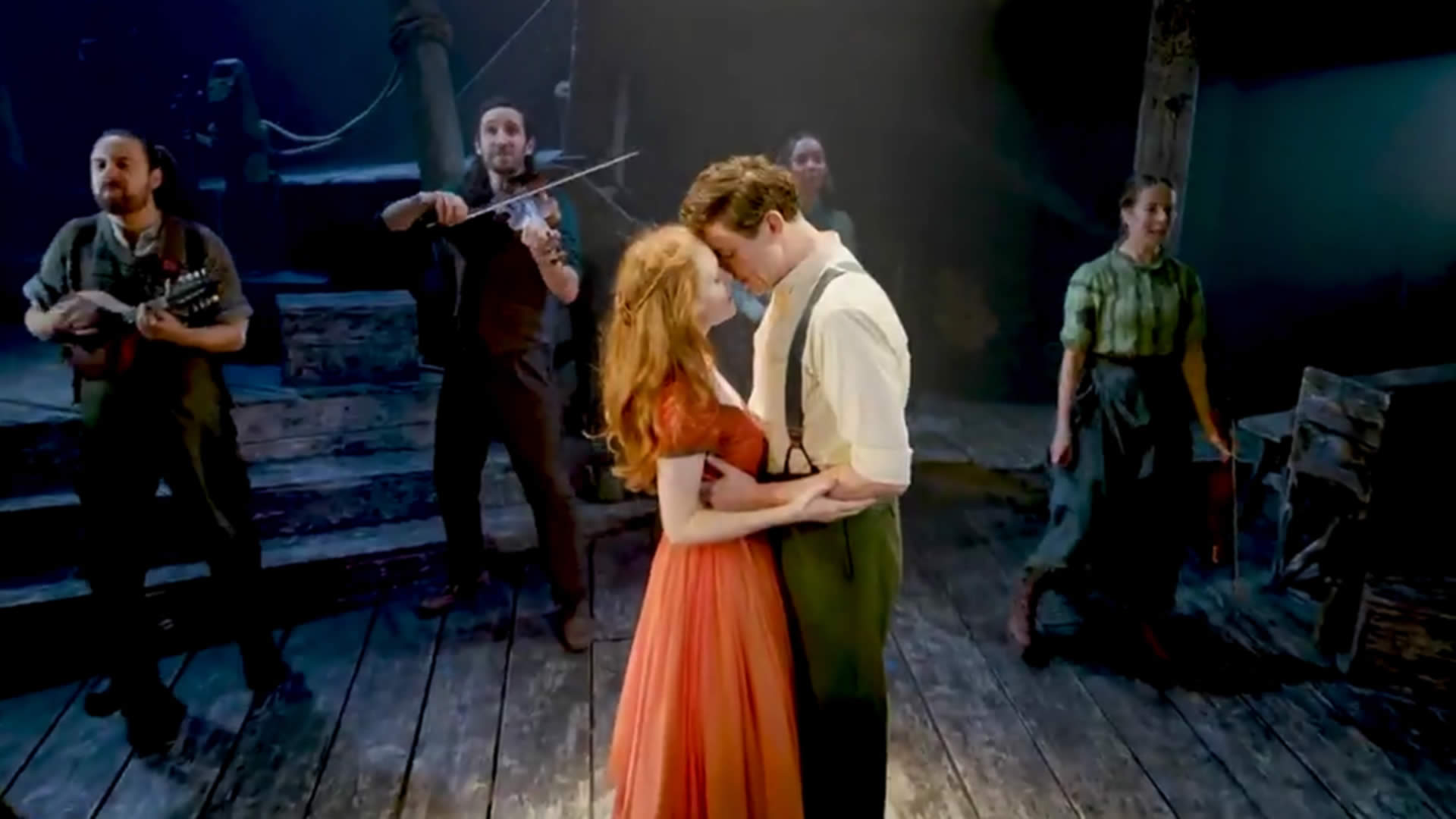
The stage musical takes Fitzgerald's imaginative starting point and places it within a small Cornish village, where the sea and the rhythms of coastal life provide the setting for Benjamin's extraordinary journey. Rather than relying on the premise as a simple curiosity, the production develops it into a story about love, loss, belonging and the fleeting nature of happiness.
The change from the American setting of Fitzgerald's original story to a Cornish community gives the musical a distinct sense of place. Here, life is shaped by the proximity of the coast, the pull of the village and the awareness that the wider world lies beyond the horizon. The sea becomes more than a backdrop. It offers a natural point of connection for a story in which everything is moving, even when the characters would prefer to hold on.
That setting also provides a contrast with the strangeness of Benjamin's condition. The village continues through its ordinary routines while one man's life follows an extraordinary course. The result is a story that moves between the intimate and the almost mythic, grounded in the recognisable details of community and the larger questions raised by a life that cannot be lived in the usual way.
From A Literary Classic To A Musical Stage
Adapting a short story for musical theatre requires more than expanding its plot. The form depends on rhythm, performance and the way music can express thoughts that ordinary conversation cannot quite contain. A character may reveal an emotion through a melody, while a repeated musical phrase can give shape to memories, regrets and changing relationships.
In The Curious Case of Benjamin Button, composers and writers Jethro Compton and Darren Clark have created a theatrical interpretation that places music at the centre of the storytelling. Their production combines a sweeping score with a company of 15 actor-musicians, who play 30 instruments as they bring the story to life.
That arrangement makes the musical performers part of the world they are creating. Instead of separating the drama from the music, the production brings the two together, allowing the sound of the instruments and the movement of the actors to contribute to the same narrative.
The result is a form of storytelling that can shift between scale and intimacy. A musical number may open out into a broad expression of communal life, then narrow to a personal exchange between two characters. Music can suggest the passing of years without requiring every change to be explained, giving the audience space to feel the weight of time rather than simply observe it.
For Benjamin, whose life runs against the ordinary progression of age, this quality is particularly important. His experience cannot be understood through chronology alone. What matters is the distance between the person he appears to be and the person he has become, as well as the changing expectations of those around him.
The musical form gives that tension room to develop. Songs can hold the contradictions of a life that is moving in one direction physically and another emotionally, while the performers' musicianship creates a continuous connection between the story and its audience.
Compton, who wrote, directed and designed the original West End production, has described the Sydney Opera House as a fitting place to begin the Australian journey. Its position beside the harbour offers a natural connection to the sea that runs through the show's world.
The Curious Case Of Benjamin Button Finds Its Australian Home
The Sydney Opera House is an appropriate setting for a production whose emotional landscape is shaped by the water. Seen from the surrounding harbour, the building seems to change with the conditions around it. Morning light sharpens its outlines, while dusk softens the white shells against the darkening sky. It remains unmistakably itself, yet never quite looks the same twice.
The Drama Theatre offers a more contained experience than the expansive views outside. Within its walls, attention narrows to the performers, the sound and the unfolding story. That intimacy is suited to a musical in which the scale of the central idea is matched by the small details of ordinary life: a conversation, a shared memory, a relationship altered by the passing of years.
The Australian premiere also gives local audiences the chance to encounter a production that has already travelled well beyond its original home. Following its West End success, the show has played to sold-out houses at New York's Public Theater, extending its audience while retaining the central concerns of Fitzgerald's story.
For the Sydney Opera House, the season forms part of its Contemporary Performance program, which brings together theatre, music, dance, comedy and other forms of live entertainment. The program places established cultural works alongside new approaches to storytelling, creating opportunities for audiences to encounter familiar ideas in unfamiliar forms.
The Opera House's own position within Sydney's cultural life adds another dimension. It is both a landmark visited by people from around the world and a working performance venue that continues to introduce local audiences to artists and productions from elsewhere. The building's public identity may be inseparable from the harbour, but its theatres are where the experience becomes personal.
The arrival of The Curious Case of Benjamin Button will bring a story of an unusual life into that setting. For audiences, it offers a chance to spend an evening considering the ordinary passage of time through the lens of someone for whom the ordinary rules do not apply.
A Story Of Love Against The Odds
The central relationship in The Curious Case of Benjamin Button gives its fantastical premise an emotional anchor. Benjamin's condition changes the way he moves through the world, but it does not remove his need for companionship, affection or a place to belong.
Love, in this story, is complicated by the fact that people do not simply grow older together. The shared experiences that ordinarily help a relationship develop are accompanied by a physical reality that moves in the opposite direction. The familiar markers of a life spent with another person become uncertain, and the future cannot be approached with the assumptions most couples take for granted.
It is this tension that gives the musical its emotional reach. The idea of living backwards might initially invite curiosity, but the consequences become more affecting as the story unfolds. Time is not merely a number of years passing. It is the opportunity to be present for another person, to make decisions together and to recognise that some moments cannot be recovered once they have gone.
The production describes itself as an emotional tale of a love that defies all odds. That idea is familiar in theatre, but Benjamin's circumstances give it a particular weight. His life asks what happens when love remains constant while the conditions around it continue to change.
There is also a quieter question beneath the romance: how much of our identity is determined by the way others see us? Benjamin's appearance repeatedly challenges the expectations of the people he meets. His outward age does not correspond with his experience, complicating the assumptions that usually guide social relationships.
The story invites audiences to consider the distance between appearance and understanding. It suggests that knowing someone requires more than placing them within familiar categories, and that a meaningful life cannot be measured by a conventional sequence of milestones.
These ideas give the musical a relevance beyond its unusual premise. Most people will never experience Benjamin's reversed ageing, but many will recognise the feeling of time moving too quickly, of relationships changing, or of wishing that a particular moment could last a little longer.
The Curious Case Of Benjamin Button And The Power Of Live Music
The company of 15 actor-musicians is central to the production's identity. With 30 instruments shared among the performers, the musical places its score directly within the theatrical experience rather than treating it as a separate layer of accompaniment.
This approach creates possibilities for a production that follows a life moving through different stages. Musical textures can change as the story develops, while the performers' physical presence links the sound to the characters and the community they inhabit.
Live music also brings an element of unpredictability to the theatre. The audience hears the performance as it happens, with every note occupying the same space as the actors' voices and movements. A pause can feel particularly exposed, while a full musical passage can fill the room in a way that a recorded soundtrack cannot quite replicate.
For a story concerned with the passage of time, that immediacy is fitting. Each performance exists in the present, even as it tells a story that spans an extraordinary lifetime. The audience shares a fixed period in the theatre with the performers, knowing that the experience will not be repeated in precisely the same way.
The production's three Olivier Awards in 2025, including Best New Musical, established it as a significant recent arrival in British musical theatre. Such recognition provides useful context for its Australian premiere, although the experience itself will ultimately depend on the relationship between the performers, the story and the audience in the room.
For Sydney, the season also represents an opportunity to see how a contemporary musical interprets a literary work that has been part of popular culture for more than a century. Fitzgerald's premise has continued to attract attention because it offers a clear imaginative reversal through which to explore familiar questions. The stage adaptation adds another interpretation, using music and theatrical performance to bring those questions into immediate focus.
Planning A Winter Visit To The Sydney Opera House
The musical will run through the heart of Sydney's winter, from 16 July to 29 August 2027. The season provides an opportunity to build an evening around the Opera House and its surroundings, where the harbour remains a compelling part of the experience even when the weather is cool.
Arriving with time to spare allows visitors to appreciate the setting before entering the theatre. The walk around Circular Quay offers views across the water, while the approaches to the Opera House provide changing perspectives of the building and the boats moving through the harbour. On a clear winter afternoon, the light can be crisp and the waterfront busy without the intensity of the summer visitor season.
The Drama Theatre is the venue for the Australian premiere. Prospective attendees should check the official Sydney Opera House booking page for performance times, ticket availability, accessibility information and any updates to the season. Individual session times may vary across the seven-week run.
Tickets are advertised from $89, plus a booking fee. Presales begin at 9 am on Tuesday 13 October 2026, with general public sales opening at 9 am on Friday 23 October 2026. As the season approaches, the venue's official listings will provide the most reliable information about available performances and booking conditions.
The production is presented by the Sydney Opera House, GMG Productions and Stoddart Entertainment Group. Following the Sydney season, the Australian tour is scheduled to continue to Melbourne and Brisbane, bringing the musical to audiences in other major cities.
For visitors travelling into the city, the location is well suited to public transport, with Circular Quay serving as a major interchange for trains, buses and ferries. Those planning to dine before or after the performance will find restaurants and cafes throughout Circular Quay and the nearby city centre. Allowing extra time for travel and entry is sensible, particularly for evening performances when the waterfront can be busy.
A visit need not be elaborate. The harbour, the Opera House and a performance in the Drama Theatre provide a natural sequence for an evening in Sydney, combining the city's physical setting with a story that asks audiences to think about the time they spend with the people around them.
A Different Way Of Measuring A Life
Stories about time often turn towards what has been lost. They look backwards, tracing the moments that shaped a character or examining the decisions that cannot be undone. The Curious Case of Benjamin Button approaches the subject from an unusual direction, imagining what happens when the body moves backwards while experience continues to accumulate.
The reversal changes the way audiences think about age, but the underlying questions remain recognisable. What makes a life meaningful? How should people measure their time together? And what happens when the future cannot be arranged according to the expectations that once seemed certain?
The musical does not need Benjamin's condition to be plausible for those questions to matter. Its imaginative premise creates distance from ordinary experience, allowing familiar concerns to be seen from a different angle. A story that begins with an impossibility becomes a way of examining the fragile, temporary nature of ordinary happiness.
In the Drama Theatre, those questions will unfold through music, performance and the movement of a story that resists the usual boundaries of a lifetime. Outside, Sydney Harbour will continue its own steady rhythms, with ferries crossing the water and the city moving through another winter evening.
For a few hours, the audience will be invited to follow a man whose life refuses to move in the expected direction. What remains after the performance may be less the mechanics of his unusual condition than the emotional truth beneath it: that time is precious not because it can be controlled, but because it cannot.
The Curious Case Of Benjamin Button Event Details
Event: The Curious Case of Benjamin Button
Dates: 16 July to 29 August 2027
Venue: Drama Theatre, Sydney Opera House, Sydney, NSW
Performance times: Vary by session. Check the official booking page for the current schedule.
Tickets: From $89 plus booking fee
Presale: 9 am, Tuesday 13 October 2026
General public on sale: 9 am, Friday 23 October 2026
Presented by: Sydney Opera House, GMG Productions and Stoddart Entertainment Group
Official website: https://www.sydneyoperahouse.com/
Australian tour: Melbourne, 3 September to 2 October 2027, at Arts Centre Melbourne's Playhouse; Brisbane, 7 to 31 October 2027, at the Queensland Performing Arts Centre's Playhouse.