
The Nutcracker returns to Sydney from 28 November to 16 December 2026, bringing Tchaikovsky’s beloved ballet, winter wonderland scenery and festive storytelling to the Sydney Opera House.
As the year draws towards Christmas, Sydney begins to take on a different rhythm. Shopfronts fill with decorations, familiar streets become busier and the city gradually settles into the anticipation of the festive season. At Bennelong Point, where the Sydney Opera House sits between the harbour and the Royal Botanic Garden, another seasonal tradition is preparing to take centre stage.
From 28 November to 16 December 2026, The Australian Ballet will bring The Nutcracker back to the Joan Sutherland Theatre. With its familiar music, intricate choreography and richly imagined stage settings, this production offers Sydney audiences an opportunity to experience one of the most enduring works in classical ballet.
There is something particularly fitting about the timing. While much of the Northern Hemisphere associates Christmas with falling snow and cold winter evenings, an Australian December unfolds in quite different surroundings. Here, the festive season arrives with longer days, warm afternoons and the occasional summer storm. Yet the imagined world of The Nutcracker, with its snow-covered landscapes, glittering decorations and fantastical characters, continues to hold its place in the cultural calendar.
It is a story that crosses seasons and generations, drawing audiences into a world where childhood imagination takes precedence over the ordinary.
A Christmas Tradition Returns to Sydney
First performed in 1892, The Nutcracker has become one of the most recognisable ballets in the international repertoire. Its music is widely familiar, even to those who have never attended a ballet, and its Christmas Eve setting has helped establish it as a recurring feature of the festive season.
The Australian Ballet's Sydney season will present Sir Peter Wright's much-loved production, a staging that remains faithful to the traditions of the original work while giving the story a distinctive visual identity.
For Sydney audiences, the return also brings an opportunity to revisit a familiar theatrical experience in a setting that has become synonymous with the city's performing arts. The Sydney Opera House provides a fitting home for a production built around music, movement and visual imagination.
The season will run for just under three weeks, with performances scheduled across weekdays and weekends. Earlier afternoon and evening sessions will provide different ways to experience the production, whether as part of a family outing or an evening in the city.
Rather than relying on dialogue, the ballet communicates through movement, music and carefully constructed theatrical scenes. Its appeal lies partly in this simplicity. The story can be followed without extensive knowledge of classical ballet, allowing younger audiences and first-time visitors to find their own way into the performance.
The Nutcracker: A Story That Begins on Christmas Eve
At the centre of the ballet is Clara, a young girl whose Christmas celebrations take an unexpected turn after she receives a nutcracker doll as a gift.
The opening scenes take place during a family Christmas gathering. There are guests, presents and the familiar excitement of a household preparing for the holiday. Among the visitors is the mysterious Drosselmeyer, who brings Clara the nutcracker, setting in motion a sequence of events that gradually moves the story away from the everyday world.
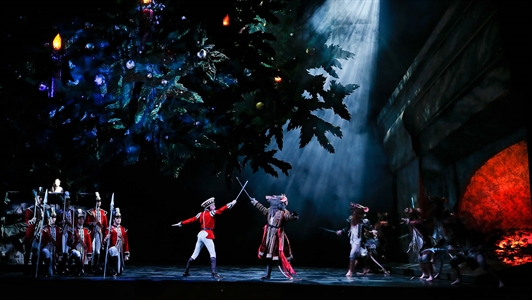
As night falls, Clara finds herself drawn into a remarkable adventure. The nutcracker comes to life, and the familiar surroundings of the family home begin to change. A battle between toy soldiers and an army of mice introduces a more dramatic dimension to the story, before the nutcracker transforms into a prince.
What follows is a journey through an imagined landscape filled with dancing characters, elaborate costumes and scenes that move between fantasy and celebration.
The second act brings Clara and the Prince to the Land of Sweets, where they encounter a succession of dances and characters. It is here that some of the ballet's most recognisable moments unfold, culminating in the celebrated performance of the Sugar Plum Fairy.
The narrative is relatively straightforward, but its theatrical possibilities are considerable. It gives the production room to move between domestic familiarity, adventure and spectacle without losing the sense of a child's expanding imagination.
Tchaikovsky's Music and the Language of Ballet
Much of The Nutcracker's lasting appeal can be traced to the score by Russian composer Pyotr Ilyich Tchaikovsky.
Written in the final years of his life, the music has become deeply embedded in popular culture. Its melodies are regularly heard during the Christmas period, often removed from their original theatrical setting. Within the ballet, however, they take on a different character, working alongside the dancers to establish atmosphere, movement and narrative.
The familiar Dance of the Sugar Plum Fairy is perhaps the most immediately recognisable passage. Its delicate, distinctive sound creates an almost weightless quality, while other sections of the score bring a more energetic and celebratory character to the stage.
The music moves between gentle passages and larger orchestral moments, giving the dancers a framework through which to express the changing moods of the story.
For the Sydney season, the production will feature the Opera Australia Orchestra. The presence of an orchestra adds another dimension to the experience, allowing audiences to encounter Tchaikovsky's compositions as part of a complete theatrical performance rather than simply as familiar Christmas music.
It is this relationship between music and movement that makes the ballet particularly accessible. Even when the story becomes fantastical, the emotional direction remains clear through the changing rhythms and melodies.
A Stage World of Snow, Soldiers and Sweets
The visual world of this production is an important part of its identity.
Designed by John F. Macfarlane, the sets and costumes create an environment that moves between the warmth of a Christmas gathering and the more elaborate landscapes of Clara's imagined journey.
The opening domestic scenes establish a sense of Victorian-era celebration, with the Christmas tree and festive surroundings providing the foundation for the adventure to come. As the story develops, the stage becomes increasingly imaginative, introducing theatrical transformations and richly detailed settings.
One of the production's defining images is the Christmas tree, which grows to an extraordinary scale, changing the proportions of the room and suggesting the way a child's imagination can transform an otherwise familiar space.
The journey into the winter landscape introduces another visual shift. Snowflakes, soldiers and elaborate costumes contribute to the atmosphere, while the Land of Sweets provides a more colourful setting for the ballet's celebrated ensemble dances.
The Sugar Plum Fairy, in particular, brings a distinctive visual presence to the production. Her appearance is closely associated with the ballet's most recognisable music and its final celebrations.
These elements are not simply decorative. They help establish the different worlds through which Clara travels, giving the audience a sense of movement between reality and fantasy.
For younger visitors, the changing scenery offers an accessible introduction to theatrical storytelling. For those more familiar with the ballet, the production's traditional visual language provides an opportunity to revisit details that have helped keep the work relevant across generations.
The Sydney Opera House as a Setting for The Nutcracker
The location adds another layer to the experience.
Situated at Bennelong Point, the Sydney Opera House occupies one of the city's most recognisable stretches of waterfront. Its white sails are familiar against the harbour, but the surrounding precinct has a character that changes throughout the day.
During the warmer months, the area becomes a natural gathering point for visitors, locals and those travelling into the city for an evening performance. The harbour reflects the changing light, ferries move between the surrounding wharves and the nearby Royal Botanic Garden provides a quieter contrast to the activity around Circular Quay.
Inside the building, the Joan Sutherland Theatre offers a more intimate setting for ballet and opera. The theatre is designed to bring audiences close to the stage, where the details of choreography, costume and movement become central to the experience.
Arriving before a performance allows time to take in the building and its surroundings. A walk along the waterfront, a stop for a drink or a meal nearby, or simply a few minutes watching the harbour can turn the performance into part of a longer Sydney outing.
For visitors travelling into the city, the Opera House is also well connected to public transport. Circular Quay is within walking distance, with train, ferry and bus services providing access from different parts of metropolitan Sydney.
The setting is particularly appealing during December, when the city's outdoor spaces remain active into the evening. It creates an interesting contrast with the imagined winter landscapes unfolding inside the theatre.
A Ballet for Different Generations
Few classical ballets have maintained the same level of seasonal recognition as The Nutcracker. Its story is rooted in childhood, but its audience extends well beyond younger visitors.
For families, the production offers an opportunity to introduce children to live performance through a story that is relatively easy to follow. Clara's journey provides a recognisable starting point, while the changes in scenery, character and music sustain interest as the narrative develops.
For adults, the ballet can bring back memories of earlier performances, childhood Christmas traditions or simply the familiarity of Tchaikovsky's score.
There is also a broader appeal for those who are new to ballet. The Nutcracker does not require an extensive understanding of classical dance or its history. Its storytelling is visual, its music is accessible and its theatrical world provides a natural introduction to the form.
The production also offers an opportunity to appreciate the physical discipline behind classical ballet. The apparent ease of a dancer's movement is supported by years of training, repetition and technical precision. Even within the more fantastical sections, the choreography depends on control, balance and the relationship between individual performers and the ensemble.
It is this combination of technical skill and imaginative storytelling that continues to give the work its place in the repertoire.
Making a December Outing of The Nutcracker
With its run extending from late November into December, the Sydney season will coincide with the period when the city begins to embrace its Christmas celebrations.
A visit to the Opera House can comfortably form part of a wider day in the city. The nearby Royal Botanic Garden offers shaded walking paths and harbour views, while Circular Quay provides access to ferry services and some of Sydney's most familiar waterfront landmarks.
Those attending an afternoon performance may prefer to spend time exploring the harbour precinct beforehand, while evening visitors can make a longer occasion of the outing with dinner or a walk along the waterfront afterwards.
The Opera House's position also makes it accessible for visitors staying in the city centre. Walking from Circular Quay is straightforward, although allowing extra time during busy periods is sensible.
The performance runs for approximately two hours and five minutes, including a 25-minute interval. Visitors should check their individual ticket for the confirmed starting time, as the schedule varies throughout the season.
Families planning to attend should also be aware that children aged 15 and under must be accompanied by an adult. The production includes theatrical haze, strobe and flash lighting, as well as a single gunshot during Act One. These details are worth considering when deciding whether the performance is suitable for younger audience members.
The Nutcracker and the Enduring Appeal of Christmas Ballet
There are many ways to mark the arrival of Christmas in Sydney. Some involve familiar gatherings, others take place outdoors, and many are shaped by the city's changing calendar of performances and cultural events.
The Nutcracker occupies a particular place among these traditions because it offers an alternative seasonal landscape. Its winter imagery may seem distant from an Australian summer, but the story's central themes of wonder, anticipation and imagination remain familiar.
There is also something reassuring about the return of a work that has been performed and reinterpreted for generations. Its melodies are recognisable, its characters have become part of the wider Christmas imagination, and its structure allows audiences to experience the same story while discovering different details each time.
For The Australian Ballet, the 2026 Sydney season continues that tradition at a time when the city is preparing for the holidays. For audiences, it provides an opportunity to step away from the pace of December and spend an afternoon or evening in the theatre.
As the performance draws towards its conclusion, the world of Clara's adventure gradually gives way to the familiar setting of the Christmas story. The music, costumes and theatrical scenery leave their impression, but it is the sense of possibility at the heart of the ballet that tends to linger.
Outside, Sydney will be moving towards another warm summer evening. Ferries will continue crossing the harbour, the waterfront will remain busy and the city will carry on with its preparations for Christmas.
For a little while, however, audiences will have been somewhere quite different. And perhaps that is the enduring appeal of The Nutcracker: not simply its celebration of Christmas, but its reminder that even familiar surroundings can become extraordinary when seen through the eyes of imagination.
Event Details
Event: The Nutcracker
Presented By: The Australian Ballet
Dates: 28 November to 16 December 2026
Venue: Joan Sutherland Theatre, Sydney Opera House
Address: Bennelong Point, Sydney NSW 2000
Performance Duration: Approximately 2 hours and 5 minutes, including a 25-minute interval.
Music: Pyotr Ilyich Tchaikovsky
Choreography: Peter Wright, Lev Ivanov and Vincent Redmon
Set and Costume Design: John F. Macfarlane
Orchestra: Opera Australia Orchestra
Performance Times:
- Saturday 28 November: 7.30pm
- Monday 30 November: 6.30pm
- Tuesday 1 December: 7.30pm
- Wednesday 2 December: 1.30pm and 7.30pm
- Thursday 3 December: 7.30pm
- Friday 4 December: 7.30pm
- Saturday 5 December: 1.30pm and 7.30pm
- Monday 7 December: 6.30pm
- Tuesday 8 December: 7.30pm
- Wednesday 9 December: 1.30pm and 7.30pm
- Thursday 10 December: 7.30pm
- Friday 11 December: 7.30pm
- Saturday 12 December: 1.30pm and 7.30pm
- Monday 14 December: 6.30pm
- Tuesday 15 December: 1.30pm and 7.30pm
- Wednesday 16 December: 1.30pm
Official Information and Tickets: https://australianballet.com.au/performances/the-nutcracker
Performance times and ticket availability are subject to change. Check the official website before attending.
Photos by: Daniel Boud