
The Overture brings Bach, Mozart, Reinecke and Brahms to Turramurra on 22 November, with the Ku-ring-gai Philharmonic Orchestra celebrating the colour and craft of classical music.
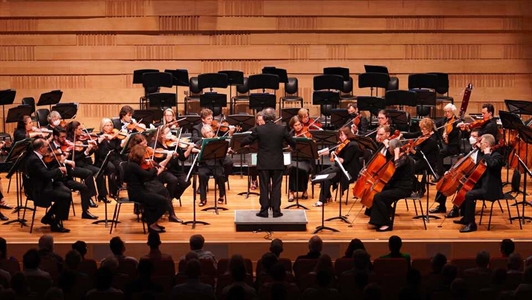
On a Sunday afternoon in Turramurra, the familiar rhythm of the Upper North Shore gives way to another kind of gathering. People arrive from leafy streets and nearby railway platforms, exchanging the pace of weekend errands for the anticipation of live music. Inside Turramurra Uniting Church, chairs fill and conversations settle. Instruments are tuned, scores are opened, and the room gradually becomes attentive.
The Overture offers an opportunity to hear four distinct voices from the European classical tradition in a single afternoon. Presented by the Ku-ring-gai Philharmonic Orchestra, the concert brings together Johann Sebastian Bach, Wolfgang Amadeus Mozart, Carl Reinecke and Johannes Brahms in a programme that moves from intricate Baroque counterpoint to the expressive breadth of the nineteenth-century orchestra.
At its centre is a conversation between musical eras. Bach’s Brandenburg Concerto No. 5 places a dazzling harpsichord part alongside the orchestra. Mozart’s Symphony No. 38, known as the Prague, brings theatrical energy and clarity. Reinecke’s Flute Concerto gives a young soloist room to explore three contrasting musical characters, while Brahms’s Variations on a Theme of Haydn closes the programme with a work of architectural strength and rich orchestral detail.
For listeners who know these composers well, the afternoon offers the pleasure of familiar works heard in a shared space. For those newer to classical music, it provides an inviting way into a repertoire shaped by melody, invention and the enduring appeal of live performance.
The Overture And The Pleasure Of Listening Closely
Classical music can seem imposing from a distance. The names are well known, the compositions carry centuries of history, and the concert hall can appear to demand a particular kind of knowledge from its audience. Yet the experience of listening is often much simpler than that reputation suggests.
A melody catches the ear. A rhythm establishes a pattern, then shifts it. One instrument answers another, or a quiet passage gives way to a sudden flourish. The listener does not need to identify every musical technique to recognise a change in mood or feel the momentum of a performance gathering strength.
The Overture draws on that accessibility without flattening the differences between its composers. Each work has its own character, shaped by the musical language of its time and the imagination of the person who wrote it.
Bach builds intricate patterns in which individual lines retain their independence while contributing to a larger design. Mozart balances formal precision with dramatic instinct. Reinecke gives the flute a lyrical and expressive role, and Brahms finds new possibilities in a theme through variation, contrast and accumulating orchestral colour.
Heard together, the works make a case for variety within tradition. The programme does not tell a single story so much as reveal several ways music can organise time, emotion and movement.
Bach Opens The Afternoon With A Conversation Between Instruments
Bach’s Brandenburg Concerto No. 5 is an especially engaging place to begin. Part of a collection of six concertos dedicated to Christian Ludwig, Margrave of Brandenburg, in 1721, the work belongs to a period when composers were exploring the possibilities of combining solo instruments with an ensemble.
The fifth concerto is particularly notable for its harpsichord part. Rather than remaining quietly in the background as an accompanying instrument, the harpsichord takes on an increasingly prominent role, eventually launching into an extended solo passage that gives the music a sense of forward motion and virtuosity.
The effect is conversational. Instruments introduce ideas, respond to one another and compete for attention without losing sight of the overall structure. The harpsichord's bright, sharply defined sound brings a different texture to the strings and flute, allowing the details of Bach's writing to emerge.
For this performance, Esther Yae Ji Kim joins Wendy Hall and Andrew Watkins as Brandenburg Concerto soloists. Kim's musical background encompasses both modern performance and the study of historical keyboard instruments, a field that considers how instruments, technique and musical conventions influence the sound of earlier repertoire.
That perspective is particularly relevant to Bach. His music depends on the independence of individual lines, but its intricacy does not make it cold. Beneath the precision is an energetic sense of exchange, with each musical idea helping to propel the next.
The concerto sets an alert, lively tone for the afternoon, inviting listeners to follow the movement of sound rather than simply wait for a familiar tune.
Mozart’s Prague Symphony Finds Drama In Clarity
Mozart’s Symphony No. 38 arrives from a different musical world. First performed in Prague in 1787, the symphony reflects a composer whose work moves comfortably between elegance and theatrical tension.
Its nickname, the Prague, refers to the city where it receives its premiere. The work also belongs to a particularly productive period in Mozart’s life, close to the extraordinary success of his opera The Marriage of Figaro.
The relationship between opera and symphony is not simply a matter of borrowing melodies. Mozart brings a dramatic sensibility to instrumental music, allowing contrasting ideas to behave almost like characters in a scene. Themes appear, develop and return with changes in emphasis, while shifts in orchestral texture keep the music alert.
The result is a work with considerable movement beneath its polished surface. The lines are clear, the exchanges can be playful, and moments of tension arrive without disturbing the larger balance.
For the listener, the appeal lies partly in the sense that the music is always going somewhere. A phrase can seem to pose a question; the next passage answers it, complicates it or leads the ear in a fresh direction.
Placed after Bach, the symphony reveals a change in musical language while retaining a shared interest in structure and interplay. The conversation between instruments continues, but Mozart gives it a distinctly theatrical quality.
The Overture Introduces Young Flutist Amily He
One of the afternoon's central features is Carl Reinecke’s Flute Concerto, performed by Amily He. A Year 12 student at the Conservatorium High School, He is part of a generation of young musicians developing their craft through intensive study, competitions and public performance.
Her musical beginnings were unusually early. She started on the fife at six, moved to the piccolo a year later and began studying the flute at ten under Noelene Poole. She now studies with Amanda Hollins and has previously worked with Rosamund Plummer.
Her competition results include wins at the 2025 Australian Flute Festival in the Piccolo 32 and Under category, the 2025 KPO NSW Secondary Schools Concerto Competition and the 2024 Sydney Eisteddfod Open Age Woodwind Concerto.
These achievements offer a sense of the commitment behind a solo performance. Preparing a concerto requires more than technical accuracy. A musician must shape long phrases, listen closely to the orchestra and maintain a clear musical direction across contrasting movements. In a live setting, those decisions unfold in real time.
Reinecke’s concerto gives He plenty of room to demonstrate that range. The opening movement has a sunny, pastoral character, suggesting open air and unhurried movement. The second turns towards a more sombre, reflective mood, before the finale brings a stronger sense of boldness and resolution.
The contrast between the movements gives the work its particular appeal. The flute can sound delicate and conversational, but it can also rise above the orchestra with striking clarity. The soloist is not merely displaying agility; she is guiding the listener through a sequence of changing emotional landscapes.
For a local audience, the performance also carries a quieter significance. Concerts provide emerging musicians with the chance to move beyond rehearsal rooms and competitions into the shared experience of a public performance. The audience becomes part of that process, listening not only to the composition but to a musician making the music her own.
Brahms Brings The Programme To A Rich Conclusion
The final work, Brahms’s Variations on a Theme of Haydn, offers a change in scale and texture. Composed in 1873, it takes a musical theme and explores its possibilities through a sequence of variations, each altering the material while preserving a connection to its source.
Variation form is one of classical music’s most satisfying ways of revealing how much can be found within a small idea. A theme may be reshaped through changes in rhythm, harmony, orchestration or mood. Sometimes the original character remains recognisable; at other moments, it seems to have travelled a considerable distance.
Brahms approaches the form with characteristic care. The music is richly contrapuntal, with independent lines woven together to create a dense but carefully balanced texture. Individual sections have their own identities, yet each contributes to a larger progression.
The work also marks an important stage in Brahms’s development as an orchestral composer. By the time he writes the variations, he is finding increasing confidence in the demands of large-scale instrumental writing. The music displays both a deep respect for earlier traditions and a willingness to make them speak in a distinctive voice.
Following Reinecke’s flute concerto, Brahms broadens the focus from the individual soloist to the orchestra as a whole. The listener can attend to the changing combinations of instruments, the recurring shape of the theme and the way the music builds towards its conclusion.
It is a fitting end to a programme concerned with the many ways composers transform musical ideas. Bach creates dialogue between instruments, Mozart balances dramatic contrasts, Reinecke explores shifts in character and Brahms discovers fresh perspectives through repetition and change.
A Local Orchestra With A Broad Musical Outlook
The Ku-ring-gai Philharmonic Orchestra has long contributed to the musical life of Sydney's northern suburbs. As a community orchestra with a substantial pool of musicians, it brings symphonic repertoire to audiences beyond the city's largest performance venues.
That local presence matters. Live orchestral music is often associated with major concert halls and formal cultural precincts, yet it also belongs in neighbourhoods where people can make an afternoon of attending a performance without travelling into the city.
Turramurra Uniting Church provides a different setting from a large purpose-built auditorium. Located on Turramurra Avenue, close to the railway station and the suburb's everyday centre, the venue places the concert within the ordinary geography of the North Shore.
The experience begins before the first note. There is the walk from the station, the familiar streets and the gradual shift in attention as the audience gathers. Afterwards, the music can follow listeners back into the afternoon, giving a familiar Sunday a different shape.
For regular concertgoers, the programme offers a chance to revisit important works in a live setting. For newcomers, it creates a natural entry point into orchestral music, with four composers whose differences are as revealing as their shared foundations.
Planning A Visit To The Overture
The Overture takes place on Sunday 22 November 2026, beginning at 2:30pm at Turramurra Uniting Church, 10 Turramurra Avenue, Turramurra, NSW 2074. The concert is presented by the Ku-ring-gai Philharmonic Orchestra, conducted by Luke Spicer, with Amily He as flute soloist.
The programme features Bach’s Brandenburg Concerto No. 5, Reinecke’s Flute Concerto, Mozart’s Symphony No. 38, known as the Prague, and Brahms’s Variations on a Theme of Haydn. Esther Kim, Wendy Hall and Andrew Watkins perform as the Brandenburg Concerto soloists.
Listed ticket prices are $50 standard, $40 concession, $25 junior or child, and $110 for a family of four, with a maximum of two adults per family ticket. Visitors should check the official event page for current ticket availability and any updated details before attending.
Turramurra is served by the T1 North Shore railway line, making the venue accessible by public transport. Those driving should allow time to find parking in the surrounding area and check any local restrictions.
Event details
Date: Sunday 22 November 2026
Time: 2:30pm
Venue: Turramurra Uniting Church
Address: 10 Turramurra Avenue, Turramurra NSW 2074
Presented by: Ku-ring-gai Philharmonic Orchestra
Conductor: Luke Spicer
Flute soloist: Amily He
Official event and tickets: https://www.kpo.org.au/current/home/concerts/111-november
When The Last Note Fades
An afternoon of classical music does not need to offer a grand revelation to be worthwhile. Sometimes its value lies in the attention it asks of us: a willingness to follow a melody, notice a change in texture or sit quietly while one musical idea gives way to another.
The Overture brings together composers separated by generations, each with a different approach to form, drama and expression. Their music moves from the intricate exchanges of Bach to Mozart’s theatrical clarity, through Reinecke’s shifting moods and into the broad architecture of Brahms.
For a few hours in Turramurra, these works share the same room and the same audience. The experience belongs neither entirely to history nor to the page. It exists in the sound of instruments responding to one another, in the concentration of the performers and in the collective silence between phrases.
When the final note fades and the audience steps back into the North Shore afternoon, the streets will look much as they did before. The difference may be small but lasting: a melody remembered, a new composer discovered, or a familiar piece heard with fresh attention.