
The Underwater Photography Competition reveals the remarkable marine life of the Northern Beaches, with award-winning images heading to local exhibitions.
Beneath the shifting surface of the water, the familiar coastline of Sydney’s Northern Beaches becomes another kind of landscape. Light breaks into fragments across the sand. Kelp moves with the current, small fish hover close to shelter and creatures that might escape an ordinary swimmer’s notice carry on with their quiet business.
It is a world that asks for patience. To see it clearly requires more than a camera and a dive beneath the surface. It means learning to wait, to look closely and to recognise the extraordinary detail in places that can appear, from above, entirely ordinary.
The Northern Beaches Council’s sixth annual Underwater Photography Competition offers a glimpse into that world through the eyes of the people who spend time exploring it. This year’s winning photographs reveal the variety of marine life found along the coast, from delicate organisms that reward a close look to larger animals moving through the underwater landscape.
Gerrad Kennedy has received the Valerie Taylor Award for Excellence for his photograph Whispers in the Reserve, a finely observed image of a hydroid. Beverly Southern has won the People’s Choice Award with I See You, which captures a toadfish and its reflection in the shallows.
The winning images will soon be available to view in person, beginning with an exhibition at Ruby Lane Café in Manly from Friday 6 November to Friday 20 November 2026. The photographs will then travel to Mona Vale Library and Manly Library, giving visitors further opportunities to encounter the Northern Beaches’ marine environment through the work of local photographers.
The Underwater Photography Competition is more than a showcase of technical skill. It is also an invitation to reconsider the coastline, and to look beyond the surface of a place many people know through beaches, headlands and familiar swimming spots.
A Closer Look At Life Beneath The Surface
The overall award recognises an image that makes a small subject feel expansive. In Whispers in the Reserve, Gerrad Kennedy photographs a hydroid, a delicate marine organism whose fine, plant-like form can be easy to overlook.
The judges praised the composition and clarity of detail, noting the way its outstretched tentacles draw the viewer closer. They also recognised the image as an example of the diversity of life that can flourish when aquatic reserves provide protection.
It is a fitting choice for an award named after Valerie Taylor, whose long association with underwater photography and marine conservation has helped bring the life of the ocean into public view. The award's emphasis on excellence sits alongside a broader purpose: encouraging people to see the marine environment as a living place, rich in detail and deserving of care.
Macro photography, the category in which Kennedy's image also took first place, depends on a particular kind of attention. It asks the photographer to move away from the grand sweep of the underwater scene and concentrate on a smaller subject. A tentacle, a pattern, an eye or a subtle shift in colour can become the centre of the frame.
The result can change the way a viewer understands the ocean. Instead of seeing a stretch of blue water or a rocky reef as a single landscape, the photograph reveals a collection of individual lives and intricate relationships.
That change in scale is one of the pleasures of the Underwater Photography Competition. It gives viewers access to details they may never have noticed, even if they have spent years visiting the same beaches.
The People's Choice: A Moment Of Recognition
While the Valerie Taylor Award for Excellence recognises the judges' selection, the People's Choice Award offers a different measure of connection. More than 550 people voted, choosing Beverly Southern's I See You as the public favourite.
The photograph captures a toadfish in the shallows, its reflection visible as it peers towards the photographer. There is a quiet encounter at the centre of the image. The fish is neither presented as a distant curiosity nor transformed into a dramatic spectacle. Instead, the photograph creates a moment of recognition between the animal and the person observing it.
That sense of meeting another life on its own terms may help explain the image's appeal. A toadfish is not necessarily the first creature people imagine when they think of underwater photography, yet the photograph gives it presence and character.
The public vote also demonstrates the value of making these images accessible beyond the diving and photography communities. People do not need specialist knowledge to respond to an expressive image of marine life. A clear composition or an unexpected encounter can be enough to prompt curiosity.
The Underwater Photography Competition brings those responses together, allowing the public to share in the process of recognising the beauty and variety of the local marine environment.
Eight Categories, One Remarkable Coastline
The competition's categories reflect the different ways photographers can approach the underwater world. Behaviour, Macro, Threatened Species, Human Connection, Seascapes, Youth, Reels and People's Choice each offer a distinct perspective, from the movement of marine animals to the relationship between people and the places they study and protect.
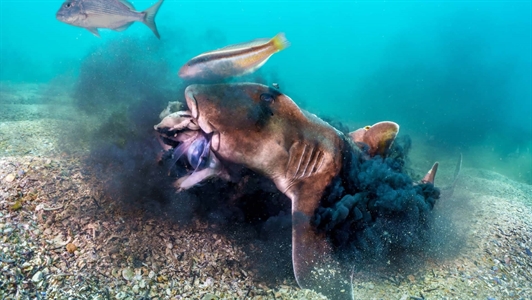
In the Behaviour category, Peter McGhee's Smoke Screen took first place, with Peter Hutchins' The Hunter Below named runner-up. Alastair Pollock's Angel Shark Jaws and Talia Gries' Beneath the Bell received highly commended recognition. These images focus on the actions and interactions of marine life, capturing moments that can be difficult to anticipate and even harder to photograph.
Kennedy's Whispers in the Reserve also won the Macro category. Edward Midgely's A Splash of Colour was runner-up, while William Gladstone's Piano Fangblenny and Lesley Spencer's Eye of the Eastern Fiddler Ray were highly commended.
The Threatened Species category brings attention to animals whose future depends on the health of their habitats and the protection of vulnerable populations. Darian Woods won with Seagrass Sanctuary, followed by Thomas Hutton's Wandering Weedy. Terence Tong's Misunderstood and Alizee Berger's In the Slipstream were highly commended.
The category is a reminder that underwater photography can do more than record an encounter. An image of a threatened animal can make an environmental issue immediate, giving viewers a reason to learn about the species and the pressures it faces. The photographs do not need to explain every conservation challenge to encourage a closer look.
In Human Connection, Edward Midgely's Care Flight received the winning award. Xina Hudson's Eye to Eye with a Ghost was runner-up, and Oscar Lo Lu's I'm a Sucker for a Tentacle was highly commended. The category recognises the positive and negative relationships between people and marine life, including research, monitoring and citizen science in aquatic reserves.
The Seascapes category takes a wider view. Rosie Richards won with Shallow Passage, while Peter Hutchins' Between Stone and Sea was runner-up. Daniel Sly's Shallow Giant received a highly commended mention. Here, the emphasis shifts from individual creatures to the underwater vista itself, with the scale and character of the marine environment becoming the subject.
Together, the categories give the Underwater Photography Competition a breadth that mirrors the coastal environment it celebrates. Some images invite close inspection; others encourage viewers to take in the wider setting. Each offers a different reason to pay attention.
A New Generation Of Underwater Photographers
The Youth category recognises photographers aged 12 to 17, making room for young people developing their skills and finding their own ways to interpret the marine environment.
Evelyn Christopher was named Underwater Youth Photographer of the Year 2026 for Rose Petal Bubble Shell. Ria Havlicek received runner-up recognition for Aspiring Model, while Thomas Bryant's A Ray Among the Grass and Dan Parker's Mesmerising Movement were highly commended.
The inclusion of a youth category is significant because an interest in the natural world often begins with a moment of curiosity. A young photographer might first notice the movement of a fish in a rock pool, the pattern of light across seagrass or the unusual shape of a small marine animal. Learning to photograph that moment can lead to a deeper interest in the habitat around it.
Underwater photography also calls for care. Working around marine life means understanding that the subject is not there for the photographer. Good observation involves patience and respect for the animal and its environment, with the image taking second place to the health of the habitat.
The competition's youth awards recognise creative achievement while giving emerging photographers a public platform. Their work sits alongside that of experienced entrants, suggesting that a fresh perspective can be just as valuable as years behind a camera.
Reels Bring The Underwater World Into Motion
Still photographs are only part of the competition. The Reels category invites entrants to capture the biodiversity of the underwater world in short videos running between 15 and 30 seconds.
In the Youth Reels section, Ezra Boulton won with Too Many Fish to Count. The Open Reels category was won by Peter Hutchins for A World Beneath. Darian Woods' Beneath Cabbage Tree Bay was runner-up, while Guy Fenton's Discovering Sydney's Life Below and Rosie Richards' Where the Wild Things Thrive received highly commended recognition.
Motion adds another dimension to underwater storytelling. A still image can hold a single instant, but a short film can show the movement that surrounds it: fish changing direction, a creature responding to the current or the shifting life within a reef.
The short format also asks its maker to be selective. In only a few seconds, a reel must establish a subject and give the viewer enough time to appreciate what is happening. It is a different discipline from still photography, but it shares the same central requirement: careful observation.
The Underwater Photography Competition therefore recognises more than one way of communicating the character of the coast. Whether through a close-up image, a broad seascape or a brief moving sequence, the aim is to bring the hidden life of the water into view.
The Aquatic Reserves That Make These Images Possible
The competition invites amateur and professional photographers of all ages and backgrounds to explore the beauty and diversity of the Northern Beaches' five aquatic reserves.
Aquatic reserves are important because they provide designated areas in which marine habitats and wildlife receive protection. Their value extends beyond the boundaries marked on a map. Healthy underwater environments support biodiversity, provide places for marine species to live and reproduce, and contribute to the broader health of coastal ecosystems.
For photographers, these places offer a remarkable range of subjects. Rocky reefs, seagrass beds and sheltered shallows each support different forms of marine life. Conditions change with the tide, the weather and the season, meaning that even a familiar location can reveal something new on another visit.
The photographs in this year's competition reflect that variety. A delicate hydroid, a toadfish, a seagrass habitat and an expansive underwater passage may seem like very different subjects, but each helps tell a larger story about the coastline.
That story is particularly relevant to people who know the Northern Beaches through their time above the water. Swimming, walking, boating and fishing all create connections with the coast, but the underwater environment remains largely unseen. Photography offers a way to make that less familiar landscape part of the public conversation.
The competition also gives conservation a human dimension. Rather than presenting marine protection as an abstract responsibility, it shows the life that depends on healthy habitats. The images encourage viewers to recognise what exists beneath the surface and consider what might be lost if those environments are not cared for.
From The Competition To The Exhibition
For those who would like to spend more time with the winning photographs, the exhibition programme provides several opportunities to see them in person.
The first display will be held at Ruby Lane Café in Manly from Friday 6 November to Friday 20 November 2026. It will then move to Mona Vale Library, where the exhibition is scheduled to run from 30 November 2026 to 2 February 2027. A further showing will take place at Manly Library from 8 February to 2 April 2027.
The different venues offer a chance to encounter the photographs in the course of an ordinary day. At a café, an image might catch someone's attention between conversations or over a morning coffee. In a library, the exhibition becomes part of a quieter public space, where visitors can take their time and look more closely.
The movement between venues also extends the reach of the competition beyond its original audience. People who may not follow underwater photography or regularly visit aquatic reserves can come across the images as part of their everyday routines.
The winning entries are also available to view through Northern Beaches Council's website. This provides another way to explore the work, including the category winners and recognised photographs.
The People Behind The Judging
The judging panel brought together experience across public art, underwater photography, citizen science and environmental education.
Holly Williams, Public Art Curator at Northern Beaches Council, joined local author, underwater photographer and dedicated citizen scientist John Sear, along with environmental educator and marine conservation advocate Robynne Millward.
Their combined perspectives are relevant to a competition that sits between artistic practice and environmental awareness. An underwater photograph needs to work visually, but it can also communicate something about a habitat, a species or the relationship between people and the marine environment.
The judges' comments on Whispers in the Reserve illustrate that balance. Their praise focused on its composition and fine detail, while also recognising the wider significance of aquatic reserves in supporting marine diversity.
For Mayor Sue Heins, the competition reflects the community's connection to the natural environment. She congratulated the entrants, finalists and winners, noting the ability of the photographs to reveal the coastline from a different perspective and reinforce the importance of protecting it for future generations.
That community connection is part of what gives the event its lasting relevance. The photographers provide the images, but the exhibition invites a much wider audience to take part in the act of looking.
Seeing The Coast Differently
The Northern Beaches are often experienced through their open spaces: long stretches of sand, coastal walks, ocean pools and headlands looking out towards the Pacific. The underwater landscape is less familiar, even to people who have spent much of their lives beside the sea.
The Underwater Photography Competition offers a different point of entry. It asks viewers to consider the small lives and complex habitats that exist just beyond the waterline, and to recognise that the character of the coast is not defined by its visible shoreline alone.
There is a quiet generosity in these photographs. They allow the photographer to share an encounter that might otherwise remain private, whether it is the delicate structure of a hydroid or the direct gaze of a fish in shallow water. The images do not require viewers to be divers or specialists. They simply ask for a little time and attention.
When the exhibition opens at Ruby Lane Café in Manly on 6 November, it will bring that hidden world into a familiar public setting. Later displays at Mona Vale and Manly libraries will continue the invitation into the new year.
For visitors, the experience may begin with a single photograph. It might end with a new curiosity about the aquatic reserves, a closer look at the water on the next coastal walk or a greater appreciation of the life supported by the local marine environment.
The ocean can seem vast from the shore, but these images remind us that its richness is often found in the smallest details. Sometimes, seeing the coast differently begins by looking a little closer.
Event And Exhibition Details
Competition: Northern Beaches Council Underwater Photography Competition 2026
Overall Award Winner: Gerrad Kennedy, Whispers in the Reserve
People's Choice Winner: Beverly Southern, I See You
Exhibition Dates And Locations:
- Ruby Lane Café, Manly: Friday 6 November to Friday 20 November 2026
- Mona Vale Library: 30 November 2026 to 2 February 2027
- Manly Library: 8 February to 2 April 2027
Exhibition Times: Daily opening hours have not been specified in the supplied event information. Check with each venue before visiting.
Entry: Check the official event page for exhibition access details.
Winning Entries And More Information: Northern Beaches Council – Underwater Photography Competition
Aquatic Reserves: Northern Beaches Council – Aquatic Reserves