
The Woollahra Small Sculpture Prize returns to Double Bay from 2 October, marking 25 years with 49 finalists exploring memory, nature, materials and place.
There is something particularly intimate about encountering sculpture on a small scale. A large work can command a room from a distance, but a smaller object asks something different of the person standing before it. You move closer. You notice a surface, a fragment, an unusual join. You begin to wonder what happened before the object arrived in the gallery and what story might have given it its shape.
That sense of close observation will be central to the 2026 Woollahra Small Sculpture Prize, which will return to Woollahra Gallery at Redleaf in Double Bay from 2 October to 29 November.
This year marks the 25th anniversary of the prize, an occasion that also provides a useful moment to consider how much contemporary sculpture has changed since the first exhibition in 2001. Across those 25 years, the Woollahra Small Sculpture Prize has resisted being defined by one material, one aesthetic or one idea of what sculpture should be.
The 2026 exhibition will bring together 49 finalists selected from 724 local and international entries. Their works will range across bronze, paper, glass and ceramics, alongside assemblages made from found and recycled materials, 3D printed works and kinetic sculpture.
The result will be less a single portrait of contemporary sculpture than a collection of individual perspectives, each compressed into a relatively small physical space.
A Quarter Century Of The Woollahra Small Sculpture Prize
The history of the Woollahra Small Sculpture Prize is closely tied to the idea that scale does not determine ambition.
Since its first exhibition in 2001, the prize has provided a platform for artists working with the possibilities and limitations of small-scale sculpture. Some works have begun with traditional materials, while others have emerged from discarded objects, experiments and unexpected combinations.
For the 2026 exhibition, the judges will consider works from artists based across Australia as well as the United States and Ireland. The finalists will include both emerging and established artists, with the selection reflecting artists at very different points in their careers.
There is also a particular connection between sculpture and place running through this year's finalists. Some artists look to landscapes, childhood memories and natural forms. Others examine history, industry or the physical behaviour of their chosen materials.
The Woollahra Small Sculpture Prize therefore becomes a kind of meeting point. A work might have originated in the Australian landscape, the American Great Plains, an artist's family memory or an experiment in the studio, before arriving in Double Bay to sit alongside something made thousands of kilometres away.
The winning artist will receive the $25,000 Woollahra Small Sculpture Prize, with the work joining Woollahra Council's public art collection. The total prize pool will be $29,000, including the Special Commendation Award, Mayor's Award and Viewer's Choice Award.
Small Works, Wide Landscapes
Among the finalists is Thirroul artist BJ Kim, whose do Geese see God? takes inspiration from seabirds moving along the New South Wales north coast.
The work's title is itself a palindrome, reflecting its dual orientation while opening a more philosophical association between birds, freedom and spirituality. It is an example of the way a small sculpture can hold several ideas at once, allowing an ordinary sight from the landscape to become something more ambiguous.
Another Thirroul artist, Lynda Draper, approaches perception through JET. Drawing on fragmented impressions of her surroundings and an interest in historical artefacts, the work uses glass and clay to create a dialogue between shape and light. The familiar becomes slightly strange, as though an object has been remembered rather than simply observed.
From Oklahoma comes Bryant Chitsey's Thunderstorm, which begins with an object associated with the Great Plains: the haybale.
Constructed through repeated toothpicks and concentric circles, the sculpture transforms a familiar agricultural form into something that carries the weight of childhood memory and regional identity. The work evokes the view across open prairie as clouds gather and rain approaches, while also considering the way a person's upbringing can shape their understanding of place.
These works demonstrate one of the pleasures of the Woollahra Small Sculpture Prize. The physical dimensions may be modest, but the landscapes behind them are not.
The Material World Of Sculpture
Material will also play an important role in the 2026 exhibition.
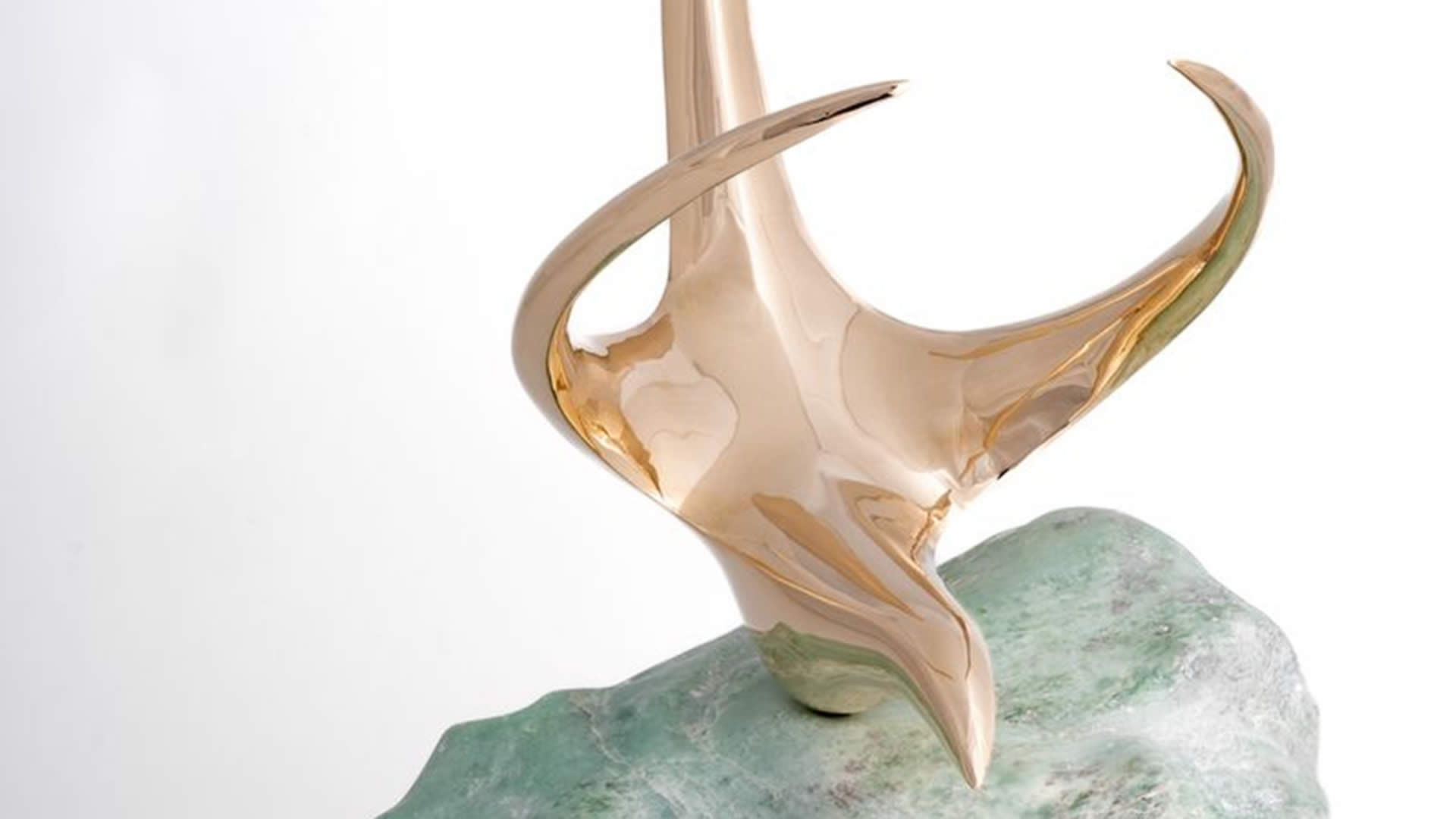
Melanie Cobham's Unfolded Trees begins with the growth patterns of Scribbly Gum Moth larvae. Raw sandstone provides the ground for bronze moulded from Australian Scribbly Gum bark, revealing markings associated with the hidden movement of insects beneath the surface.
The resulting forms resemble topographical drawings. They suggest maps, pathways and the unpredictable patterns of growth, turning something that might normally be overlooked into a study of movement and place.
Tricia Singer's Peacock comes from a different landscape and a deeply personal memory.
The work recalls encountering a peacock at Mataranka and combines wire and rusty metal collected around Iwantja with colours and forms inspired by local wildflowers. Basket-weaving techniques taught to Singer by her mother, senior Tjanpi artist Maringka Burton, helped transform the flower shapes into the bird.
Here, material is inseparable from memory. Objects gathered from Country, inherited knowledge and a family experience all become part of the sculpture.
That relationship between making and remembering will recur throughout the exhibition, where artists use materials not simply because they are suitable for construction, but because they carry associations of their own.
Looking Closely At The Finalists
The 49 finalists will offer a deliberately varied view of contemporary sculptural practice.
The list includes artists such as Anita Johnson, Annabel Lahz, Benjamin Jay Shand, Billie Baker, Christian Atichian, Harriet Schwarzrock, Jacob Davidson, Kat Shapiro Wood, Katherine Sankey, Kelly Fatseas, Liss Finney, Liz Bryan, Mark Booth, Nasim Nasr, Olivia Chin, Omi McCurdie, Robyn Campbell, Samantha Mackie, Sassy Park, Satu Bushell, Silke Raetze, Simon Chalmers, Tony Manning, Tony Tran, Valissa Butterworth and Wanita Lowe, among many others.
There are artists working with established processes and others pushing into less predictable territory. Assemblage features strongly, with found and recycled objects becoming part of new constructions. Other works are shaped through 3D printing, kinetic movement or experiments with the properties of individual materials.
For visitors, this variety means there is no single visual language to learn before entering the exhibition.
Instead, the Woollahra Small Sculpture Prize asks viewers to move between very different ways of thinking about objects. A sculpture may suggest the natural world, a personal history or an industrial process. Another may seem almost abstract until its material begins to reveal where the idea came from.
Judge Emily Sullivan, Assistant Curator of Contemporary International Art at the Art Gallery of New South Wales, describes the finalist works as personal windows into the things that fascinate and affect us, including the natural world, people and the uncanny.
That sense of curiosity is likely to be one of the defining qualities of the exhibition.
A Gallery Exhibition With Room To Explore
Woollahra Gallery at Redleaf provides a fitting setting for the prize.
Located on New South Head Road in Double Bay, the gallery sits within a part of Sydney where urban life, harbour geography and the quieter rhythms of the eastern suburbs meet. The exhibition will offer visitors a reason to spend time indoors looking closely, while the surrounding streets, shops and harbour landscape provide an easy continuation of the day.
The exhibition itself will run from 2 October to 29 November, with the winners announced on 1 October.
Visitors will also be able to encounter the work through a program of tours, talks and workshops. Director's Tours will take place on 3 October, 17 October and 21 November, while Gallery Tours will be presented on selected Sundays throughout October and November.
Artist Talks will take place on 17 October and 21 November, offering an opportunity to hear more about the ideas and processes behind the works.
Workshops will also form part of the program, with morning sessions from 10am to 1pm and afternoon sessions from 2pm to 5pm across selected dates from late September through October.
The program extends the central idea of the Woollahra Small Sculpture Prize beyond simply looking at finished objects. Sculpture is also about process, experimentation and the decisions that happen before something reaches the gallery wall.
A New Prize For Young Sculptors
The 25th anniversary will also introduce a new initiative aimed at younger makers.
The inaugural Woollahra Super Small Sculpture Prize will invite primary school-aged children to create an original sculpture no larger than 15 centimetres in any dimension.
There will be two age categories, for children aged 5 to 8 and 9 to 12, with finalists and winners selected on merit and originality by the Gallery Director and a guest judge.
The finalists will be exhibited online and alongside the main Woollahra Small Sculpture Prize exhibition from 4 to 29 November.
Entries will open online on 21 September and close on 13 October. With prizes available in each age category as well as a Viewer's Choice Award, the initiative offers children an opportunity to experiment with materials and ideas without needing to make something large to make something meaningful.
In some ways, it brings the prize back to its essential premise. Scale is only one part of sculpture. Imagination is another.
The Woollahra Small Sculpture Prize At 25
After 25 years, the Woollahra Small Sculpture Prize has become a record of how artists continue to reconsider the objects and materials around them.
This year's finalists suggest that the impulse remains much the same. Artists are looking at birds, trees, weather, childhood memories, landscapes, industry and found objects, then translating those observations into forms that can be held in the mind long after the physical encounter.
That is perhaps what makes small sculpture so compelling. It demands attention without necessarily demanding a great deal of space.
A visitor might spend several minutes studying a piece no larger than a book, noticing a surface that initially seemed incidental or a detail that changes the character of the whole work. Another sculpture may bring a distant landscape into a gallery in Double Bay, carrying with it the memory of somewhere else.
For the 25th anniversary exhibition, the Woollahra Small Sculpture Prize will gather these small acts of transformation under one roof.
The works will be compact, but the ideas behind them will travel much further, from Australian bushland and desert Country to the American prairie, from family stories to the strange possibilities of glass, bronze, paper and stone.
By the time visitors step back outside onto New South Head Road, the exhibition may leave them looking slightly differently at the objects around them. A discarded fragment, a weathered piece of metal, a pattern in bark or the movement of a bird overhead can become the beginning of a sculpture.
And perhaps that is where the prize's quarter-century story continues: not only inside the gallery, but in the ordinary world beyond it, where artists keep finding new ways to make us look twice.
Event Details
What: 2026 Woollahra Small Sculpture Prize Exhibition
Where: Woollahra Gallery at Redleaf, 548 New South Head Road, Double Bay, NSW
When: 2 October to 29 November 2026
Winners announced: 1 October 2026
Prize: $25,000 Woollahra Small Sculpture Prize, with a total prize pool of $29,000
Public programs: Director's Tours, Gallery Tours, Artist Talks and sculpture workshops across October and November
More information: Woollahra Gallery