
Discover Simone Waddell’s review of the 2026 Australian Poetry Slam NSW Final, celebrating powerful voices, courageous stories and spoken-word artistry.
Words have extraordinary power. They can entertain, challenge, confront injustice, inspire change and move us profoundly. All these qualities were on display at the Australian Poetry Slam NSW Final, held at the magnificent State Library of New South Wales.
I attended with my friend Imelda, who deeply appreciates both the written and spoken word. I knew she would love the evening as much as me, and she certainly did!
Presented by Word Travels, the non-profit organisation bringing Australian Poetry Slam to audiences since 2010, the event showcased 19 finalists from across NSW:
Amy Felicity Robinson (Coffs Harbour), Blake Mackenzie (Newcastle), Brian Daly (Newcastle), Edward Chan (Sydney), Erifili Davis (Dubbo), Gavin Pugh (Wollongong), Guy Simpson (Lithgow), Helen Latukefu (Southern Highlands), Jason Dearmer (Dubbo), Jess Larter (Albury–Wodonga), Julie Haseler-Reilly (Southern Highlands), Kathy Edwards (Central Coast), Rhonda Cowell (Sydney), Robyn Wren (Coffs Harbour), Sarah Lock (Byron), Sophie Holliday (Central Coast), Suzi Andrews (Byron), Swarna (Wollongong) and Tenille Evans (Lithgow).
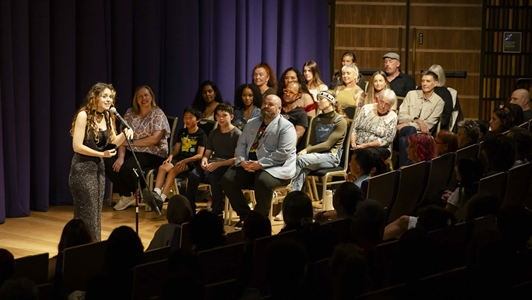
The diversity of subject matter was remarkable. We heard poetry addressing war, Hiroshima, domestic violence, childhood sexual abuse, migration, addiction, racism, motherhood, family, food, technology, propaganda and the increasingly intrusive influence of algorithms. There were also wonderfully light-hearted contributions, offering welcome humour and contrast throughout the evening.
Robyn Wren from Coffs Harbour, who tied for first place, was an absolute standout. Addressing the confronting realities of domestic violence and childhood sexual abuse, Robyn delivered her work with extraordinary courage, conviction and emotional honesty. She was fully prepared, fully heartfelt and fully committed to using her voice as an instrument for change.
Her performance went beyond personal expression. It challenged the complacency of a society that has yet to adequately confront these devastating issues, particularly through meaningful legislative and institutional reform. There was nothing tentative about her delivery. Every word mattered. Her commanding presence, artistic preparation and unwavering commitment made her a deserving winner.
Sharing first place with Robyn was the remarkable Blake Mackenzie, a 12-year-old poet from Newcastle. His moving reflection on Hiroshima demonstrated a maturity, sensitivity and understanding of human suffering far beyond his years. To see someone so young confidently exploring such profound subject matter was genuinely inspiring. Blake subsequently went on to win the 2026 Australian Poetry Slam National Youth Championship at the Sydney Opera House, an extraordinary achievement and richly deserved recognition of his emerging talent.
Brian Daly from Newcastle delivered another of the evening's most powerful performances. His extraordinary poem confronted sexual abuse within the Catholic Church and the hypocrisy surrounding institutional accountability. Drawing a striking comparison with disgraced entertainer Rolf Harris, whose songs have effectively disappeared from public performance, Brian questioned why the Church continues without equivalent consequences for the abuses committed within its institutions.
His offering was courageous, uncompromising, profoundly honest and, in its pursuit of truth and justice, genuinely holy. More holy, I would argue, than the outward religiosity of those who have inflicted such harm while living lives of devastating contradiction.
The audience responded with support and appreciation. It was encouraging to witness a room welcoming the creative exploration of subjects that are too often silenced, minimised or avoided. Brian demonstrated poetry at its most important: speaking truth with artistic integrity and moral courage.
Other memorable contributions explored the experiences of migrants, the suffering of children in war zones, tributes to mothers and grandmothers, family relationships, and the struggle to reclaim human connection in an increasingly digital world.
The most effective performances demonstrated the essential qualities of compelling live artistry: light and shade, dynamic variation, carefully considered pacing, emotional authenticity and thoughtful delivery. Like music, spoken-word poetry relies not only on what is expressed, but how it is communicated. The interplay between rhythm, silence, intensity and restraint can transform a well-written poem into an unforgettable performance.
The evening's host, DEFNE, was wonderfully entertaining, engaging and full of personality, maintaining a lively atmosphere throughout. The DJ also did an excellent job, contributing to the energy and flow of the event.
A special highlight was In Other Words, an exceptional four-woman spoken-word ensemble whose collaborative performance combined individual expression with remarkable unity, theatricality and precision. Their delivery was dynamic, engaging and thoroughly accomplished. They were genuinely outstanding.
As a professional musician, and singer who delves deeply into lyrics and words, I am often struck by the legitimacy and sophistication of spoken-word poetry as a performing artform. It demands exceptional writing, interpretive skill, rhythmic awareness, emotional intelligence, and stagecraft. It deserves recognition and support alongside music, theatre, and other established performance disciplines.
Word Travels deserves considerable credit for championing diverse voices and providing opportunities for artists to develop and share their work. As a non-profit organisation, its important contribution warrants continued philanthropic, corporate and government support.
The NSW Final was inspiring, entertaining, confronting and deeply worthwhile. Above all, it demonstrated that when creativity meets courage, the human voice becomes a formidable instrument for truth, connection and change.
Review by: Simone Waddell