
There is a scene towards the end of Ken Ludwig’s Moriarty where Holmes & Watson are sitting discussing their most recent case. Lush orchestral music plays in the background, strings heavy, reminiscent of the romantic, Franz Waxman scores of 1940s Hollywood movies.
This short scene is a microcosm of the problems with this production: no action, lots of talk, inappropriate cinematic effects intended to compensate for a lack of genuine emotional substance, and a directional approach that doesn’t seem to know the best way to handle this, admittedly, less than engaging material. As if to underline the point, while the stage lights fade, the wailing saxophone riff of Gerry Rafferty’s 1978 hit “Baker Street” takes over, striking a very discordant note (no pun intended). The song not only adds nothing to the production’s mood, style or thematics, it seems to have been tacked on in a lazy attempt to be ‘relevant’: Sherlock Holmes = “Baker Street” - get it?! Not only does it add nothing to the production, it diminishes whatever skerricks of period authenticity the production had laboured to create.
For, despite the efforts to give this ersatz Sherlock Holmes concoction a sense of late Victorian noirish dread & brooding menace so characteristic of the literary works of the time – one thinks of “Dr Jekyll and Mr Hyde”, “The Hound of the Baskerville’s”, and the real life horror of Jack the Ripper – the inexplicable directorial choices keep subverting the best efforts of the actors. Action is constantly interrupted, and any build up of tension and forward momentum is derailed by the interminable trundling on and off of unnecessary furniture and set elements. The director-cum-production designer is at pains to create a set that is flexible and can quickly morph from one location to the next: from Holmes’ residence to a plethora of London and Paris locales, climaxing at the Reichenbach Falls, by introducing myriad chairs, doors, bookcases, windows, street lamps … are you getting my drift? However, all this to-ing and fro-ing is a major distraction, and militates against the essence of a Sherlock Holmes mystery.
If it sounds like I am nit-picking about trivialities, to some extent that may be true, but whichever way you turn, you are presented with odd choices, none moreso than the use of life-size puppets, operated by actors who are not trained puppeteers.
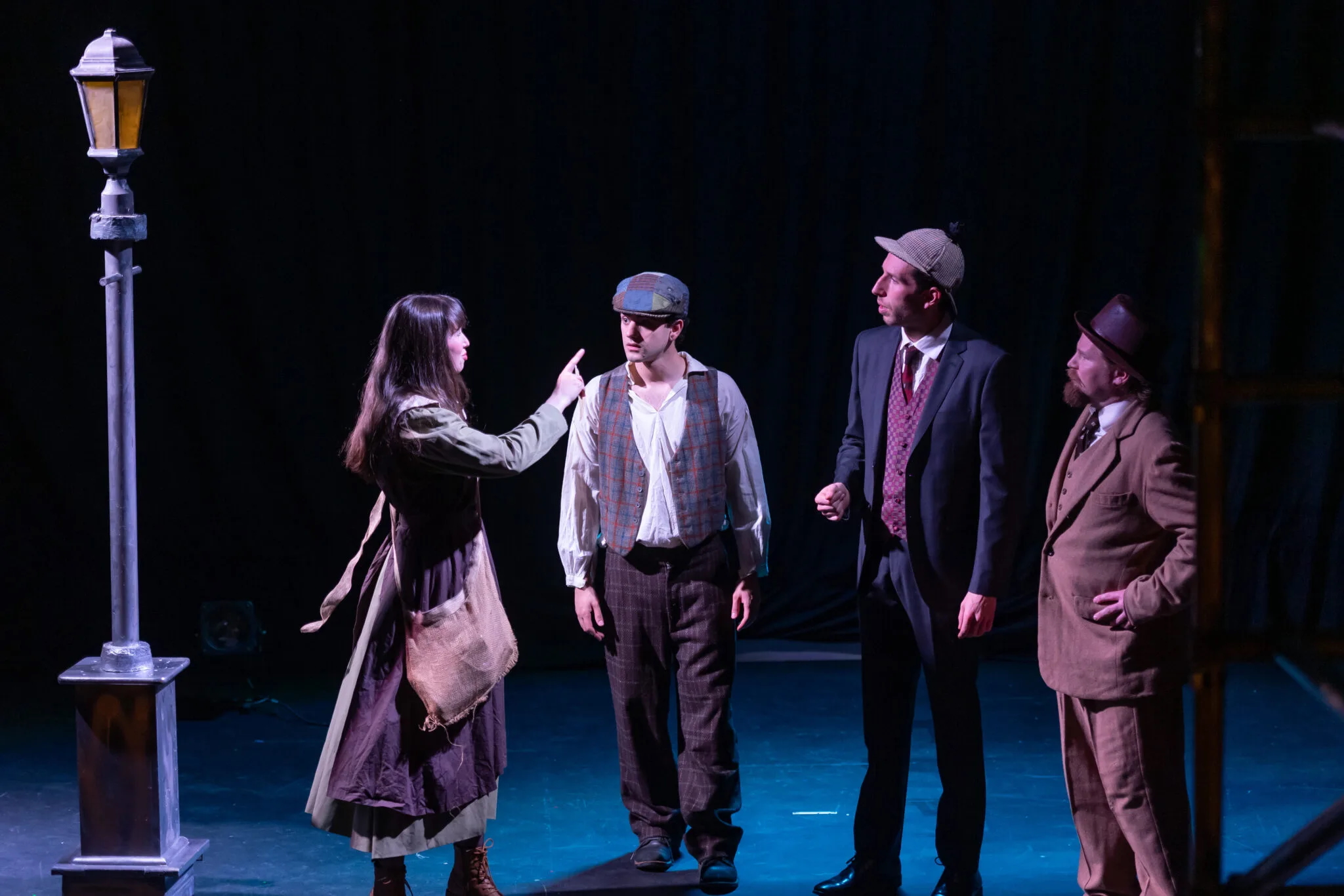
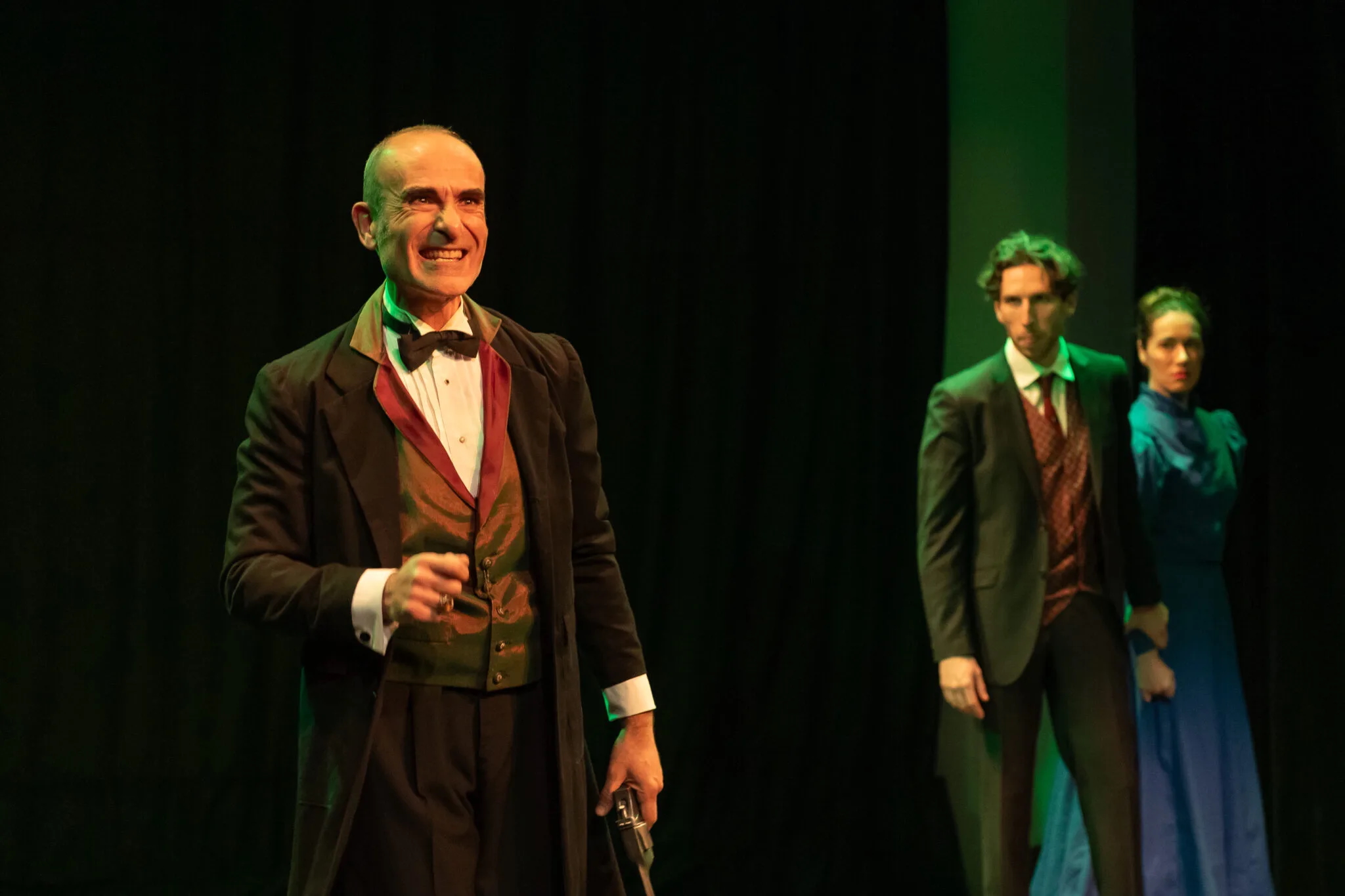
The play has a dramatis personnae of 22 characters, with a cast of eight, which means a lot of doubling and tripling up. Nothing unusual there. However, a completely random selection of the characters are presented as puppets, or “special characters”, as the programme calls them. Why these specific characters and not others is anyone’s guess. But what I found singularly perplexing was one “special character” - Toby the dog, was portrayed by an actor wearing theatre blacks, like the stage crew, not as a puppet. I was confused. The actor didn’t dress like a dog, move like a dog, have his face painted to resemble a dog, or do anything to indicate his dogginess other than bark when spoken to. How were we, the audience, meant to interpret this, and why, of all the characters who should have been presented by way of puppetry, was Toby the only one who wasn’t? And don’t even get me started on the use of shadow puppets in the opening scene, and only the opening scene.
Ken Ludwig is a multi-award winning playwright (5 Tony awards, 5 Olivier’s, 2 Drama Desk awards – to name a few). He is best known for his Broadway & West End musical comedies, with over 30 works to his credit, so he clearly knows how to write, but if Moriarty is any yardstick, his best is well and truly behind him. Moriarty lacks; you name it, Moriarty lacks it.
All this notwithstanding, one has to give credit where credit is due. The acting, as is usual at the Genesians, is of a high calibre, with particular mention going to Jessica Joseph-McDermott as Irene Adler, a totally engaging performance, with a flawless American accent; Susan Jordan, a criminally under-appreciated actor of enormous versatility and skill, in several roles; Peter David Allison, whose rich, sonorous voice lends gravitas and authority to his Watson; and Joshua McGowan, who manages to embody the erratic, emotionally detached, socially awkward Holmes.
Ken Ludwig’s Moriarty, directed by Gregory George, is not a production which has set the bar very high, but if you’re just looking for a pleasant, fun night out at the theatre, watching good acting, then this Genesian’s offering will appeal. 2 stars.
Playing at the Genesian Theatre until September 13, 2025
https://genesiantheatre.com.au/events/moriarty/
Reviewed by: Garreth Cruikshank