
Discover Nick Bennett’s 3-star review of Yerma at Genesian Theatre: Lorca’s powerful tragedy of motherhood, repression and social expectations.
YERMA, by Federico Garcia Lorca, is the second in his Rural Trilogy of plays - Blood Wedding, Yerma, The House of Bernarda Alba, which constitute his best known works in English, and are widely considered his masterpieces. However, for a substantial part of the 20th century all his poetry and plays were banned in his native Spain, a ban which lasted until the death of Spain’s Fascist dictator, Francisco Franco, in 1975.
Rebel & Martyr
Why did this happen, and why was Spain’s greatest poet and playwright murdered, at the age of 38, by Falangist militia at the outbreak of the Spanish Civil War?
Garcia Lorca’s works rebelled against the outdated norms of bourgeois Spanish society. They challenged the accepted role of women in society and explored taboo subjects - sexual stereotypes, class, repression & freedom of the individual to determine their own future, all of which he addresses in Yerma.
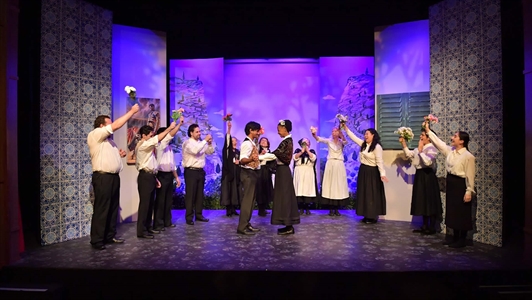
In the play, Yerma, a young wife, desperately wants a child. Married for two years, her yearning is starting to distort her perception of reality. She and her husband, Juan, do not see eye-to-eye on this matter, a conflict loaded with tragic irony considering Juan is a farmer who spends his days tilling the field and harvesting crops. His resistance to having a child equals Yerma’s desire for one, but of course her failure to conceive while all the young wives of the village are getting pregnant, is viewed as her fault. Deaf to her entreaties, Juan insists that she remain confined to the house to avoid adding to the slanderous village gossip concerning her. Three years pass and nothing has changed on the baby-making front. The atmosphere in the house has only become more suffocating and emotionally cold. Whatever love Yerma may have once felt for Juan has long since died, but not a desire for a child - a desire which has curdled into dark obsession. In a final attempt to fall pregnant, Yerma attends a fertility festival, hoping for a miracle. At the festival’s hermitage where barren women make pilgrimage, Juan finds her and the conflict comes to a head, with tragic consequences.
This production of Yerma, Spanish for ‘barren’, or ‘barren land’, has been translated by Barry Nielsen, who also directed and co-designed the production. The play explores themes of identity, social and sexual roles, repression, isolation, conformity, and freedom of the individual v. tradition & duty.
Throughout the play Yerma is portrayed as lacking agency. Her struggle is between her duty to her husband and her own inner desire for motherhood, the role society has allocated to her, but which her husband inexplicably denies her. As she says, in her community a woman only has the care of children to get her through the day. Without children Yerma has nothing but an aching void inside her soul.
In the role of Yerma, Nora Masige delivers an impressive performance. She manages to communicate Yerma’s spiritual and emotional anguish, and subtly creates a sense of interiority for her character. Michael Sebastian has a more difficult task in making Juan sympathetic, or at least relatable, however in the final scene we are allowed to see him in a more emotionally rounded exchange with his wife. Sandra Bass, Jenny Jacobs & Billy Allagianis also bring life to their roles.
Overall, however, I found this production of one of Lorca’s master works to be devoid of ‘Andalucian’ colour and passion. In writing his Rural Trilogy, Garcia Lorca put a target on his back. His plays incited the hatred of the Fascists. No sooner had the civil war begun than members of the local Falangist militia dragged him out to an olive grove in the middle of the night and shot him. For nearly 40 years the Franco regime tried to extinguish his name and his very existence. One does not provoke such hostility by being tame.
The Genesian Theatre is to be commended for staging Yerma. It is just a pity that this production lacks, with some notable exceptions, the passion and fire that such work requires.
YERMA is playing at the Genesian Theatre in Rozelle till November 14th. 3 stars.
Reviewed by: Nick Bennett