
Mischa Maisky joins pianist Lily Maisky at the Sydney Opera House on 8 November for an intimate recital spanning Schubert, Rachmaninoff and Shostakovich.
There are few concert halls in the world where the journey towards an evening of music is quite as distinctive as it is at the Sydney Opera House. A ferry crosses the harbour below, the sails catch the changing light, and visitors drift along Bennelong Point as the city moves around them. By night, the foyers become quieter, the harbour darkens and the Concert Hall settles into another kind of anticipation.
On Sunday 8 November 2026, that setting will welcome Mischa Maisky, one of the most recognised cellists of his generation, for a recital with his daughter, pianist Lily Maisky.
The performance will be part of an Australian tour taking the father and daughter from Melbourne to Sydney, Brisbane and Perth. In Sydney, they will appear in the Concert Hall at 7.30pm, presenting a programme that will include music by Franz Schubert, Sergei Rachmaninoff and Dmitri Shostakovich. The recital will run for approximately 120 minutes, including a 20 minute interval.
For Sydney audiences, the interest will extend beyond the names on the programme. This will be an opportunity to hear two musicians from the same family negotiating the particular intimacy of chamber music, where there is nowhere for either performer to disappear behind an orchestra.
A Life Shaped By Music
Mischa Maisky's story reaches across several of the great musical traditions of the 20th and 21st centuries.
Born in Riga in 1948, he began his musical education in Latvia before entering the Leningrad Conservatory. His career developed rapidly, including a debut with the Leningrad Philharmonic and study with the legendary cellist Mstislav Rostropovich at the Moscow Conservatory. In 1970, Maisky was imprisoned in a labour camp near Gorky for 18 months before emigrating from the Soviet Union. He eventually settled in Israel.
A further chapter in his musical education came in the United States, where he studied with Gregor Piatigorsky. That makes Maisky unique among cellists in having studied with both Piatigorsky and Rostropovich, two towering figures whose influence continues to be felt in the instrument's modern history.
His international career followed, with performances in the world's major concert halls and collaborations with conductors and musicians including Leonard Bernstein, Daniel Barenboim, Zubin Mehta, Riccardo Muti and Martha Argerich.
Yet biography alone does not quite explain the particular place Maisky occupies in classical music. His career has always been closely associated with the expressive possibilities of the cello, from the intimacy of Bach's solo suites to the large-scale emotional sweep of the Romantic repertoire.
His recordings have also played a considerable part in bringing that sound to listeners far beyond the concert hall. Maisky has recorded more than 35 albums for Deutsche Grammophon and has returned repeatedly to the music of Bach, including three recordings of the six Cello Suites.
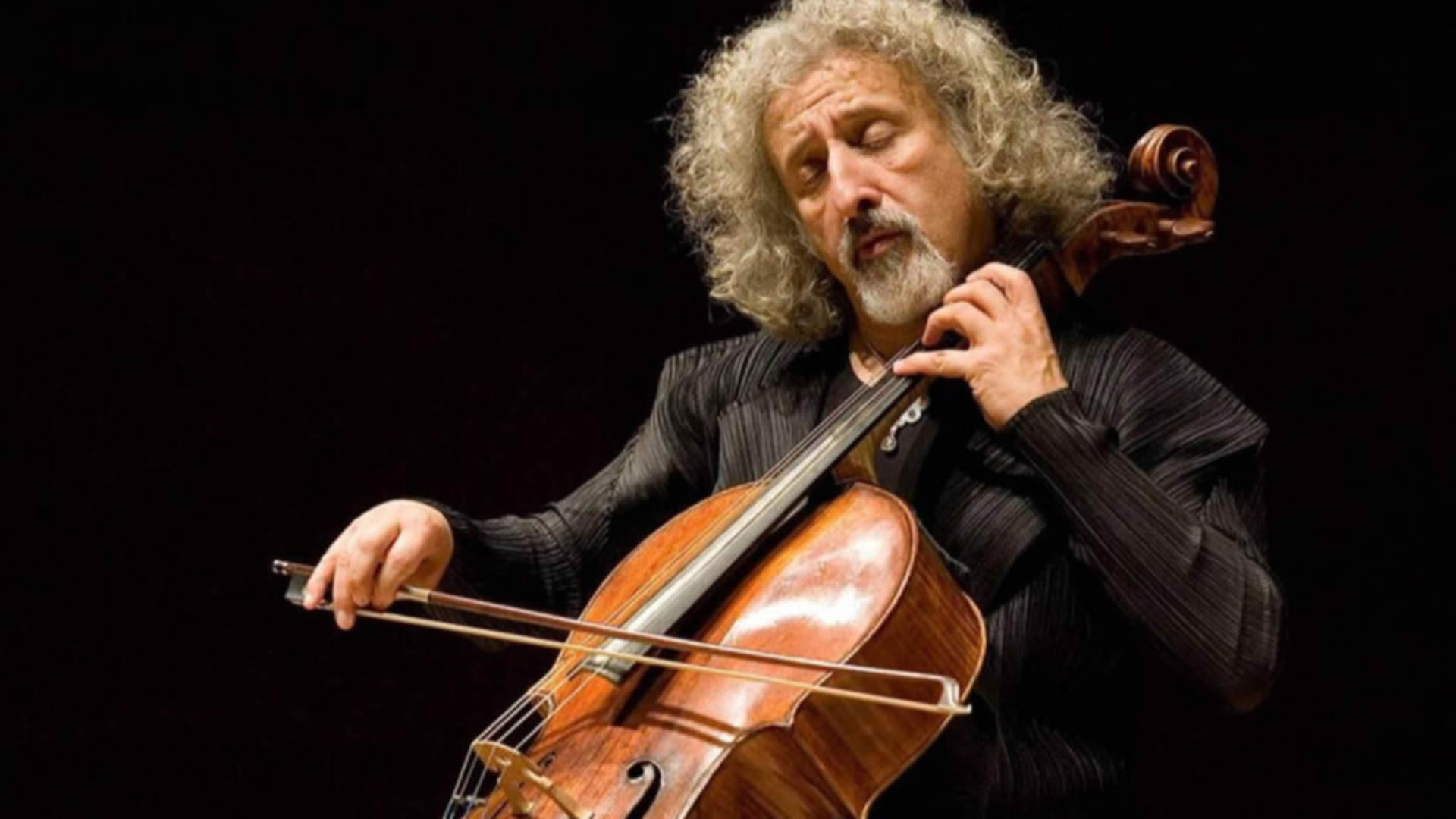
Mischa Maisky And The Sound Of The Cello
A cello has an unusual ability to occupy the space between the human voice and the orchestral instrument.
Its lower register can feel almost physical, while its higher notes can take on an astonishingly vocal quality. In a recital setting, the instrument's changing colours become particularly apparent because there is no surrounding ensemble to obscure the smallest shifts in tone.
That quality has long been central to Maisky's musical identity.
His relationship with Bach has been particularly significant. In 2000, he undertook more than 100 concerts devoted to Bach around the world, including a programme in Zurich in which he performed Bach's cello works across three concerts in a single day.
His connection with the music has also continued through recordings and performances across decades. A 2024 Deutsche Grammophon release drawn from the Verbier Festival collected performances spanning Schubert, Rachmaninoff, Tchaikovsky, Bruch and other composers, with Lily Maisky among his musical partners.
It is this long relationship with repertoire that gives the Sydney recital its sense of continuity. The programme will not simply place a celebrated cellist in front of an audience. It will bring together music that has occupied different parts of Maisky's career and musical life.
A Father And Daughter At The Opera House
Lily Maisky has been performing with her father for many years, making the Sydney recital part of a much longer musical relationship.
Born in Paris and raised in Brussels, Lily began playing piano at the age of four. Her studies took her through the Purcell School of Music, where she also studied jazz piano, followed by masterclasses and musical guidance from artists including Martha Argerich, Dmitri Bashkirov and Joseph Kalichstein.
Her concert career has taken her through Europe, Asia and the Americas, with appearances at venues including London's Royal Festival Hall, Vienna's Musikverein, Berlin's Konzerthaus and New York's Carnegie Hall.
Her partnership with Mischa is nevertheless a particularly personal part of her work. The two have recorded together, including the 2018 album Adagietto, which brought together chamber works and arrangements performed by father and daughter alongside a wider circle of musicians.
That shared history matters in a programme of this kind.
Chamber music depends on listening. A pianist and cellist must continually respond to one another, adjusting timing, dynamics and phrasing within the music itself. With a family partnership, there is also a familiarity that comes from years spent making music together.
The result is not necessarily about perfect agreement. The more interesting possibility is conversation – moments when one instrument seems to question the other, when a phrase passes between them, or when silence becomes part of the musical exchange.
Mischa Maisky Brings Three Musical Worlds Together
The Sydney programme will draw on Schubert, Rachmaninoff and Shostakovich, three composers separated by time and circumstance but united by their ability to give chamber music an intensely personal character.
Schubert brings the intimacy of the early 19th century, where melody often seems to unfold as naturally as conversation. Rachmaninoff's music reaches into a more expansive Romantic world, with long melodic lines and a distinctive sense of emotional breadth. Shostakovich introduces another perspective, shaped by the pressures and contradictions of the 20th century.
Placed together, the composers offer a journey through very different musical landscapes.
It is also a programme well suited to the cello and piano. Rather than relying on spectacle, the evening will depend on the shifting relationship between two instruments, with the performers sharing the architecture of each work.
The Concert Hall itself adds another dimension.
Following its extensive renewal, the Sydney Opera House Concert Hall is designed for performances where the relationship between musicians and audience is central. The hall can seat up to 2,664 people in the round, although chamber music creates a very different sense of scale within the space.
The building's location also makes the evening feel distinctively Sydney. The Opera House sits at the edge of the harbour, with Circular Quay only a short walk away. For those arriving by ferry, train, light rail or bus, the approach is part of the experience, moving from the movement of the city into the relative stillness of the performance space.
The Maisky Legacy
There is something fitting about a father and daughter appearing together in a city that has long embraced music as part of its public life.
Mischa Maisky's career has already crossed generations. He learned from Rostropovich and Piatigorsky, worked with musicians including Bernstein and Argerich, and has continued performing with younger musicians, including his own children.
His recordings have also become a substantial archive of that journey. In 2021, Deutsche Grammophon released a 44 CD box set covering his recordings for the label up to that point, reflecting more than three decades of work with one of classical music's most important recording companies.
The Royal Academy of Music lists Maisky among its honorary figures, having awarded him an honorary distinction in 2019.
For all the statistics of a long international career, however, the most revealing details are often smaller.
A particular phrase held for a fraction longer than expected. The breath before an entry. The slight change in colour when the bow moves closer to the bridge. The piano responding to the cello rather than simply accompanying it.
These are the details that disappear from a biography but become the substance of a live recital.
An Evening On Bennelong Point
By early November, Sydney will be moving towards summer. The evenings will be lighter, the harbour busy with ferries and visitors, and Bennelong Point will once again be one of the city's busiest meeting places.
Inside the Opera House, the pace will change.
The audience will take their seats beneath the Concert Hall's high interior, programmes will be settled, conversations will fade and the stage will narrow the evening's focus to two performers.
Mischa Maisky and Lily Maisky will then begin.
For a musician whose career has travelled through Riga, Moscow, Israel, Europe, North America and some of the world's great concert halls, Sydney will be another stop in a remarkably long musical journey. For Lily, it will be another chapter in a partnership that began within a family and developed into an international musical collaboration.
And for the audience, the appeal of the evening may ultimately be quite simple.
Classical music is often heard through recordings now, separated from the physical circumstances in which it was made. A live recital restores that sense of presence. The bow moves. The keys sound. The room responds. A phrase disappears as soon as it is played.
On 8 November, beneath the sails of the Sydney Opera House, that fleeting quality will be the point.
Event Details
Mischa Maisky in Recital with Lily Maisky
Sunday 8 November 2026
7.30pm
Concert Hall, Sydney Opera House
Bennelong Point, Sydney NSW 2000
Running time: approximately 120 minutes, including a 20 minute interval
Tickets: $59 to $209, plus booking fees
Presented by Castiglione Arts and Culture with Greg Hocking Music.