
Shooting Hedda Gabler brings a sharp, layered reimagining of Ibsen’s classic to Sydney audiences.
In 2025 Secret House staged a production of Henrik Ibsen's play "Hedda Gabler" at KXT Broadway. Written in 1891, his play still had the power to shock and challenge. 135 years on, it remains relevant, which accounts for its myriad stage, film and TV productions. Fast forward to 2026, and Secret House's production of Shooting Hedda Gabler.
The concept is a very postmodern one - a play about a film of a play. An American actress is lured to Norway to shoot a film version of "Hedda Gabler", and in an effort to revive her career and escape a scandal back in L.A, she accepts. She is intrigued by the director's legendary status as a brilliant auteur, but from the get-go she is shown to be out of her depth. Norway is not L.A. - they do things differently there, and Nordic indie art-house productions are nothing like the Hollywood big budget, high concept cartoons she is used to starring in, plus the Norwegian 'national character', if one can refer to such a thing, is the polar opposite to that of sun-drenched California. Much humour is extracted from this 'herring out of water' culture clash, which comes as a bit of a surprise, given that laughs are generally thin on the ice in Ibsen's plays. However, the razor-sharp wit of Nina Segal's script, delivered with perfect comic timing by Lib Campbell as Thea, and Matt Abotomey as Jorgen, serves a higher purpose than providing easy laughs at the unnamed American actress's expense. The humour warms us up, gets us to drop our guard, so that the series of body blows in the second half land with even greater force. But I'm getting ahead of myself.
A Me Too Hedda
The American actress, who is constantly referred to as Hedda despite her objections, looks, feels and sounds completely out of place on the film set, and things only get worse when she meets Henrik the director - a mix of the worst character flaws of Stanley Kubrick and Ingmar Bergman: he is chauvinistic, emotionally manipulative, demanding, cruel, and sexually exploitative, but also brilliant, which in part explains why 'Hedda' doesn't turn around and leave immediately. Also, she has something to prove; she constantly says, "I can do this". She won't let herself be beaten down. As Hedda, Jennifer Rani gives a powerful, nuanced performance that ranges across a vast landscape of emotions - one minute anxious the next assured, indignant then combative, vulnerable and scheming. Rani traverses the full gamut of emotional beats with confidence. It is not for nothing that Hedda Gabler is often referred to as the female Hamlet, nor surprising that some of the greatest female actors of the 20th century have performed Ibsen's iconic character.
Through A Glass Darkly
Notwithstanding Rani's powerhouse performance, this is, at heart, an ensemble production. Secret House's co-founders Jane Angharad and James Smithers bring their not inconsiderable talents to the roles of Berta, the much put-upon assistant director, struggling to deal with Henrik's insults and unreasonable demands while trying to cope with a sick child, and Henrik - the "enfant terrible" of Nordic cinema, a man possessed of an egomaniacal world view, who cares only for his art at the expense of everybody around him. Each of these characters, including Thea, Jorgen and an American movie star (Alpha Sylla) - Hedda's ex-lover, brought over from America to play the role of Ejlert, the ex-lover in the film, function to reveal different aspects of Hedda's character, challenging her, forcing her to see herself honestly, and realise her full self which child stardom has stifled. Yet, as filming progresses the atmosphere on set becomes increasingly volatile and claustrophobic, paranoia takes hold, the manipulation intensifies & Henrik becomes determined to end the film with a bang.
The Hour Of The Wolf
A play about a film of a play, by definition, creates a sequence of multiple frames of reference, as the actors question the film-making process, and where reality ends and artifice begins. Segal's script is clever, fast and savagely witty, as she interrogates the layers of meaning, addressing issues of identity, freedom, truth, sexual exploitation and control in the arts as well as life, asking the question, "Does art imitate life, or life art?" It seeks to recontextualise the meaning and relevance of Ibsen's play for a contemporary audience, conflating the 135 years since it was written into the now and asks how much the lot of women in society has substantially changed.

Nordic Noir
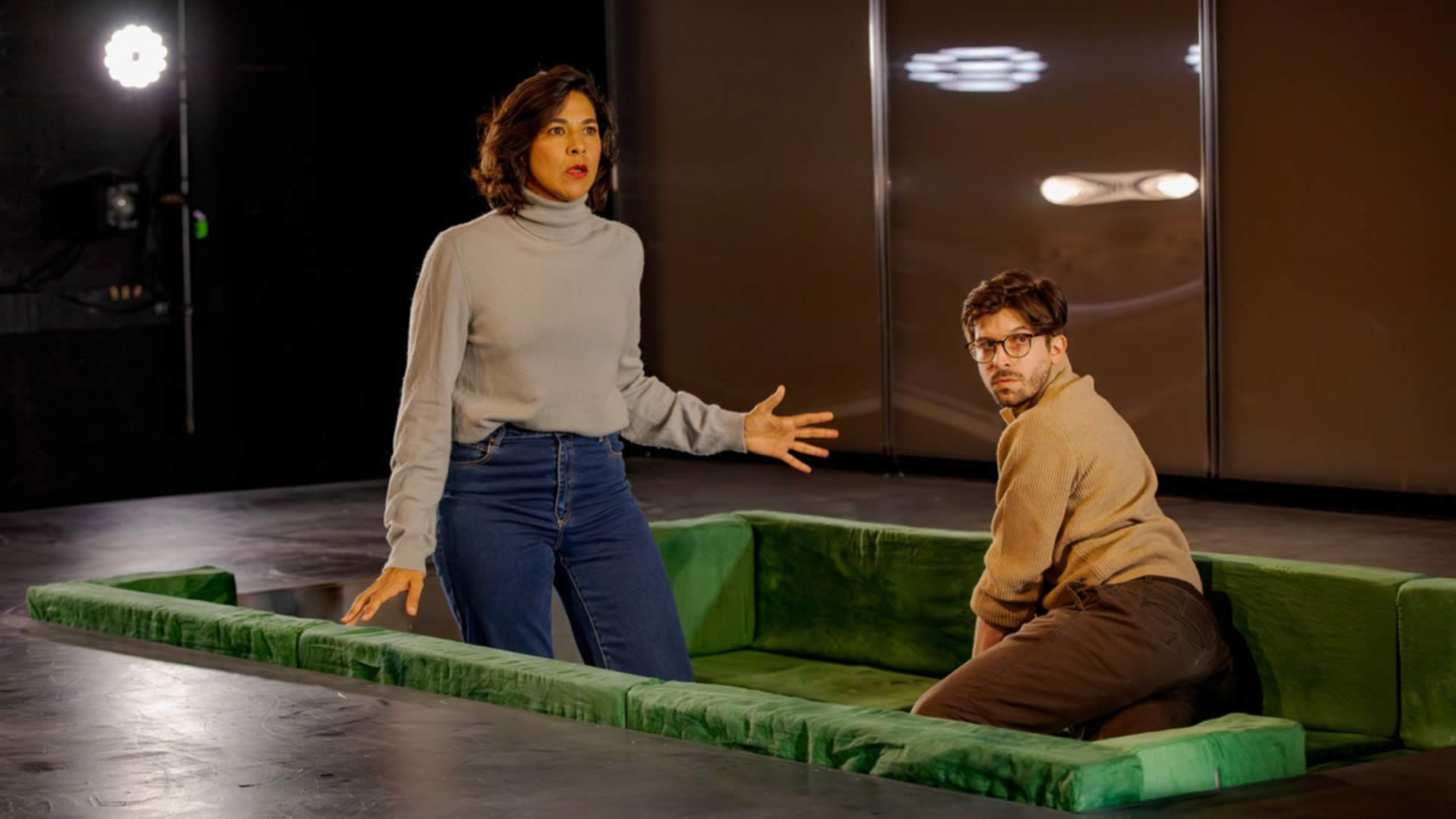
One of the most striking things about SHG is the set, designed by James Smithers, and one of his best. It is pure Scandi minimalism - clean lines, balance, clever use of space and nothing extraneous. The creation of two 'dressing trailers' at the rear of the stage, with glass walls that can become transparent or opaque as required, allows for multiple spheres of action while never allowing the stage to look cluttered. By raising the stage and sinking a 'conversation pit' into the centre, he has established a sacred space for the key confrontations, which takes on symbolic overtones, especially at the point where Hedda makes a fire in it. More than simply a pretty frame for the action, this set exists as a dynamic presence that helps shape our understanding of the play, as really good set designs should. Equally strong are the costume design by Charlotte Savva, brooding music by Anthony MacDermott and brilliant lighting design by Travis Kecek. And helming all these moving parts is the assured hand of director Monica Sayers, whose clear-sighted choices and sensitive guidance has produced a production of considerable depth, intelligence and skill. 4.5 stars
Reviewed by: Nick Bennett
Photos by: Phil Erbacher